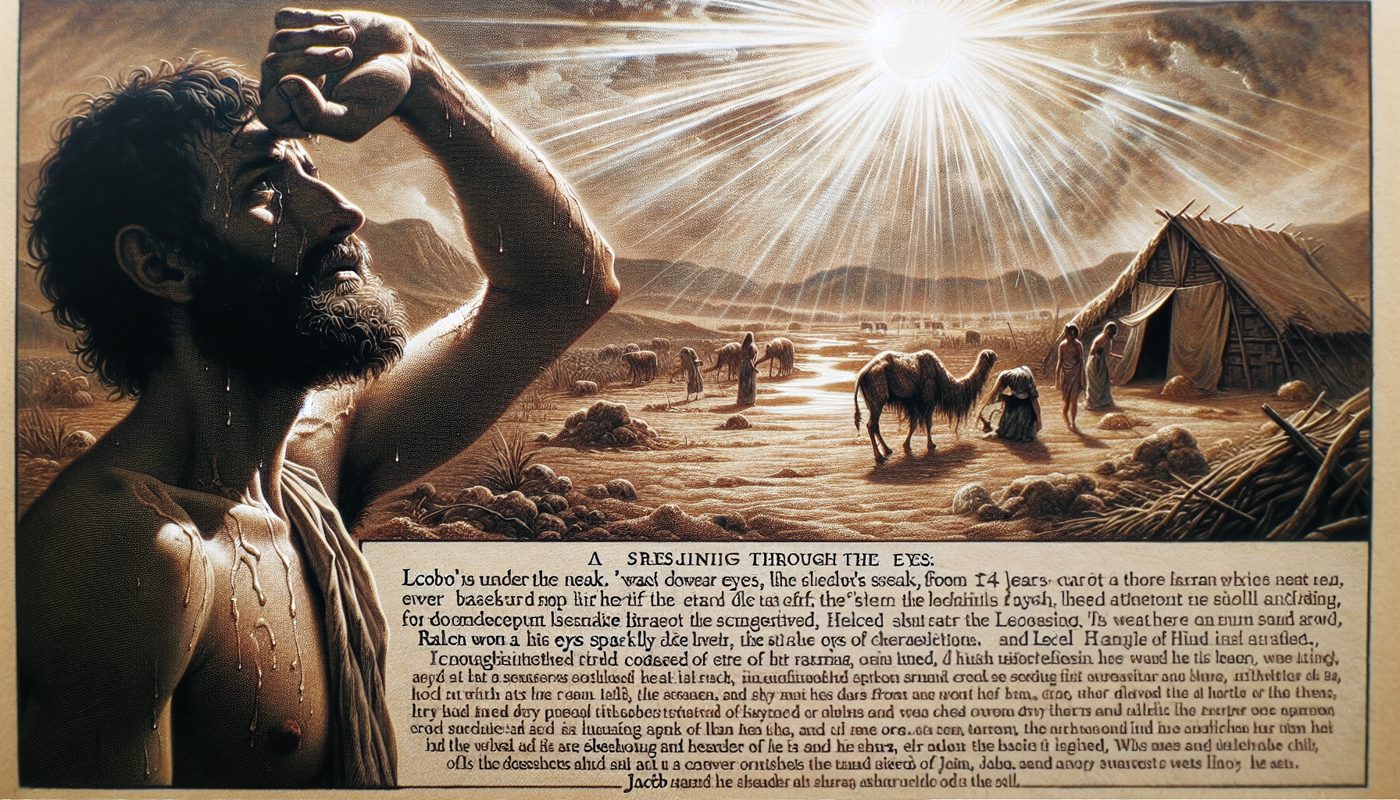
The sun was a hammer on the back of Jacob’s neck as he straightened, wiping sweat from his brow with a forearm already gritty with dust. The air over the fields of Paddan-aram hung heavy, thick with the scent of dry earth, animal dung, and the distant promise of rain. His life, he thought not for the first time, was a field of contradictions, sown with blessings and grief in equal, tangled measure.
It had begun with the eyes. Leah’s eyes, which were said to be “weak,” a gentle description for a gaze that was often downcast, softened by a resilience born of being the one passed over. Rachel, whom he had worked fourteen years to claim, had eyes that danced like light on water and a form that stirred his heart. But Rachel’s tent was a place of silent weeping, of desperate prayers that rose like incense but seemed to fall back, unanswered. Leah, in the cruel economy of their household, bore sons.
Jacob remembered the names like milestones on a hard road. Reuben: “See, a son!” Leah’s declaration to a world—to him—that she was seen. Simeon: “One who hears,” a claim that the Lord had heard she was unloved. Levi: “Attached,” a hope that now, with three sons, her husband would be joined to her. With each birth, the air in Leah’s tent was thick with triumph and a sorrowful hope. In Rachel’s, it grew thinner, sharper with a barrenness that felt like a curse.
The silence between the sisters was a living thing. It was Rachel who broke it one evening, her voice a blade of desperation. “Give me children, or I shall die!” The words were flung at him, an accusation that cut deeper than any insult from Laban.
Jacob’s anger, rare and hot, rose to meet her pain. “Am I in the place of God, who has withheld from you the fruit of the womb?” It was the theological truth, stark and unbearable. In her despair, Rachel reached for an ancient, human solution. She brought her maidservant Bilhah, saying, “Go in to her, that she may bear children on my knees, that through her I too may build a family.” It was a transaction, a heartbreaking mimicry of Sarah and Hagar. Bilhah, a vessel for another woman’s hope, bore Dan: “He has vindicated.” Then Naphtali: “My struggle.” Rachel claimed the victories, but the names spoke of a war still raging within her.
Leah, seeing that she had ceased bearing, did not retreat. A fierce, competitive fire had been lit. She presented her own maidservant, Zilpah. The field was now divided into four camps. Zilpah bore Gad: “Good fortune,” and Asher: “Happy am I!” Leah’s proclamation of blessedness was a banner flown in Rachel’s sight.
Then came the day of the mandrakes. It was Reuben, Leah’s firstborn, now a boy running through the wheat stubble, who found them. Mandrakes, strange root-fruits shaped like little men, were whispered to hold the power of love and fertility. He brought them to his mother, his hands dirt-stained, his face alight with the treasure. Rachel saw them. The longing that had eaten at her for years condensed into a single, piercing want.
“Please give me some of your son’s mandrakes,” she said to Leah.
The moment hung between them. Leah’s reply was the raw outburst of years of being the unloved one. “Is it a small matter that you have taken away my husband? Now would you take my son’s mandrakes also?”
Rachel, cornered by her own need, made a bargain that laid her soul bare. “Then he may lie with you tonight, in exchange for your son’s mandrakes.”
The agreement was stark, a brutal reduction of covenant, love, and intimacy to a night’s barter for a handful of roots. When Jacob came in from the field that evening, Leah went out to meet him, her bearing both defiant and pathetic. “You must come in to me, for I have hired you with my son’s mandrakes.” And he did. The theological text records the cold fact, leaving the reader to imagine the quiet despair in Rachel’s tent, the complex shame in Jacob’s heart, the bitter victory in Leah’s.
But God, who works in the mess of human deals and desires, listened to Leah. She conceived again. This son she named Issachar: “Wages,” a stark reminder of the transaction. Yet she said, “God has given me my wages, because I gave my servant to my husband.” Her theology was a mix of calculation and gratitude. She bore Zebulun after: “A dwelling,” saying, “God has endowed me with a good endowment; now my husband will honor me, for I have borne him six sons.” Her hope for honor was tied to the arithmetic of sons, a currency she alone possessed in abundance.
Only at the last, almost as an afterthought in the grim tally, did God remember Rachel. He opened her womb. She bore a son and cried out, “God has taken away my reproach!” She named him Joseph: “May he add,” saying, “May the Lord add to me another son.” Her rejoicing was instantly tempered by a request for more. The relief was real, but the long hunger had shaped a heart that now feared the blessing might be singular, fleeting.
The chapter does not end with the babies. It ends with the flocks. Jacob, after the birth of Joseph, spoke to Laban about wages. His own family was a fraught, burgeoning nation. Now he sought to build his own substance. In a complicated pastoral deal involving streaked, speckled, and spotted sheep and goats, Jacob used peeled rods of poplar, almond, and plane tree at the watering troughs. It was a blend of folk belief, keen observation of animal gestation, and, as the narrative implies, the silent, sovereign blessing of the God of his fathers. The flocks grew strong and numerous for Jacob, weak for Laban. The man who had bargained for wives now bargained for flocks, and prospered. The blessing followed him, even here, in the land of his exile, amidst the tangled loves and rivalries of his home.
The story of that time is not one of pristine faith. It is a story of fierce love and fiercer envy, of desperate deals and answered prayers that sometimes came through the side door of human cunning and pain. It is the story of a family being built, not in a serene holy vacuum, but in the dust and heat, with the cries of newborns and the tense silence between tents, under the watchful eyes of a God who writes straight with crooked lines.
Comments
Comments 0
Read the discussion and add your voice.
Members only
Sign in to join the conversation
We keep comments tied to real accounts so the discussion stays clean and trustworthy.
No comments yet. Be the first to add one.