The Lord spoke to Moses and Aaron in Egypt with a command that would redefine time itself. This month, He said, would become the beginning of months, the first month of the year for Israel. Not a suggestion, not a calendar adjustment for convenience, but a rupture. The old cycle of servitude under Pharaoh's sun would be replaced by a new reckoning, measured from the night of deliverance.
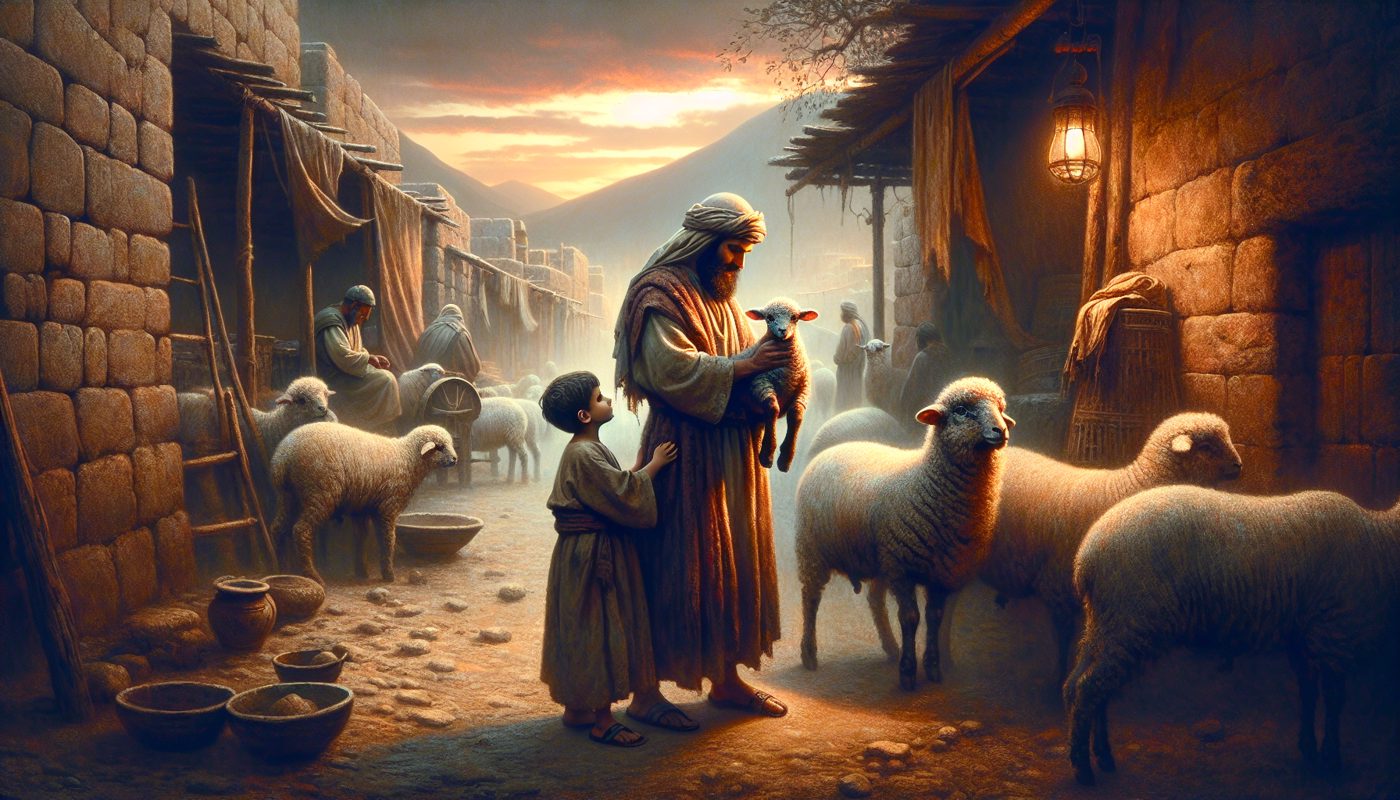
The instructions were precise, and their precision was the point. On the tenth day of that month, every household was to take a lamb, a male without blemish, a year old, from the sheep or the goats. If a household was too small, a neighbor could share, counted by the number of eaters. The lamb was to be kept until the fourteenth day, a four-day wait that forced the community to sit with the coming event, to watch the animal live among them before it died.
At twilight on the fourteenth day, the whole assembly of Israel was to slaughter the lambs. The blood was to be caught in a basin, and with a bunch of hyssop, the blood was to be struck on the two doorposts and the lintel of each house. No one was to leave the house until morning. The blood was the sign, not for human eyes but for the Lord's. When He saw the blood, He would pass over that door, and the destroyer would not enter to strike.
The meal itself was to be eaten in haste. Roasted over fire, not boiled, not raw, with unleavened bread and bitter herbs. Nothing was to remain until morning; what was left was to be burned. The people were to eat with their loins girded, sandals on their feet, staff in hand, ready to move. It was the Lord's Passover, a meal eaten on the edge of departure.
The Lord declared that He would pass through Egypt that night and strike all the firstborn, from Pharaoh's son to the firstborn of the captive in the dungeon, and even the firstborn of cattle. He would execute judgments against all the gods of Egypt. The blood on the houses of Israel would be the token, and when He saw it, He would pass over them. No plague would destroy them.
Moses called the elders of Israel and repeated the command. The people bowed their heads and worshiped. Then they went and did exactly as the Lord had commanded Moses and Aaron. There is no record of hesitation, no note of debate. The chapter simply states that they did it.
At midnight, the Lord struck all the firstborn in Egypt. There was a great cry throughout the land, for there was not a house where there was not one dead. Pharaoh rose in the night and called for Moses and Aaron. He told them to leave, to take their flocks and herds, to go serve the Lord as they had said, and to bless him also. The Egyptians urged the people to leave in haste, saying, 'We are all dead men.'
The Israelites left so quickly that they took their dough before it was leavened, carrying their kneading troughs wrapped in their clothes on their shoulders. They asked the Egyptians for silver, gold, and clothing, and the Lord gave them favor in the sight of the Egyptians, so that they gave what was asked. The people despoiled Egypt, not by force but by the Lord's arrangement.
They journeyed from Rameses to Succoth, about six hundred thousand men on foot, besides children. A mixed multitude went with them, along with flocks and herds, very much cattle. They baked unleavened cakes from the dough they had brought, because they were thrust out of Egypt and had no time to prepare provisions.
The chapter records that the time the children of Israel dwelt in Egypt was four hundred and thirty years, to the very day. On that selfsame day, all the hosts of the Lord went out from Egypt. It was a night to be much observed to the Lord, a night for all generations.
The Lord also gave Moses and Aaron the ordinance of the Passover for the future. No foreigner could eat of it, but a servant bought with money could eat after being circumcised. A sojourner or hired servant could not. The lamb was to be eaten in one house, no bone broken, no flesh carried outside. The same law applied to the homeborn and the stranger who chose to keep the Passover, provided all males were circumcised.
On that night, the Lord did not ask for a display of strength from Israel. He asked for blood on the doorposts, a meal eaten in readiness, and a people who would trust the sign. The mark was not for their protection alone; it was the boundary between judgment and mercy. The Lord passed over, and the door that bore the blood was a door that could not be entered by death.
Comments
Comments 0
Read the discussion and add your voice.
Members only
Sign in to join the conversation
We keep comments tied to real accounts so the discussion stays clean and trustworthy.
No comments yet. Be the first to add one.