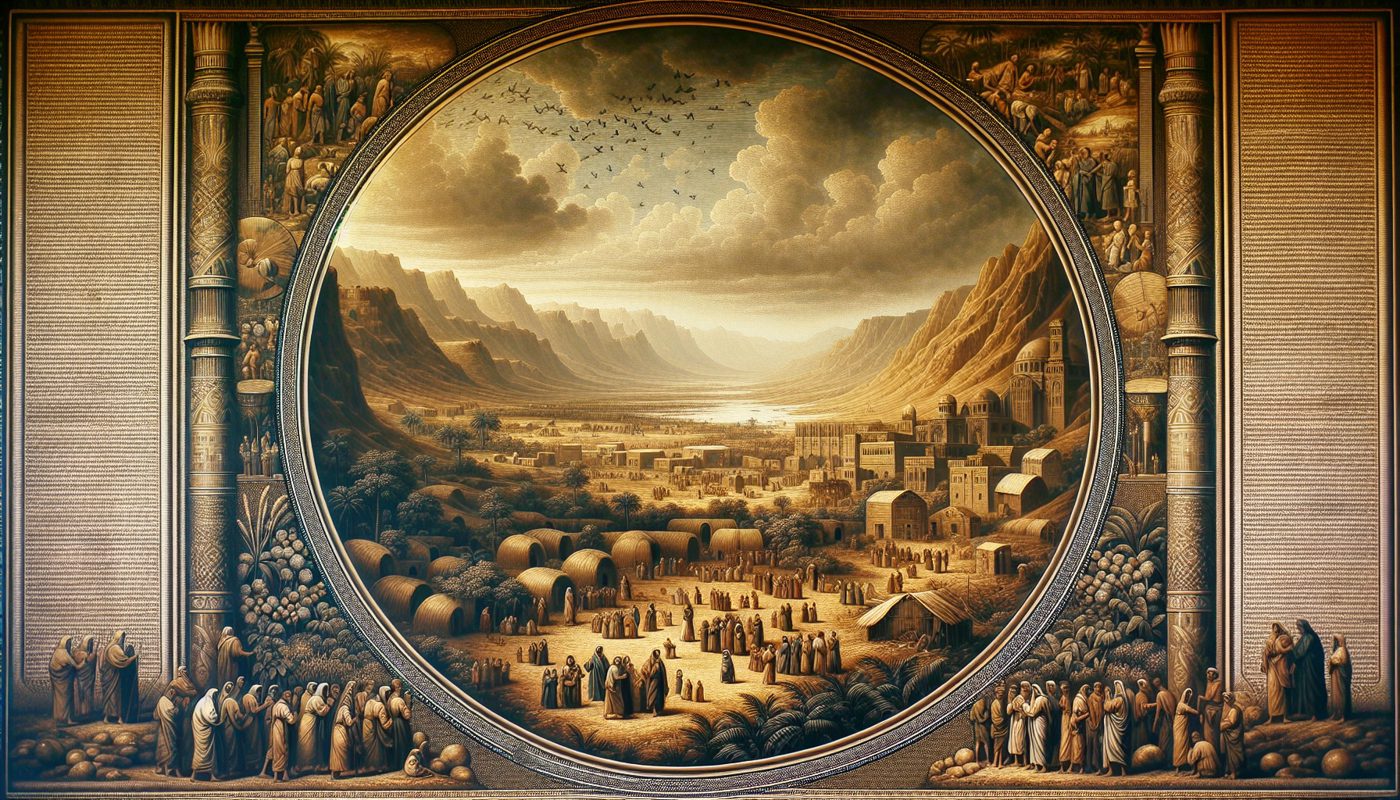
The book of Exodus opens with a list of names, but the story it tells is about the erasure of a name. The sons of Israel who came into Egypt with Jacob are recited—Reuben, Simeon, Levi, Judah, and the rest—seventy souls in all, including Joseph who was already there. But then the chapter does something abrupt: it buries that generation. Joseph died, and all his brothers, and everyone who remembered them. The names become a census of the dead.
What survived was not memory but fertility. The children of Israel were fruitful, the text says, and increased abundantly, and multiplied, and waxed exceeding mighty. The language piles up like the mud bricks they would soon be forced to make. The land filled with them. That is the first pressure of the chapter: a people who were once guests had become a presence too large to ignore.
Then a new king arose over Egypt. The text does not name him. It only says he did not know Joseph. The man who had saved Egypt from famine, who had gathered grain and fed the nation through seven lean years, was no longer a living reference. He was a dead file in an archive no one consulted. The king saw only the arithmetic of power: the Israelites were more and mightier than his own people. That was not a fact to celebrate. It was a threat to manage.
The king spoke to his people, not to the Israelites. He framed his concern as a strategic problem. If war came, the Israelites might join the enemy, fight against Egypt, and then leave the land. The fear was not that they would stay and rebel. It was that they would leave. A slave population that could walk away was a population that had to be bound. So the king proposed a policy of wise dealing: affliction that would break their spirit and slow their growth.
Taskmasters were set over them. The Israelites built store-cities for Pharaoh: Pithom and Raamses. The names of those cities are the only geography the chapter gives. They were storage centers, monuments to Egyptian surplus, built by forced labor. The work was hard, the service rigorous, the lives bitter. Mortar and brick and field labor—every kind of work that could break a body was used. But the text records a strange inversion: the more they afflicted them, the more they multiplied and spread abroad. The oppression did not work. It made the Egyptians grieve.
The king escalated. He summoned the Hebrew midwives, two of whom are named: Shiphrah and Puah. These are the only individual Israelites named in the entire chapter. The king gave them a direct order: when they attended a Hebrew woman in labor, if the child was a son, they were to kill him. Daughters could live. The command was clinical and genocidal, aimed at the male infants who would grow into soldiers and workers and threats.
The midwives feared God, and they did not obey the king. They saved the boys alive. When the king called them to account, they gave an answer that sounds like a ruse: Hebrew women are not like Egyptian women, they said; they are lively, and they give birth before the midwife arrives. The explanation may have been a cover, or it may have been true. Either way, it worked. The king did not punish them.
God dealt well with the midwives. The people multiplied and grew very mighty. And because the midwives feared God, he made them households. The phrase is compact: they were given families of their own. In a story about the destruction of families, two women who refused to destroy were themselves built into houses.
But the king did not stop. He issued a new command, this time to all his people: every Hebrew son that is born shall be cast into the river. Every daughter shall be saved alive. The order was now public, a national policy. The river that had once been the source of Egypt's life was now to become a grave for Israel's sons. The chapter ends there, with the water waiting.
The pressure of Exodus 1 is not dramatic in the way of a battle or a plague. It is the slow, grinding pressure of a state that has decided a people must be reduced. The king did not know Joseph. That ignorance was not innocent. It was the precondition for cruelty. The chapter names the midwives but not the king. That is the editorial judgment of the text: the ones who resisted are remembered; the one who commanded is not.
Comments
Comments 0
Read the discussion and add your voice.
Members only
Sign in to join the conversation
We keep comments tied to real accounts so the discussion stays clean and trustworthy.
No comments yet. Be the first to add one.