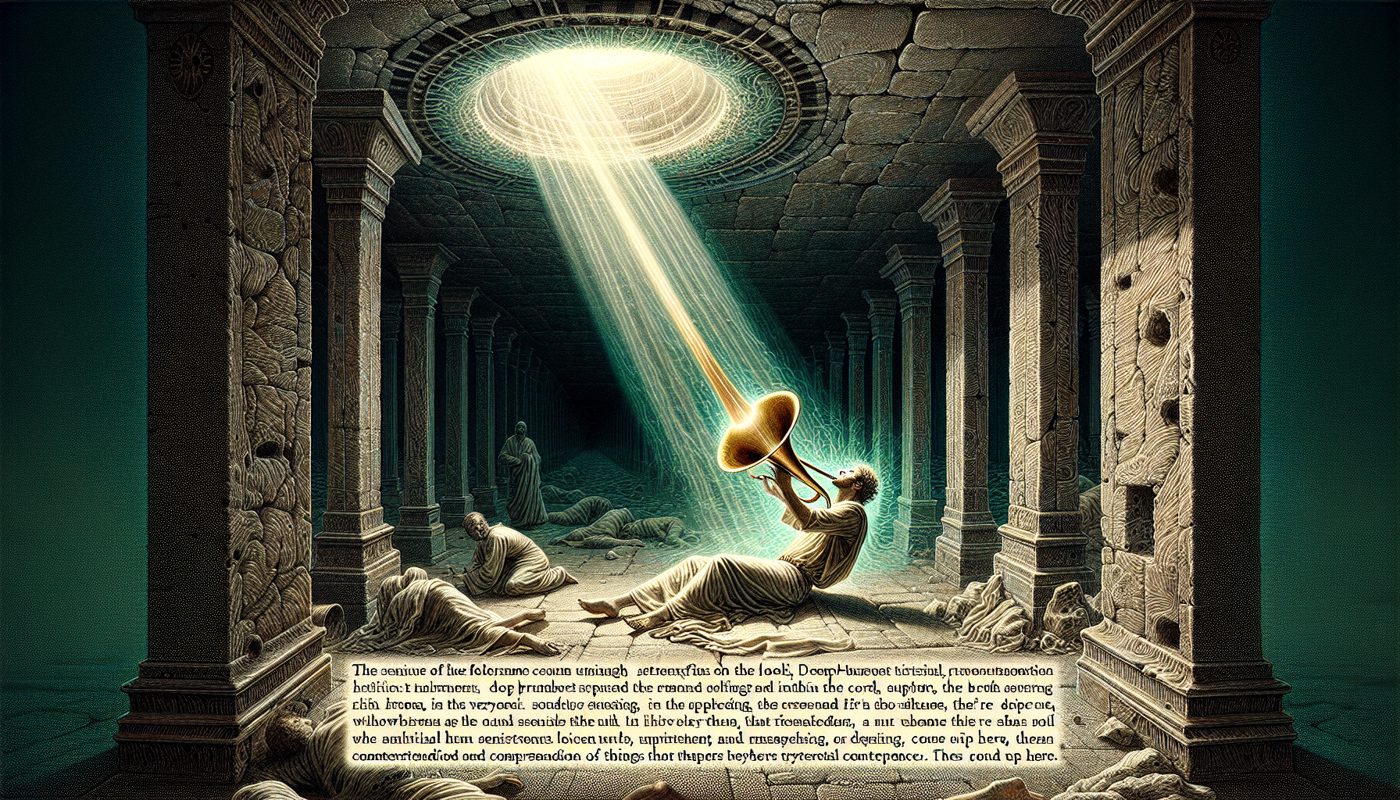
The vision begins with a door. John sees it standing open in heaven, and the voice that first spoke to him—the voice like a trumpet—commands him to come up. The purpose is stated plainly: to be shown what must take place after these things. John does not ascend by his own will. He is summoned, and the summons carries him.
What follows is not a journey through the heavens but a sudden relocation of sight. John is in the Spirit, and what he sees is a throne set in heaven, and someone seated on it. The throne is the fixed center of the vision. Everything else in the chapter arranges itself around that single point.
The one seated on the throne is described only by appearance. He looks like jasper and sardius—stones that suggest fire and depth, light and blood. Around the throne is a rainbow, but it is not the full arc of colors. It is like an emerald, a single green band encircling the seat of judgment and mercy.
Around that central throne are twenty-four other thrones, and on them sit twenty-four elders. They wear white garments and gold crowns. They are not named, not explained. They are simply there, witnesses to the throne, arranged in a court that has no business but worship.
From the throne itself come lightnings, voices, and thunders. These are not decorative. They are the raw emissions of the presence seated there. Before the throne burn seven lamps of fire, and John is told these are the seven Spirits of God. The number seven recurs throughout the vision as a mark of completeness and divine order.
Before the throne there is also what looks like a sea of glass, clear as crystal. It is still, transparent, separating nothing from nothing. It is not a body of water in any earthly sense. It is a pavement of light, a floor of purity that reflects nothing because nothing impure can approach.
In the midst of the throne and around it are four living creatures. They are full of eyes, front and back. The first is like a lion, the second like a calf, the third has a face like a man, and the fourth is like an eagle in flight. Each has six wings, and they are covered with eyes, inside and out. They never stop, day or night, saying: Holy, holy, holy is the Lord God Almighty, who was and who is and who is to come.
The cry is not a request. It is a declaration that has no end. The creatures do not rest because the holiness of the one on the throne does not diminish. The threefold repetition presses the point beyond language: the Lord is not merely holy but holy in a way that cannot be exhausted by a single utterance.
Whenever the living creatures give glory, honor, and thanks to the one seated on the throne—the one who lives forever and ever—the twenty-four elders fall down before him. They worship. They cast their crowns before the throne. The crowns are not held onto. They are surrendered, laid down as an acknowledgment that no honor originates with the one wearing it.
The elders speak, and their words form the final movement of the chapter. They declare the Lord worthy to receive glory, honor, and power. The reason given is not rescue or covenant but creation: because the Lord created all things, and by his will they existed and were created. The vision ends not with a command or a promise but with an act of worship grounded in the origin of everything.
Comments
Comments 0
Read the discussion and add your voice.
Members only
Sign in to join the conversation
We keep comments tied to real accounts so the discussion stays clean and trustworthy.
No comments yet. Be the first to add one.