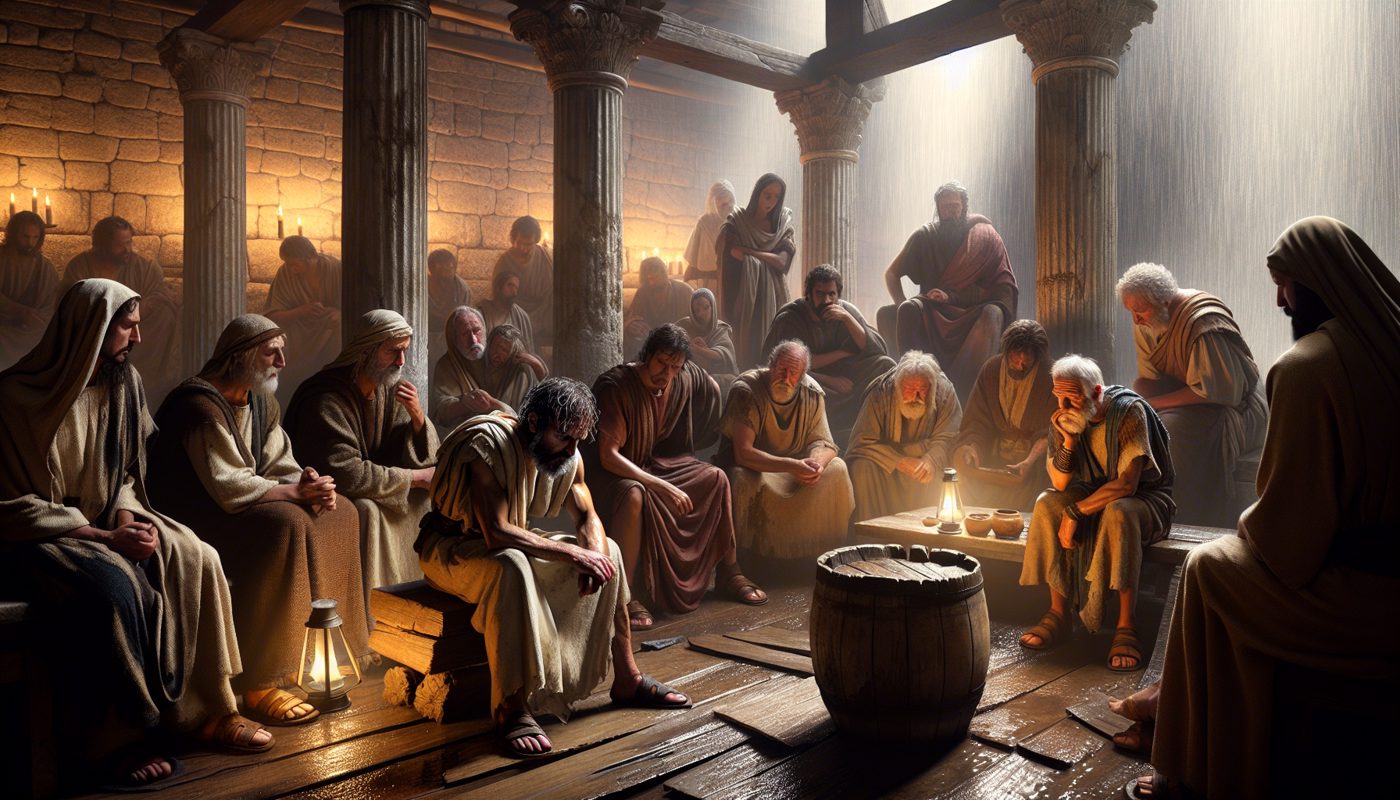
The letter pressed hard on a single question: what happens when someone who has tasted everything—the light, the gift, the Spirit, the word, the powers of the age to come—turns away? The writer did not soften the answer. He called it impossible to renew such a person to repentance. The language was not a threat thrown at a crowd. It was a precise, painful statement, and it landed like a stone in still water.
The readers had not fallen away. The writer said so plainly: “We are persuaded better things of you, and things that accompany salvation.” But he did not remove the warning. He let it stand because the warning itself was part of the ground they stood on. To remove it would be to mislead them about what it meant to hold fast.
He reminded them of their own work. God had not forgotten the love they had shown toward his name, the way they had served the saints and kept serving. That was not a footnote. It was evidence that the life they had tasted was still producing fruit. But the writer wanted more than past evidence. He wanted them to show the same diligence all the way to the end, so that hope would be fully formed in them, not slack and half-held.
The danger he named was sluggishness. Not dramatic apostasy, not a public denial of Christ, but a slow drift into indifference. The kind of drift that looks like staying in place while the current moves underneath. He called them to imitate those who through faith and patience inherited the promises. Patience was not passive. It was the long grip of a hand that would not let go.
Then he turned to Abraham. God made a promise to Abraham, and because there was no one greater to swear by, he swore by himself. The oath was not for God’s sake. It was for theirs. God wanted the heirs of the promise to have something solid to hold, something that could not shift. Two unchangeable things—the promise and the oath—stood together. In both, it was impossible for God to lie.
The writer called that hope an anchor of the soul. An anchor does not remove the storm. It holds the vessel steady in the storm. This anchor was both sure and steadfast, and it did not drop into the sea floor. It entered into the inner sanctuary, behind the veil, where the high priest went once a year. That was where the anchor was fixed.
Jesus had already entered there as a forerunner. He had gone ahead, not as a visitor but as a high priest forever, after the order of Melchizedek. The writer did not explain that order here. He simply named it and moved on. The point was that the priesthood had changed, and with it the ground of hope. The anchor was not a feeling. It was a person who had passed through the veil and would not come back out.
The warning and the anchor belonged together. The warning kept the readers from treating grace as cheap. The anchor kept them from thinking the door had slammed shut. The same God who warned them had also sworn an oath. The same Christ who was the forerunner was also the high priest. The letter did not resolve the tension. It held both truths in one hand and told them to press on.
Comments
Comments 0
Read the discussion and add your voice.
Members only
Sign in to join the conversation
We keep comments tied to real accounts so the discussion stays clean and trustworthy.
No comments yet. Be the first to add one.