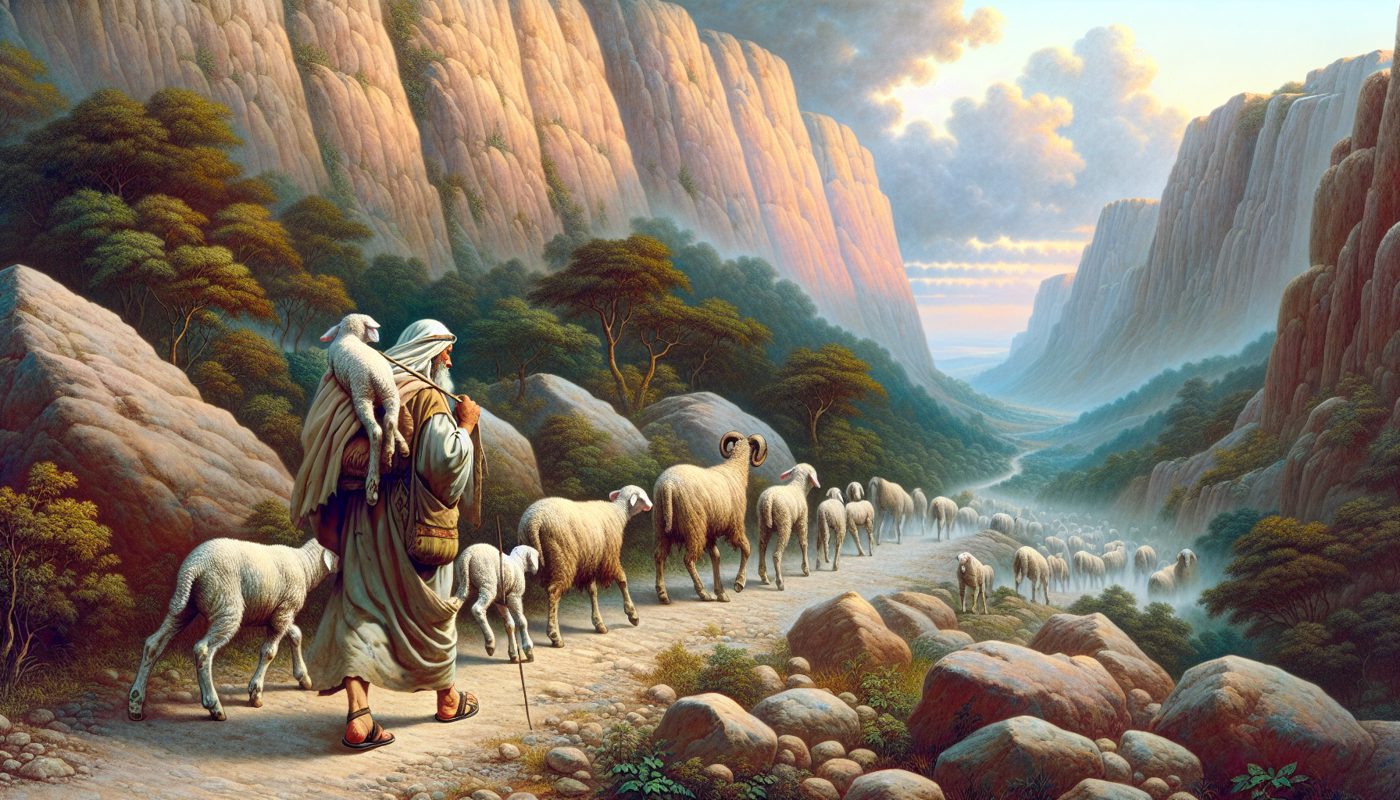
The dust of the path from Jeshana to the place was a fine, pale powder that rose in little puffs with every step, coating sandals and the hem of Elimelech’s robe. He walked slowly, not only because of the weight of the lamb across his shoulders—a yearling male without blemish, its wool warm against his neck—but because his father, now gone two years, had walked this same path at this same season, and the memory clung to the landscape. The hills of Manasseh were just beginning to whisper the promise of green with the early rains, but today the sun was a hammer on the bare rock.
His son, Joab, a boy of ten with legs like a young goat, scampered ahead, then back, impatient. “How much farther, Abba?”
“Until we see the smoke of the offerings,” Elimelech replied, his voice roughened by the road. “And then a little more. The place the Lord chooses is not around the next bend for our convenience.”
That was the heart of it, he mused, shifting the lamb. The *choosing*. It wasn’t Shiloh this year; the word had come that the Tent was pitched near the great trees of Moreh, a journey of three days. You couldn’t just stay home, slaughter your Passover in your own courtyard. You went *up*. You left the settled boundary of your inheritance, the fields you knew stone by stone, and you went to where God had set His name. It was inconvenient. It was costly. It was the point.
Joab had found a stream trickling across the path and was delighting in the mud. “Leave some water in it for the lamb,” Elimelech chided gently. The animal was quiet, trusting. A good sign. He remembered his own father’s story of a lamb that fought all the way from Hebron, a memory that had become family lore. This one felt like a promise fulfilled.
By afternoon, the traffic on the path thickened. They fell in with others: Zibia from the next valley with her two daughters, carrying baskets of unleavened cakes wrapped in linen; old Malchiel, leaning on a staff, his breathing a soft whistle, attended by a grandson carrying a skin of wine. The journey became a slow, murmuring procession. Stories were exchanged—the barley harvest had been good; Reuben’s ox had gone lame; a firstborn son had been born to the potter’s family. The law was not discussed in abstract terms. It was in the flour for the cakes, in the health of the lamb, in the effort to be here.
As dusk softened the harsh light, they crested the final ridge. Below, in a broad valley beside the oaks of Moreh, lay the camp. Not a city, but a temporary, purposeful settlement. The Tabernacle itself was a distant, serene core of white linen and gold gleam, but around it swirled the vivid, messy life of Israel. Smoke from a hundred cooking fires braided into the evening sky. The sound was a low roar—children laughing, sheep bleating, the chant of Levites rehearsing the psalms of ascent. The smell was complex: woodsmoke, roasting meat, dung, crushed grass, and the faint, sharp scent of the holy incense that drifted from the sanctuary.
“We are here,” Elimelech said, more to himself than to Joab. The weight of the lamb felt sacred now.
The next days had their own rhythm, dictated by the moon and the command. On the fourteenth day, as the sun bled out behind the hills, a solemnity descended. Elimelech took the knife and the basin to the designated place. He was not alone. Men from Dan and Benjamin, from Judah and Naphtali stood in lines, each with their lamb. The Levites moved among them, not as priests for the sacrifice, but as guides, ensuring all was done rightly. There was no pomp. Just the awful, intimate business of redemption. His hand was steady. The lamb did not cry out. As the blood was caught and splashed against the base of the great bronze altar by a silent priest, Elimelech felt the old story become new in his veins. *Because we were slaves. Because He brought us out.* The roasted meat that night, eaten with bitter herbs and unleavened bread in the tent with Zibia’s family and Malchiel, was not a feast of jubilation, but of sober, grateful remembrance. The storytelling was not lively, but measured. Joab asked the questions, and the answers were given as they had been for generations.
Seven weeks later, they returned. This was the Feast of Weeks, a different spirit altogether. The hard work of the wheat harvest was done. Now it was a celebration of firstfruits. Elimelech carried a coarse woven basket, not heavy with an animal, but with the tangible yield of his land: the finest heads of wheat, a clay jar of new oil, a small sack of the earliest figs. The offering was a confession. *The land is Yours. Its fruit is Yours. You have kept Your promise.* The camp was brighter, the mood lifting with the summer sun. The freewill offering he gave was from a full heart, not a dutiful one. He saw the faces of the poor—the sojourner, the fatherless, the widow—gathered at the edges of the celebration, and he made sure Joab was the one to press a measure of grain and a cake of pressed dates into their hands. “So that you may rejoice,” he told his son, quoting the words Moses had given. The boy’s face was puzzled for a moment, then cleared with understanding. The joy was not complete unless it was shared. It was a law that felt like kindness.
But it was the final pilgrimage, at the turn of the year, that etched itself deepest into Elimelech’s memory. The Feast of Booths. After the final, brutal work of the olive press and the grape harvest, they came again, this time with every member of the household. For seven days they lived in a *sukkah*, a rough booth Joab helped him build from branches of olive, myrtle, and palm. Its roof was loose enough to let in the stars. It was flimsy, temporary, utterly at the mercy of the weather.
The first night, a chill wind rattled the walls. Joab, wrapped in a blanket, whispered, “Abba, why is our house in Jeshana so much stronger than this?”
Elimelech lay on his pallet, looking up at a slice of the Milky Way through the gaps. “Because our houses in Jeshana can make us forget. They can make us think we built the land, we secured the harvest, we made our own safety. This,” he said, gesturing to the trembling shadows of leaves on the canvas, “this is how our fathers lived for forty years. With only the Lord’s pillar of cloud and fire between them and the desert. This is the truth of our life. Everything else is a gift of His rest.”
For seven days they rejoiced—truly rejoiced. There was music from pipe and timbrel. There was dancing in the open spaces before the Tabernacle. There were stories told not of Egypt, but of the wilderness—funny stories of misplaced quail, awe-filled stories of water from the rock. The shared, vulnerable life in the booths broke down the last barriers between tribe and clan. They were one people, living in fragile tents, utterly dependent on the God who had chosen them.
On the eighth day, the solemn assembly, there was no work. A deep, quiet joy, a contentment, settled over the camp. As Elimelech stood with the congregation for the final blessing, the early morning sun warming his face, he understood the cycle. The Lord had brought them from death to life (Passover), provided for them in faithfulness (Weeks), and dwelt with them in ongoing, vulnerable grace (Booths). It was all one story.
The walk back to Jeshana was lighter. The basket was empty. Joab walked quietly beside him for once, no longer scampering.
“Will we do it again next year, Abba?” the boy asked finally.
Elimelech looked at the path, at the now-familiar hills, at his son’s face, already changing from a child’s to a young man’s. “If the Lord wills, and He chooses a place, we will go up. We will always go up. It is the going up that reminds us who we are.”
And the dust of the path, now stirred by their homeward steps, seemed not a nuisance, but a part of the offering itself.


