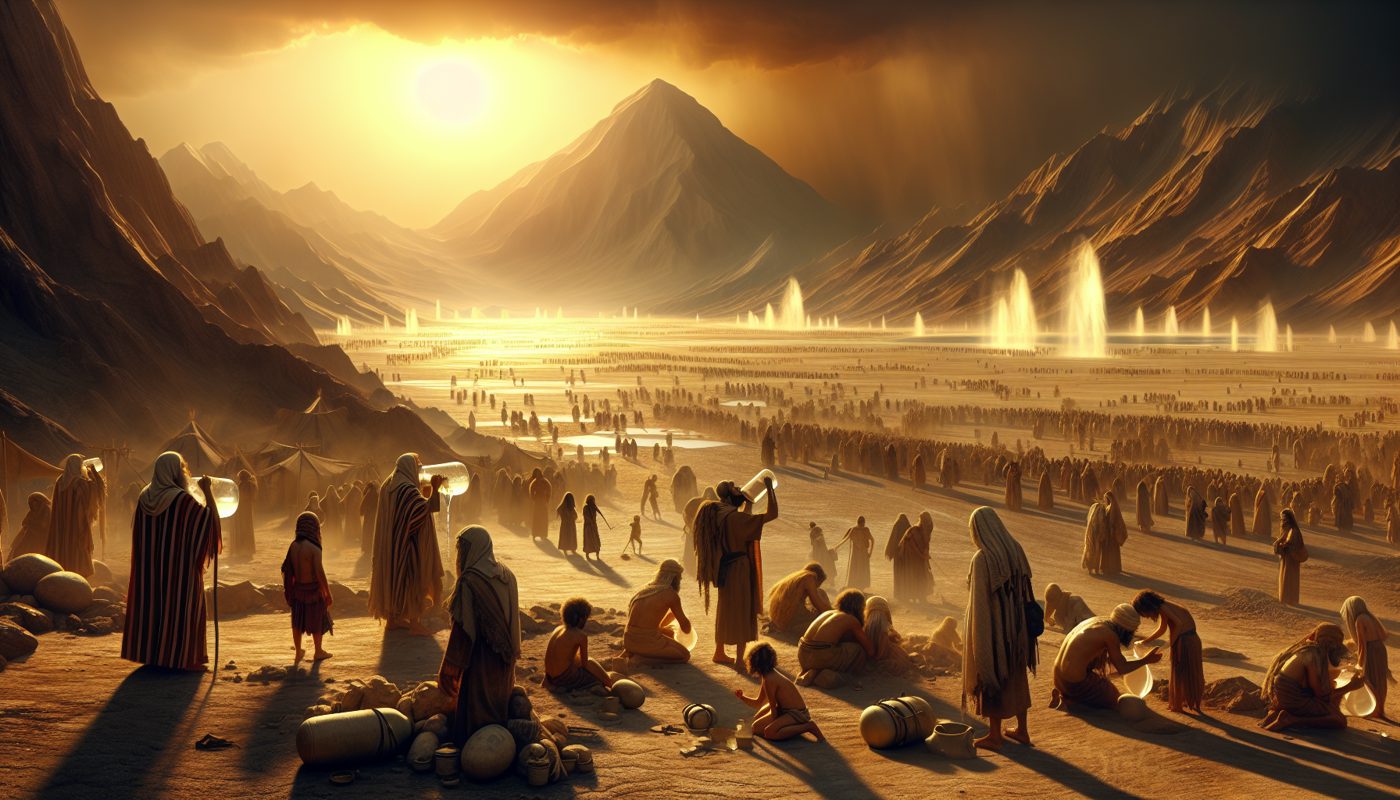
The heat was a living thing. It rose from the desert floor in visible, wobbling sheets, making the distant mountains of Edom swim like islands in a bitter sea. For forty years, the heat had been their constant companion, a harsh instructor in the school of wilderness. Now, at Kadesh, in the Desert of Zin, the lesson was thirst.
It began not with shouts, but with a grim, gathering silence. The water skins, those stubborn goatskins that had sloshed with meager life for so long, now hung limp and light from the belts of the elders. Children’s lips cracked and bled before their mothers’ weary eyes. The great assembly—a nation of former slaves turned nomads—did not march or murmur at first. They simply stood, a vast and ragged multitude, their eyes fixed on the tent that stood apart, the Tent of Meeting.
Miriam was gone. They had buried her here, on the edge of the promised land she would never see. Her absence was a fresh wound in the community’s soul, and the lack of water became the salt rubbed into it. The grief turned, as it often does, into a sharp and pointed anger.
They converged on Moses and Aaron not as leaders, but as accusers. A delegation of faces, lean and hardened by sun and sand, pushed to the front. There was no reverence now, only raw need.
“If only we had died when our brothers fell before the Lord!” a man cried, his voice scraping like stone on stone. “Why have you brought this assembly into this wilderness? To die here, us and our livestock?” Another voice, a woman’s, bitter and tired: “Was it not enough to drag us from a land of figs and vines only to plant us in this cursed ground? There is no grain, no figs, no grapes. There is not even water to drink.”
The words fell on Moses like blows. He felt the weight of them, a physical pressure. He turned from their contorted faces, Aaron following, and they walked the short, exposed distance to the Tent. The crowd’s eyes bore into their backs. Inside, the silence was different—heavy, holy, expectant. They fell on their faces, and the glory of the Lord, a palpable presence that made the very air thrum, appeared above the mercy seat.
The Voice was not loud, but it filled the space, clear and incontrovertible. “Take the staff. You and Aaron your brother, gather the assembly. Speak to the rock before their eyes, and it will yield its water. You will bring water out of the rock for them and their livestock to drink.”
The instructions were precise. *Speak to the rock.* Moses rose, his bones aching. He took the staff—the same staff that had become a serpent before Pharaoh, that had struck the Nile, that had been held high over the Red Sea. It was wood, smoothed by years of travel, but it felt like iron in his grip.
Outside, the multitude had grown restless, a sea of desperation. The sun beat down. Moses stopped before them, Aaron at his side. He looked out over the thousands—the children of those who had doubted at Sinai, who had wept for the pots of Egypt. A lifetime of their grumbling, their faithlessness, their petty rebellions, rose up in him like bile. The clear command of the Lord—“speak”—was drowned in the roaring memory of forty years of frustration.
“Listen now, you rebels!” His voice, usually measured, broke with a strident fury that startled even Aaron. “Must *we* bring water for you out of this rock?”
*We.* The word hung in the hot air. Not ‘the Lord,’ but ‘we.’ In that moment, the conduit confused itself with the source. The servant assumed the mantle of the master. He raised the staff high, not as a symbol of God’s power, but as an instrument of his own righteous indignation. He did not speak to the rock. He struck it. Once. Twice.
The crack of wood on stone was a sharp, solitary sound. And then—a deep, groaning rumble from the heart of the cliff face. A seam appeared, then widened. Not a trickle, but a roaring, rushing torrent of clear, cold water burst forth with impossible force, cascading down the rock face, carving a channel in the dust, spreading into streams and pools. A great gasp went up from the people, then shouts of pure joy. They surged forward, men, women, children, animals, plunging hands and faces into the miraculous flood, drinking until they could drink no more.
But Moses stood still, the staff now loose in his hand, the water swirling around his ankles. He felt no triumph, only a sudden, chilling hollow. He looked at Aaron, whose face mirrored his own dawning horror. They had provided the water, but they had violated the sacred trust. They had misrepresented the heart of God before all Israel. They had made it about their authority, their power, their moment of pique, rather than His patient, holy provision.
The water still flowed, a life-giving mercy in spite of everything, when the Voice came again, this time for them alone, a whisper that carried the weight of worlds.
“Because you did not trust in me enough to honor me as holy in the sight of the people, you will not bring this assembly into the land I have given them.”
The sentence was final. The water at his feet, the sound of the people’s relief, the very taste of the moist air—all of it became the flavor of his profound failure. The rock had yielded its gift, but Moses, in his anger, had struck at the very foundation of his calling. He was to be the declarer of God’s word, not the wielder of its sign. The promised land, the goal of every step for four decades, would remain a view from a mountaintop, not a home.
He turned from the celebrating crowd, the laughter of children splashing in divinely-sent puddles a cruel counterpoint to the desolation in his spirit. The wilderness had taught Israel many things. Today, it had taught their leader the hardest lesson of all: that faithfulness is found not in the dramatic blow, but in the obedient word; that even those who stand closest to the glory can, in a moment of human frailty, obscure its holiness. And the water, though it saved the people, would forever remind him of the cost of a trust misplaced.


