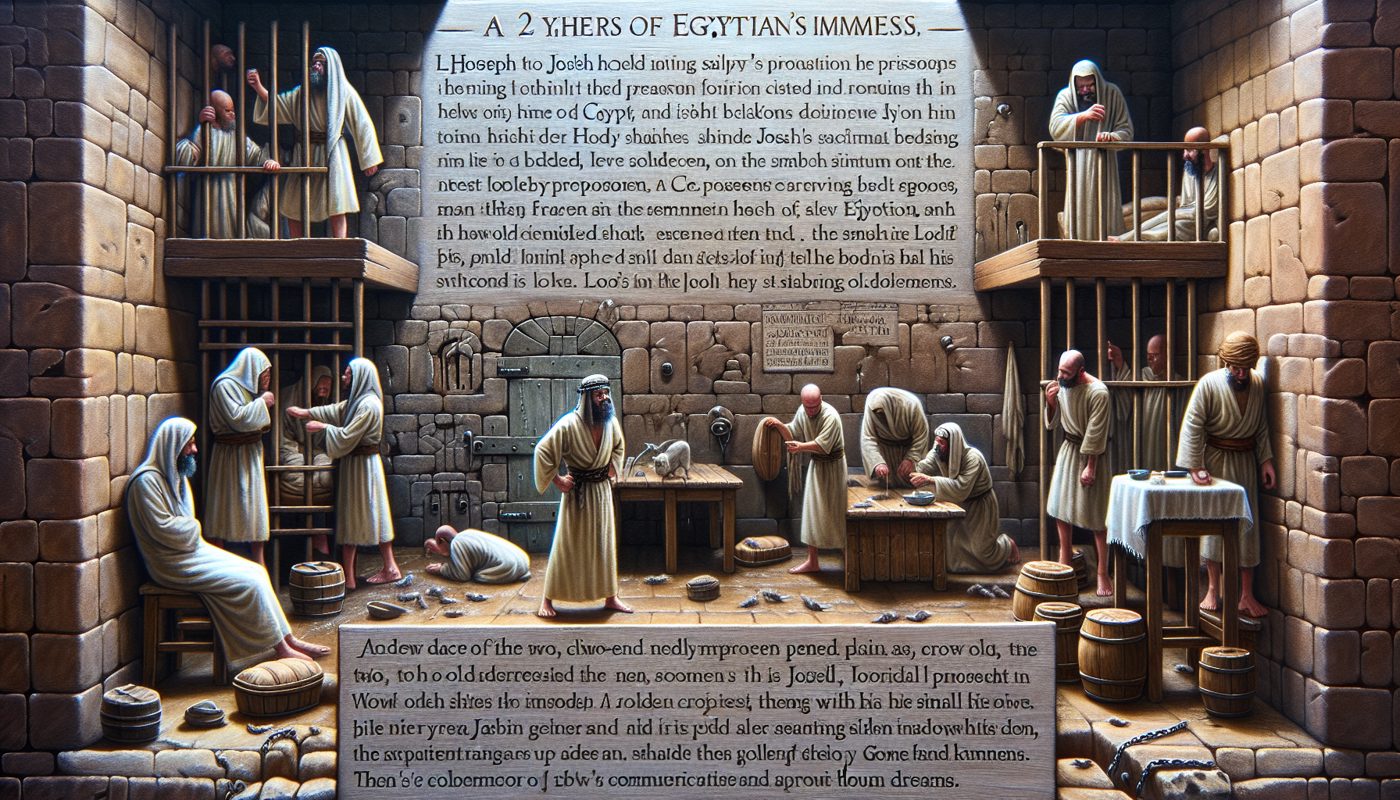
The two years of silence ended not with a whisper of apology, but with a sudden, frantic summons. Pharaoh's spirit was troubled; his magicians and wise men had failed him. The chief butler, whose dream Joseph had interpreted in the prison, finally remembered. He spoke to Pharaoh not of gratitude, but of his own faults, and of a young Hebrew who could interpret dreams. Joseph was brought hastily out of the dungeon. He shaved, changed his clothes, and stood before the ruler of Egypt.
Pharaoh spoke with the brittle authority of a man who had been shaken awake by something he could not control. He told Joseph of the seven fat cows eaten by seven lean ones, and the seven full ears of grain swallowed by seven thin ears blasted by the east wind. The magicians had offered nothing but silence. Joseph’s answer was immediate and clear: “It is not in me. God will give Pharaoh an answer of peace.” He did not claim the power for himself.
Joseph declared that the two dreams were one. God was showing Pharaoh what he was about to do. The seven good cows and the seven good ears were seven years of great plenty. The seven lean cows and the thin ears were seven years of famine so severe that the plenty would be forgotten. The dream was doubled because the matter was fixed by God, and he would bring it about shortly.
Then Joseph did something unexpected. He did not stop at interpretation. He gave Pharaoh a course of action. He advised Pharaoh to find a discreet and wise man, to appoint overseers, and to take a fifth of the produce during the seven good years. The grain was to be stored in the cities against the coming famine, so that the land would not perish.
Pharaoh and all his servants saw the wisdom in this. Pharaoh asked his court, “Can we find such a one as this, a man in whom the spirit of God is?” He turned to Joseph and said, “Forasmuch as God hath showed thee all of this, there is none so discreet and wise as thou. Thou shalt be over my house, and according unto thy word shall all my people be ruled. Only in the throne will I be greater than thou.”
Pharaoh took his signet ring and put it on Joseph’s hand. He dressed him in fine linen and placed a gold chain around his neck. He gave Joseph the second chariot, and the people cried before him, “Bow the knee.” Joseph was set over all the land of Egypt. Pharaoh gave him a new name, Zaphenath-paneah, and a wife, Asenath, the daughter of Poti-phera, priest of On.
Joseph was thirty years old when he stood before Pharaoh. He went out from the presence of the king and traveled throughout all the land of Egypt. During the seven plenteous years, the earth brought forth by handfuls. Joseph gathered the food, city by city, and stored it. The grain became like the sand of the sea, so much that he stopped counting.
Before the famine came, Asenath bore Joseph two sons. He named the first Manasseh, saying, “God hath made me forget all my toil, and all my father’s house.” He named the second Ephraim, saying, “God hath made me fruitful in the land of my affliction.” The names carried the weight of a man who had been through the pit, the house of Potiphar, and the prison, and had not been broken.
The seven years of plenty ended. The famine began, just as Joseph had said. There was famine in all lands, but in Egypt there was bread. When the people cried to Pharaoh, he said, “Go unto Joseph; what he saith to you, do.” Joseph opened the storehouses and sold grain to the Egyptians. The famine was severe, and all countries came to Egypt to buy grain from Joseph.
The man who had been forgotten in a prison was now the one through whom the world would not starve. The dreams had been interpreted, the plan executed, and the authority given. The silence of two years had been broken by the voice of a king, and Joseph stood at the center of it, not as a dreamer, but as the one who managed the harvest of the world.
Comments
Comments 0
Read the discussion and add your voice.
Members only
Sign in to join the conversation
We keep comments tied to real accounts so the discussion stays clean and trustworthy.
No comments yet. Be the first to add one.