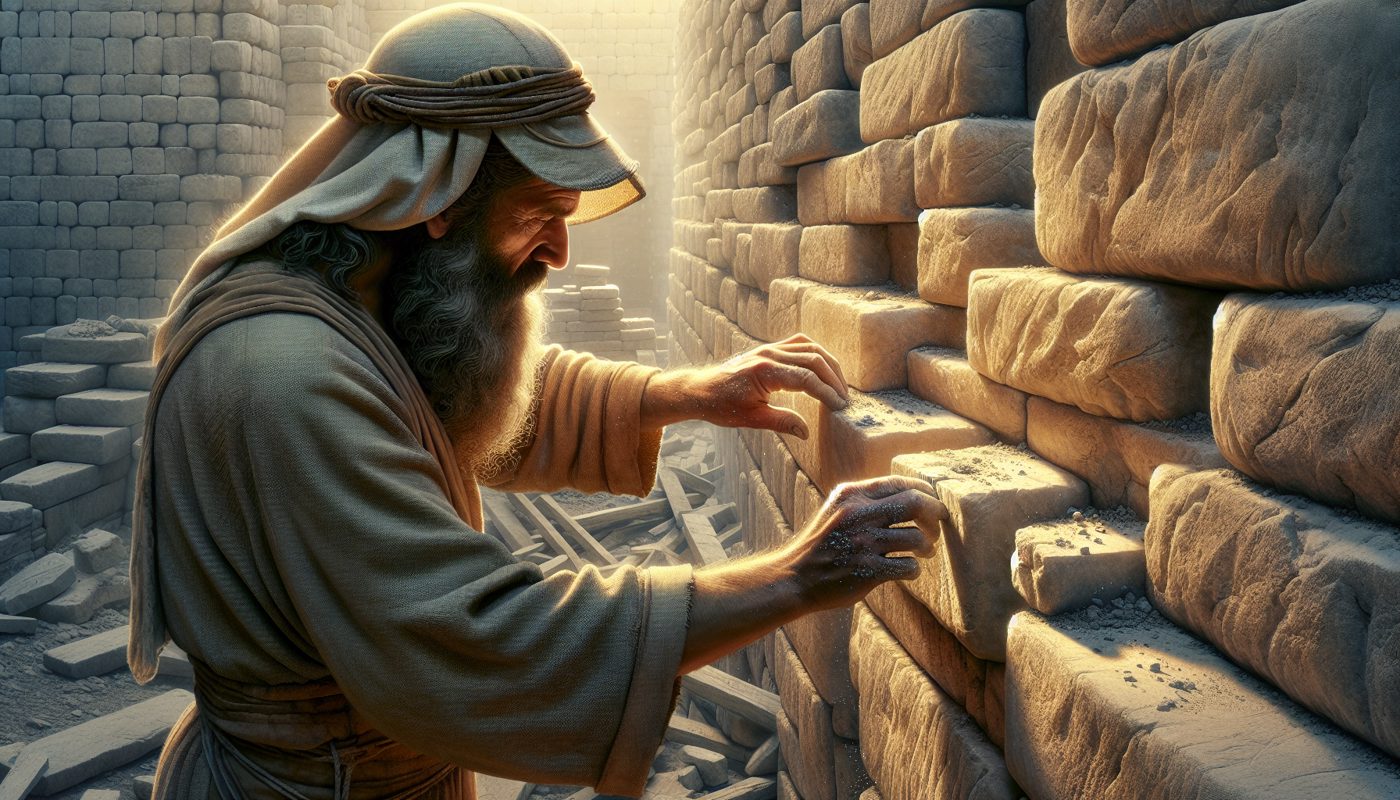
The heat over Jerusalem was a physical thing, a heavy wool cloak soaked in brine. It pressed down on the shoulders of Eliah, master mason, as he squinted at the join between two great ashlar blocks in the city’s expanding western wall. His hands, calloused and chalky with limestone dust, traced the seam. Perfect. A hair’s breadth of space, filled with strong mortar. His work. His legacy.
He had risen before the watchman’s cry, lit his lamp in the inky dark, and was already tasting the grit of stone on his tongue. The rhythmic *tap-tap-tap* of his chisel was his liturgy. *If the Lord does not build the house*, the old proverb went, but Eliah’s arms were strong, his eye true, his reputation solid as the bedrock. He *was* building the house—this house of Zion, stone by painstaking stone. His sweat would secure his family’s name. His vigilance would be their shield.
His son, Jotham, a boy of seven with eyes too wide for his thin face, brought his noon meal. A scrap of bread, a bit of cheese, a skin of tepid water. Eliah ate without tasting, his gaze fixed on the course of stones climbing toward the sun. “See this line, boy?” he said, not unkindly. “Straight as justice. A man’s work tells his story.”
Jotham watched a sparrow, a insignificant brown flutter, dart into a crevice in the very wall his father was repairing. It emerged with a bit of straw. “It’s building a nest, Abba.”
“Aye,” Eliah grunted, wiping his brow. “But its house is a tumble of twigs. Ours will endure.”
That night, in the small house that clung to the hillside, Eliah lay awake. The silence after the day’s clamor was a roar in his ears. He listened to the soft breathing of his wife, Shira, and of Jotham. He calculated the shekels needed for the next load of cedar from Lebanon for a merchant’s courtyard project. His mind was a city under siege, full of plans and counter-plans. He rose, lit the lamp again, and checked the bolt on the door twice. The watchmen in the city might be vigilant, but a man’s first responsibility was his own gate.
The seasons turned. The wall section was completed, a triumph of precision. Yet, a strange emptiness followed the celebration. The merchant’s courtyard project came, a intricate dance of imported wood and costly veneers. Eliah drove himself harder. He rose earlier, his lamp burning into the deeper watches of the night, his chisel strikes ringing out a frantic, lonely hymn. He was weary in a way sleep did not touch. Shira’s gentle words seemed to slide off him like water off sealed stone. Jotham would come to the worksite, but now he would just sit, whittling a piece of scrap wood into vague, patient shapes, saying little.
Then the fever came. It swept through the city’s cramped quarters, a merciless, drying wind. It took Shira first. Her strength, which had always been like the quiet, deep-rooted olive tree in their courtyard, was consumed in three terrible days. Eliah’s world, so carefully built of stone and calculation, cracked. He sat by her bed, his strong builder’s hands useless, clutching hers as the heat left them.
In his grief, he drove himself back to work like a man fleeing a shadow. But his heart was not in it. His famous precision faltered. A measurement was off; a costly block of marble, perfectly dressed, was chipped in a moment of distracted anger. He labored late into a moonless night, the solitary flame of his lamp guttering in the wind. Exhaustion, a cold, heavy stone, settled in his bones. He slumped against the cool marble, the unfinished arc of a rich man’s fountain looming over him like a mockery. He had built walls, but could not keep death out. He had secured gates, but could not lock sorrow away. His breath came in ragged pulls. *In vain you rise early*, the old proverb whispered now not as a saying, but as a verdict. *In vain you stay up late.*
He did not remember the walk home. The house was dark, silent. But as he pushed the door open, a small, warm shape collided with his legs. Jotham. Not wailing, not speaking. Just holding on. Eliah sank to the floor, the dust of his futility still on his robes, and held his son. The boy’s quiet, steady breath was the only sound in the vast, hollow night.
The next morning, Eliah did not rise before dawn. He slept, a deep, dead sleep of surrender. When the sun was already high, he awoke to the smell of bread—burned at the edges, but present. Jotham stood by the hearth, a determined look on his face, a clumsy loaf on the table.
They ate in silence. Then, instead of his tools, Eliah took his son’s hand. They walked, not to the worksite, but up to the Mount of Olives. They sat under the gnarled, ancient trees, looking west across the valley at the city. Jerusalem glittered, walls proud, temples ambitious. From here, his completed section of wall looked small, a single stitch in a grand tapestry.
Jotham, without looking at him, spoke. “The sparrows are back. In the wall. There are chicks now. You can hear them.”
Eliah looked. He saw not just the stones he had laid, but the life they now held—the unseen, chirping life in the crevices. He looked at his son, his face still soft with youth, but his eyes holding a quiet understanding that the fever had written there.
A peace he had never found in perfect seams or balanced ledgers settled upon him, slow as the morning shadows shortening. It was not the peace of a task completed, but of a burden relinquished. The city stood not because of his sleepless anxiety, but because of a covenant older than its foundations. His house, this quiet boy beside him, was not his own construction, but a gift—an inheritance, unforeseen and unearned.
He put his arm around Jotham’s shoulders. They sat there a long time, watching the afternoon light gild the city. The watchmen would take their posts on the walls later, the builders would resume their tapping. But for now, there was just the sun, the wind in the olives, and the solid, breathing weight of his son beside him. It was enough. It was more than enough. It was like coming home after a long, wearying journey to a fire already lit, a door held open by a hand you did not know was waiting. The true building, he understood now, had never been about stone.
Comments
Comments 0
Read the discussion and add your voice.
Members only
Sign in to join the conversation
We keep comments tied to real accounts so the discussion stays clean and trustworthy.
No comments yet. Be the first to add one.