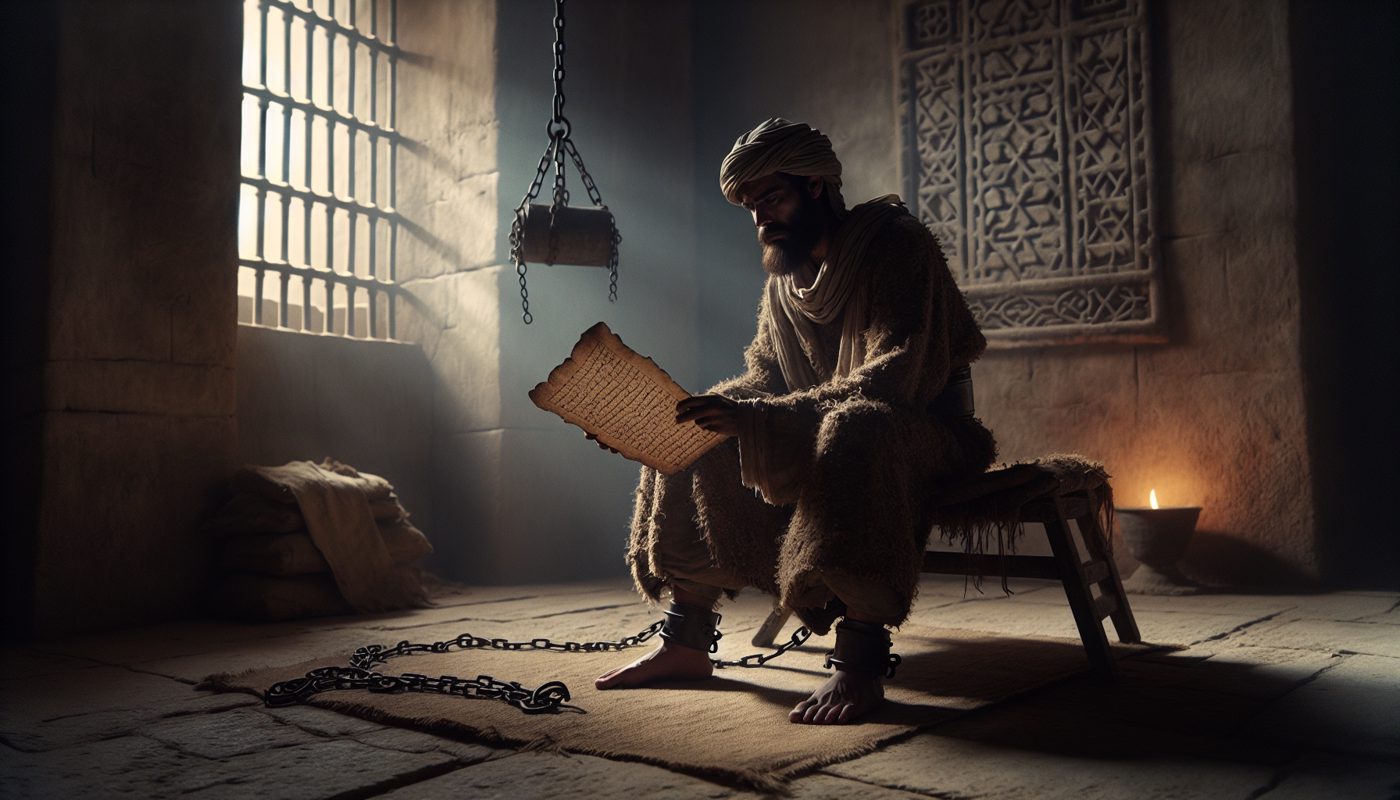
The air in the prefect’s quarters was thick, a stale mixture of dust, old incense, and the underlying tang of damp stone. Paul shifted on the thin pallet, the coarse wool of his tunic scratching against the fetters on his ankle. Not the Mamertine, this time. A kind of rented house, they called it. A guarded room, really. A chain’s length from freedom. From the high window, a narrow column of late afternoon light fell, illuminating motes that danced like forgotten spirits.
He held the sheet of papyrus in his hands, its surface coarse under his thumbs. Epaphroditus had brought it from Philippi, along with the gift—money for his upkeep, simple comforts. The young man’s face, still pale from his near-fatal illness, was etched with concern in the corner of the room, watching him read. The letter from the community there was not a single document, but a collection of voices—scraps of parchment, some elegant, some crude, tied with a bit of flax cord. He could hear them in the phrases: the robust faith of Syntyche, the practical kindness of Lydia, the steady patience of Clement.
He dipped the stylus into the small pot of ink, the metal cool against his fingers. How to begin? Not with the weight of the chain, but with the weight of grace. He pressed the point to the page.
*Paul and Timothy, servants of Christ Jesus, to all the saints in Christ Jesus who are in Philippi, with the overseers and deacons…*
The words flowed, not as a formal treatise, but as a conversation across the miles. He told them of his gratitude, a deep, flowing river that welled up each time he remembered them in his prayers. It was true. In the long silence of the night, when the guard’s snoring was the only sound, his mind would travel the Via Egnatia, back to the riverbank where he first met Lydia, the seller of purple cloth. He saw her keen eyes, heard her direct questions, felt the profound shift in the air when the Lord opened her heart. That was the true chain that bound him—not iron, but love, forged in the Spirit.
He wrote of his confidence. This was the hard part, the part that required a vision beyond stone walls. He was confident, he told them, that the One who began a good work in them would see it through to completion. He pictured the young man who had once been so volatile, now serving the poor with a quiet humility. He thought of the former slave girl, freed from more than one kind of bondage, now using her voice to lead hymns of praise. Yes, it would be completed. It had to be. The alternative was unthinkable—that God’s work could be thwarted by distance, or by time, or by the whim of an imperial official.
A pang, sharp and sudden, twisted in his gut. Not from hunger, but from longing. *I yearn for you all with the affection of Christ Jesus.* He let the feeling sit, then poured it into the wax. This was the heart of it. His imprisonment wasn’t a disaster; it had become a strange, sprawling pulpit. The whole Praetorian Guard, the rotation of hard-faced soldiers chained to him day after day, had heard the story. Not in sermons, but in fragments. In answers to their bored questions about his homeland. In his patience when the food was spoiled. In the inexplicable peace he exhibited when a verdict was delayed again. Some listened with cynical ears. Others, like the young Celt with the scar across his brow, had begun to ask questions of a different sort, his voice dropping to a whisper when the centurion walked past.
He knew, of course, of the other preachers in Rome. Some, motivated by genuine love, preached Christ boldly, encouraged by his chains. Others, sensing a vacuum, preached out of rivalry, thinking to add affliction to his imprisonment. He smiled a small, weary smile. What did it matter? The message was getting out. *Whether in pretense or in truth, Christ is proclaimed, and in that I rejoice.*
He paused, looking at his own hand, the knuckles swollen, the skin etched with lines of age and travel. To live was Christ. It wasn’t a slogan. It was the daily reality. Christ was the breath in his lungs when the cell air was foul. Christ was the patience in his voice when explaining the scriptures for the tenth time to a confused guard. Christ was the joy that surfaced, inexplicable and solid, when Epaphroditus recovered from his fever. Christ was the singular, consuming purpose.
And to die? To die was gain.
It was not a morbid wish. It was a calm assessment of the ledger. To depart, to be with Christ—that was far better, the ultimate gain, the end of the race. But to remain in the flesh was more necessary, for their sake. He was suspended between two undeniable truths, both pulling at him with equal force. He was convinced he would remain, for their progress and joy in the faith. Their boasting in Christ Jesus would overflow because of him, whether he came to them again or only heard news of them from afar.
The light from the window had faded to a deep blue twilight. Epaphroditus lit a small clay lamp, the flame painting wild shadows on the wall. Paul’s hand was cramping, but he had to finish.
He wrote of their conduct. They were to live as citizens of heaven, their lives a single, united spirit striving side-by-side for the faith of the gospel. They were not to be frightened by their opponents. This, too, was a grace—not just to believe in Christ, but to suffer for him. They were sharing in the same conflict they had seen in him long ago, and now heard he was still enduring.
He laid the stylus down. The letter was complete. He rolled the papyrus carefully, sealing it with a dab of wax pressed with the signet ring he was still permitted to wear—a simple, worn thing depicting an anchor.
“It is ready,” he said, his voice rough from disuse.
Epaphroditus took it, holding it as something precious. “They will treasure it.”
Paul leaned back against the cold wall, the chain clinking softly. The joy he had written about was not a feeling. It was a location. It was found in Christ, and because of that, it was unassailable. It lived in a damp prison room in Rome. It thrived in a Macedonian house church. It traveled the Roman roads in the hands of a convalescent man. It was, and would always be, a reason to give thanks. The trial ahead was merely the next page in the story, and he was ready to turn it, trusting the Author with all that was written, and all that was yet to be.
Comments
Comments 0
Read the discussion and add your voice.
Members only
Sign in to join the conversation
We keep comments tied to real accounts so the discussion stays clean and trustworthy.
No comments yet. Be the first to add one.