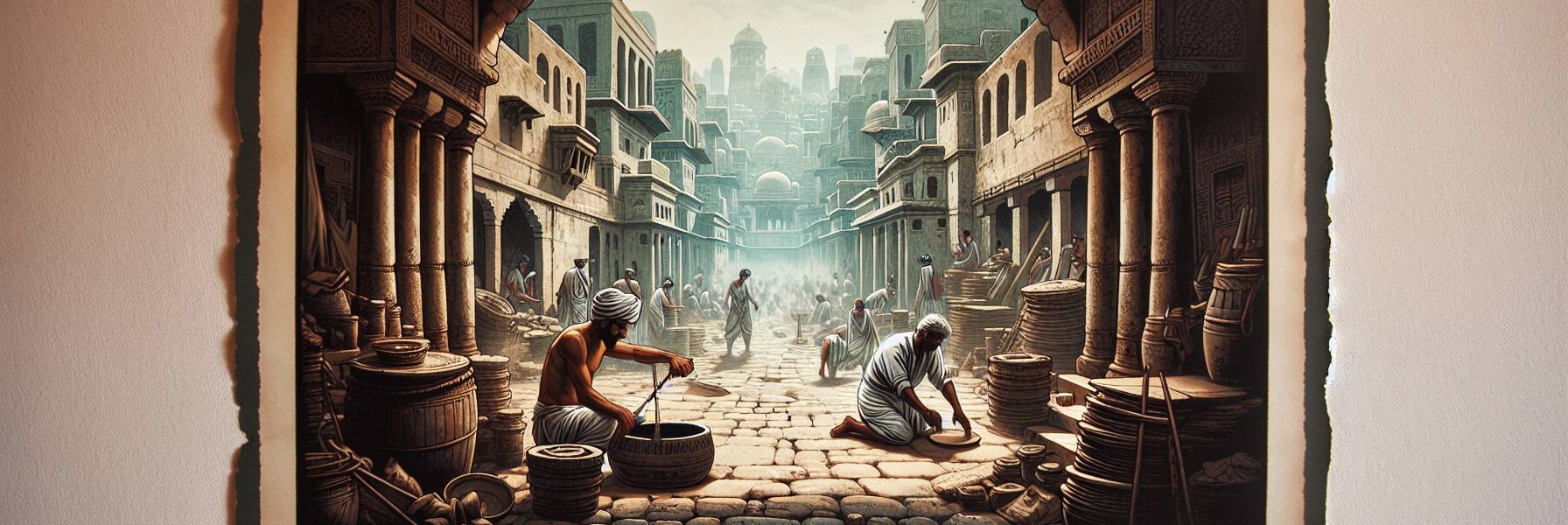

The heat in Nineveh was a physical weight, a thick, woolen blanket soaked in the sweat of the Euphrates and laid heavy over the city. It was the kind of heat that made the stone walls of the houses shimmer at noon and turned the air in the narrow streets to a sluggish, visible haze. Jonah’s warning, delivered over a century before, had long since faded from the city’s collective memory, eroded by generations of conquest and prosperity. The great city, the terror of nations, felt immortal, its foundations sunk not into mud and reed, but into the very bedrock of its own invincibility.
In a small, shaded courtyard, a man named Barukh wiped dust from a clay tablet. He was a minor official, a record-keeper for the Assyrian trade bureau, and his work was a monument to minutiae. But in the stillness of the evening, with the sun a bloody orange smear in the west, his mind was not on tariffs or grain shipments. He was thinking of his homeland, a strip of rocky hills and olive groves far to the west, a place called Judah. A fugitive priest, fleeing the political machinations of King Manasseh’s reign, had arrived months ago, hollow-eyed and whispering of a God who was not Ashur or Ishtar.
This God, the priest said, was a jealous God. A consuming fire. The words had ignited something in Barukh, a memory of a faith his own family had abandoned for the pragmatic gods of empire. Tonight, the priest was to speak again, in the hidden cellar of a potter’s house near the quay.
The cellar was cool and smelled of damp clay and fermenting wine. The only light came from a single oil lamp, its flame casting long, dancing shadows on the curved walls. The priest, Eleazar, was an old man, his face a web of wrinkles, but his voice was low and steady, carrying the weight of deep conviction.
“The burden of Nineveh,” he began, his Aramaic accented with the guttural sounds of Hebrew. “The book of the vision of Nahum the Elkoshite.”
Barukh shifted on the rough-hewn bench. Nahum. He did not know the name.
“God is jealous,” Eleazar recited, his eyes closed as if reading from a scroll only he could see. “And the Lord revengeth; the Lord revengeth and is furious; the Lord will take vengeance on his adversaries, and he reserveth wrath for his enemies.”
The words were not gentle. They were hard, like stones. They spoke of a God who was not indifferent, not a distant celestial bureaucrat, but a person, with a person’s fierce emotions. A God who could be furious.
“The Lord is slow to anger, and great in power,” Eleazar continued, his voice dropping. “And will not at all acquit the wicked.”
Barukh thought of the public squares, the pyramids of skulls built from conquered cities, the flayed skins of rebels nailed to the gates. He thought of the casual cruelty of the soldiers in the streets. *The wicked.* The phrase had a new, terrifying specificity.
“The Lord hath his way in the whirlwind and in the storm,” the priest said, and as he spoke, Barukh could almost hear it—the distant rumble gathering beyond the eastern mountains. Not the petty anger of men, but the foundational fury of creation itself. “And the clouds are the dust of his feet.”
The image was staggering. The vast, indifferent sky, the very clouds that brought life-giving rain or parching drought, were merely the dust kicked up by Yahweh’s footsteps. This was a scale of power that made the Assyrian war machine, for all its chariots and siege towers, look like a child’s toy.
“He rebuketh the sea, and maketh it dry,” Eleazar went on, “and drieth up all the rivers…”
Barukh’s mind flew to the stories of the Exodus, tales his grandmother had half-whispered. A sea torn in two. A river, the Jordan, piled up in a heap. This was not a God of philosophical concepts. This was a God who acted in geography, in history, with a terrible, tangible force.
“Bashan languisheth, and Carmel, and the flower of Lebanon languisheth.” The priest named the proud, fertile regions, the jewels of the empire’s crown, and declared them withered by a single word from this God.
“The mountains quake at him, and the hills melt,” he whispered, and the small lamp flame seemed to gutter. “And the earth is burned at his presence, yea, the world, and all that dwell therein.”
A silence fell, thick and heavy. The God of Judah was not just a local deity, a tribal patron. His jurisdiction was the world. His presence was a geological event.
“Who can stand before his indignation?” Eleazar’s voice was barely audible now. “And who can abide in the fierceness of his anger? His fury is poured out like fire, and the rocks are thrown down by him.”
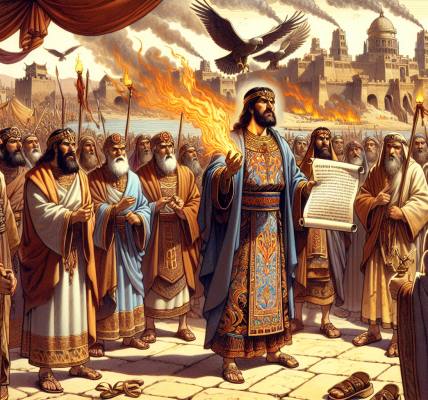
Barukh saw it then, not as a metaphor, but as a future reality. He saw the mighty walls of Nineveh, walls they said were so broad three chariots could race abreast upon them, not being scaled by ladders, but being struck by divine fists, the stones themselves leaping from their mortar as if in terror. The fire of this God’s fury was not a campfire; it was the core of the sun.
Yet, as the vision of absolute destruction settled in the room, the old priest’s tone softened, shifting like a wind changing direction.
“The Lord is good,” he said, and the words were a balm, a sudden, shocking relief. “A strong hold in the day of trouble; and he knoweth them that trust in him.”
The duality was breathtaking. The same power that could shatter mountains was a fortress for those who took refuge in it. The same fire that could consume the world was a hearth for his people. This was not a God of simple, predictable benevolence. This was a God of terrifying, specific loyalties.
“But with an overrunning flood he will make an utter end of the place thereof,” Eleazar said, returning to Nineveh’s fate, “and darkness shall pursue his enemies.”
The final verses were a direct address, a proclamation of judgment and a simultaneous promise of deliverance. Barukh listened, his heart pounding, as the priest spoke of plots against the Lord being cut off, of affliction not rising up a second time. He spoke of a messenger on the mountains, publishing peace, telling Judah to keep its feasts and perform its vows.
“For the wicked shall no more pass through thee,” Eleazar concluded, his voice firm with a finality that brooked no argument. “He is utterly cut off.”
The meeting ended. The small group dispersed into the night with hushed goodbyes. Barukh walked back through the labyrinthine streets, but the city felt different. The grandeur was a facade. The power was an illusion. The heat was no longer just the climate; it was the slow-burning anticipation of a coming fire.
He looked up at the ziggurat, its top lost in the dark, a man-made mountain trying to touch heaven. It seemed pathetic now. A child’s pile of bricks against the God whose footsteps were the clouds, whose voice was the storm, whose love was a fortress and whose wrath was an overrunning flood. The burden of Nineveh was no longer an abstract prophecy. It was a sentence, written not on his clay tablets, but on the very stones of the street beneath his feet, waiting only for the day of its execution.