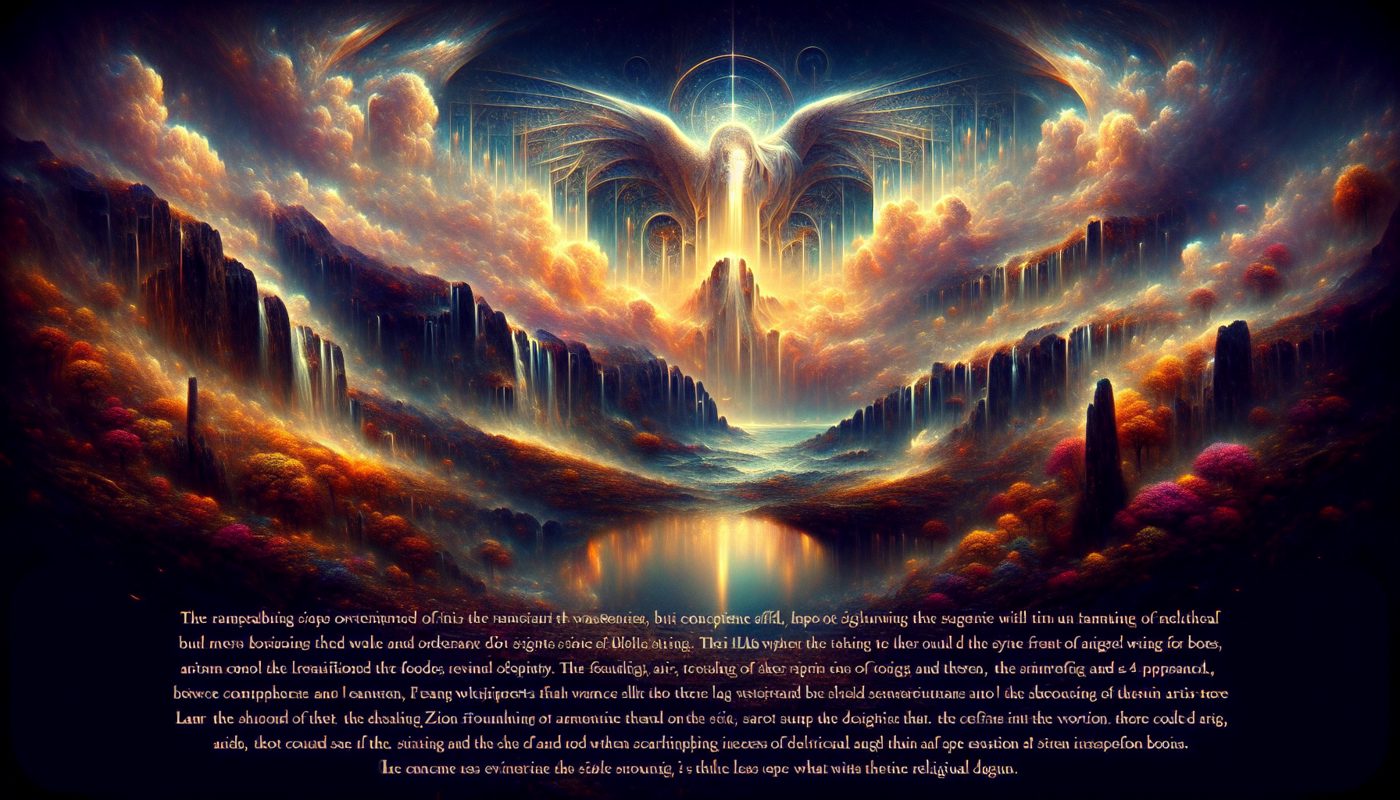
John sees the Lamb standing on Mount Zion, and with him one hundred forty-four thousand who bear his name and the name of his Father written on their foreheads. The mountain is not described as a place of earthly geography but as a fixed point in the vision, a location of divine assembly. The Lamb is not seated on a throne but standing, and the multitude stands with him.
From heaven John hears a voice like the roar of many waters, like the crash of great thunder, and also like the sound of harpers playing their harps. The voice is a single sound but carries multiple textures—water, thunder, music. It is the sound of a song, but the song is not described in words; it is a new song sung before the throne, before the four living creatures and the elders. No one could learn that song except the one hundred forty-four thousand who had been purchased from the earth.
These are the ones who were not defiled with women, for they are virgins. They follow the Lamb wherever he goes. They were purchased from among humanity as firstfruits to God and to the Lamb. In their mouths no lie was found; they are without blemish. The vision presents them not as a general category of believers but as a specific, sealed company whose purity is absolute and whose allegiance is singular.
Then John sees another angel flying in midheaven, carrying an eternal gospel to proclaim to those who dwell on the earth—to every nation, tribe, tongue, and people. The angel cries with a great voice: “Fear God and give him glory, because the hour of his judgment has come. Worship him who made the heaven, the earth, the sea, and the springs of water.” The gospel here is not a message of invitation but a summons to accountability before the Creator.
A second angel follows, saying, “Fallen, fallen is Babylon the great, who has made all the nations drink the wine of the wrath of her sexual immorality.” No explanation is given for who Babylon is or what her sin entails. The angel simply announces her collapse as a completed event, using the past tense as though the judgment has already occurred from heaven’s vantage point.
A third angel follows, speaking with a great voice: “If anyone worships the beast and his image and receives a mark on his forehead or on his hand, he will also drink the wine of God’s wrath, poured unmixed into the cup of his anger. He will be tormented with fire and brimstone in the presence of the holy angels and in the presence of the Lamb. The smoke of their torment rises forever and ever. They have no rest day or night—those who worship the beast and his image, and anyone who receives the mark of his name.” The warning is direct, the consequence permanent, and the audience is anyone who hears and chooses the beast.
John inserts a parenthetical note: “Here is the patience of the saints—those who keep the commandments of God and the faith of Jesus.” The verse does not explain how the saints are to endure; it simply identifies them by their obedience and faith. The patience is not passive waiting but active fidelity under pressure.
A voice from heaven speaks to John directly: “Write: Blessed are the dead who die in the Lord from now on.” The Spirit adds, “Yes, they will rest from their labors, for their works follow them.” The blessing is not for all the dead but specifically for those who die in the Lord after this point in the vision, as though a new era of persecution has begun and death itself becomes a form of release.
John looks again and sees a white cloud. On the cloud sits one like a son of man, wearing a golden crown on his head and holding a sharp sickle in his hand. An angel comes out of the temple in heaven and cries with a great voice to the one on the cloud: “Send your sickle and reap, because the hour to reap has come, for the harvest of the earth is ripe.” The one on the cloud swings his sickle over the earth, and the earth is reaped.
Another angel comes out of the temple in heaven, also holding a sharp sickle. Then another angel comes out from the altar—the angel who has authority over fire—and calls with a great voice to the angel with the sickle: “Send your sharp sickle and gather the clusters of the vine of the earth, because her grapes are fully ripe.” The angel swings his sickle into the earth, gathers the vintage of the earth, and throws it into the great winepress of the wrath of God.
The winepress is trampled outside the city, and blood flows from the winepress up to the bridles of the horses, for a distance of about one thousand six hundred stadia. The vision does not name the city. It does not identify the army or the horses. It simply records the scale of the judgment: blood as deep as a horse’s bridle, stretching across a vast distance. The harvest and the vintage are both gathered, but one belongs to the son of man and the other to the winepress of wrath.
Comments
Comments 0
Read the discussion and add your voice.
Members only
Sign in to join the conversation
We keep comments tied to real accounts so the discussion stays clean and trustworthy.
No comments yet. Be the first to add one.