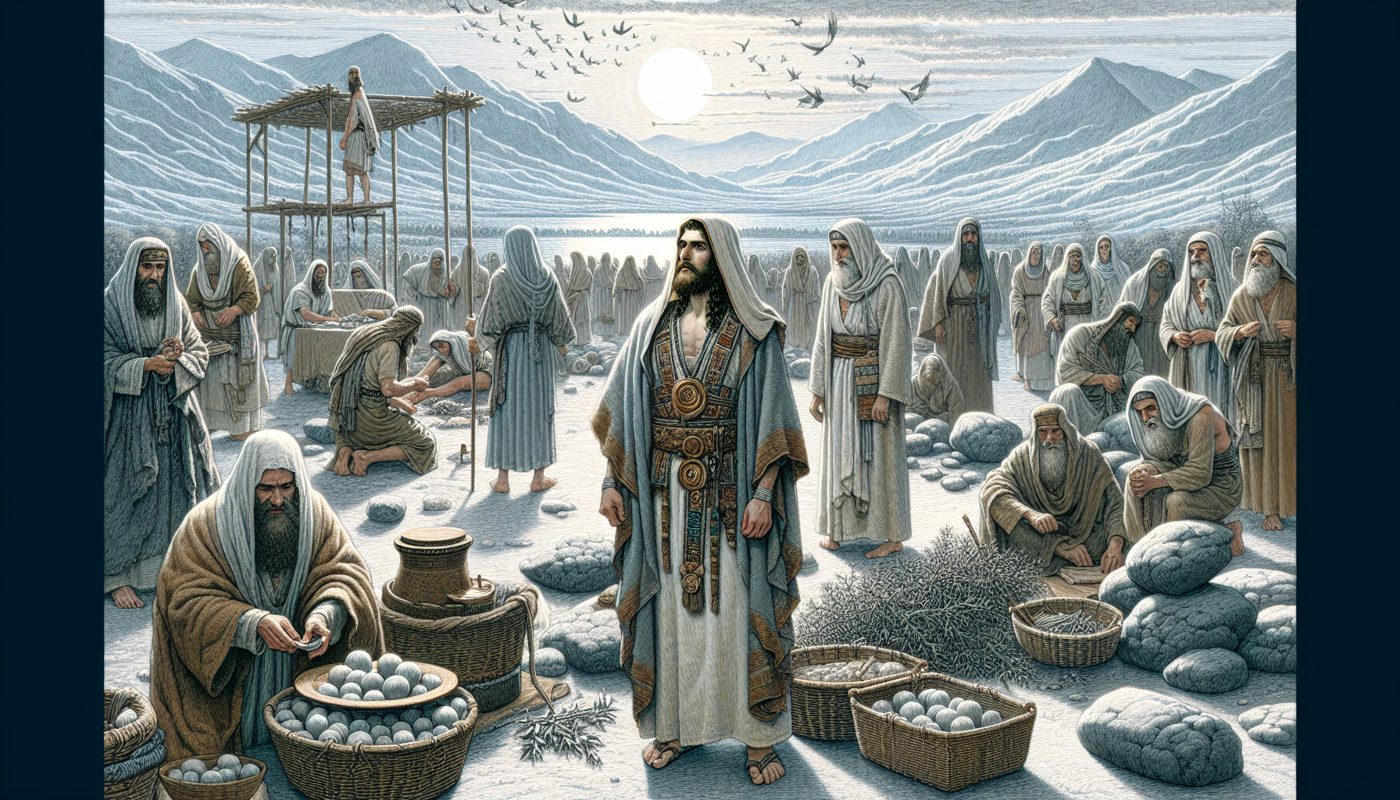
The law of the leper’s cleansing does not begin with the man. It begins with the priest going out. The Lord spoke to Moses, and the command was clear: the priest shall go forth out of the camp. He does not wait at the gate. He does not send a messenger. He walks into the space where the unclean have been standing, and he looks. The first act of restoration is not a word but a movement toward the one who has been kept apart.
What the priest sees matters. He does not assume. He examines the flesh. If the plague of leprosy is healed in the leper, then the priest commands the materials: two living clean birds, cedar wood, scarlet, and hyssop. One bird is killed in an earthen vessel over running water. The living bird is dipped, along with the cedar, the scarlet, and the hyssop, into the blood of the slain bird mixed with the running water. Then the priest sprinkles the man seven times. He pronounces him clean. And he lets the living bird go into the open field.
The bird released carries nothing. It is not a sacrifice. It is a sign that the man’s separation has ended. The blood has been applied. The running water has been used. The living bird flies away, and the man is no longer bound to the edge of the camp. But he is not yet home.
He washes his clothes. He shaves off all his hair. He bathes in water. Then he may enter the camp, but he does not enter his tent. For seven days he dwells outside his own dwelling. On the seventh day he shaves again—his head, his beard, his eyebrows, every hair. He washes his clothes and his body. And only then is he clean in the sense that prepares him for the eighth day.
The eighth day is the day of offerings. The man brings two he-lambs without blemish, one ewe-lamb a year old without blemish, fine flour mingled with oil, and a log of oil. The priest sets the man and these things before the Lord at the door of the tent of meeting. One he-lamb becomes a trespass offering. The log of oil is waved. The lamb is killed in the place of the sanctuary, where the sin offering and the burnt offering are killed. The blood of the trespass offering is placed on the tip of the man’s right ear, on the thumb of his right hand, and on the great toe of his right foot.
The priest then takes the oil, pours it into his own left palm, dips his right finger, and sprinkles it seven times before the Lord. The rest of the oil is applied to the same places—ear, thumb, toe—over the blood already there. The remainder of the oil is poured on the man’s head. The priest makes atonement for him. Then the sin offering is offered, the burnt offering is killed, and the meal offering is brought to the altar. The priest makes atonement, and the man is clean.
But the law does not assume every man can afford this. If he is poor and cannot get so much, he may bring one he-lamb for a trespass offering, a tenth of an ephah of fine flour mingled with oil, a log of oil, and two turtle-doves or two young pigeons—one for a sin offering, one for a burnt offering. The ritual of blood and oil on ear, thumb, and toe remains the same. The sprinkling remains seven times. The atonement is not reduced because the man is poor. The provision is made for him, but the cleansing is not cheaper.
The chapter does not end with the man. It turns to the house. When the Lord brings Israel into the land of Canaan, and puts a plague of leprosy in a house, the owner must come and tell the priest. The priest commands that the house be emptied before he enters, so that nothing in it becomes unclean. He looks. If the plague is in the walls with hollow streaks, greenish or reddish, and lower than the wall, he shuts the house for seven days. On the seventh day he returns. If the plague has spread, the stones with the plague are removed and cast into an unclean place outside the city. The house is scraped inside and around. The mortar is poured out. New stones are put in, and new mortar is applied.
If the plague returns after the stones are replaced and the house is plastered, then the priest pronounces it a fretting leprosy. The house is unclean. It must be broken down—stones, timber, mortar—and carried out of the city to an unclean place. Anyone who enters while it is shut up is unclean until evening. Anyone who lies down or eats in it must wash his clothes. But if the plague does not spread after the plastering, the priest pronounces the house clean. He takes two birds, cedar wood, scarlet, and hyssop. He kills one bird over running water in an earthen vessel, dips the living bird and the materials in the blood and water, sprinkles the house seven times, and lets the living bird go out of the city into the open field. The house is clean.
The chapter closes with a summary: this is the law for all manner of plague of leprosy, for a scall, for leprosy of a garment, for a house, for a rising, for a scab, for a bright spot. The purpose is stated plainly: to teach when it is unclean and when it is clean. The law does not explain why a house can become leprous. It does not moralize. It simply gives the priest the steps. The priest goes out. The priest looks. The priest shuts up, scrapes, replaces, or breaks down. The priest sprinkles. The living bird goes into the open field. And the house, like the man, is restored to the ordinary life of the camp.
Comments
Comments 0
Read the discussion and add your voice.
Members only
Sign in to join the conversation
We keep comments tied to real accounts so the discussion stays clean and trustworthy.
No comments yet. Be the first to add one.