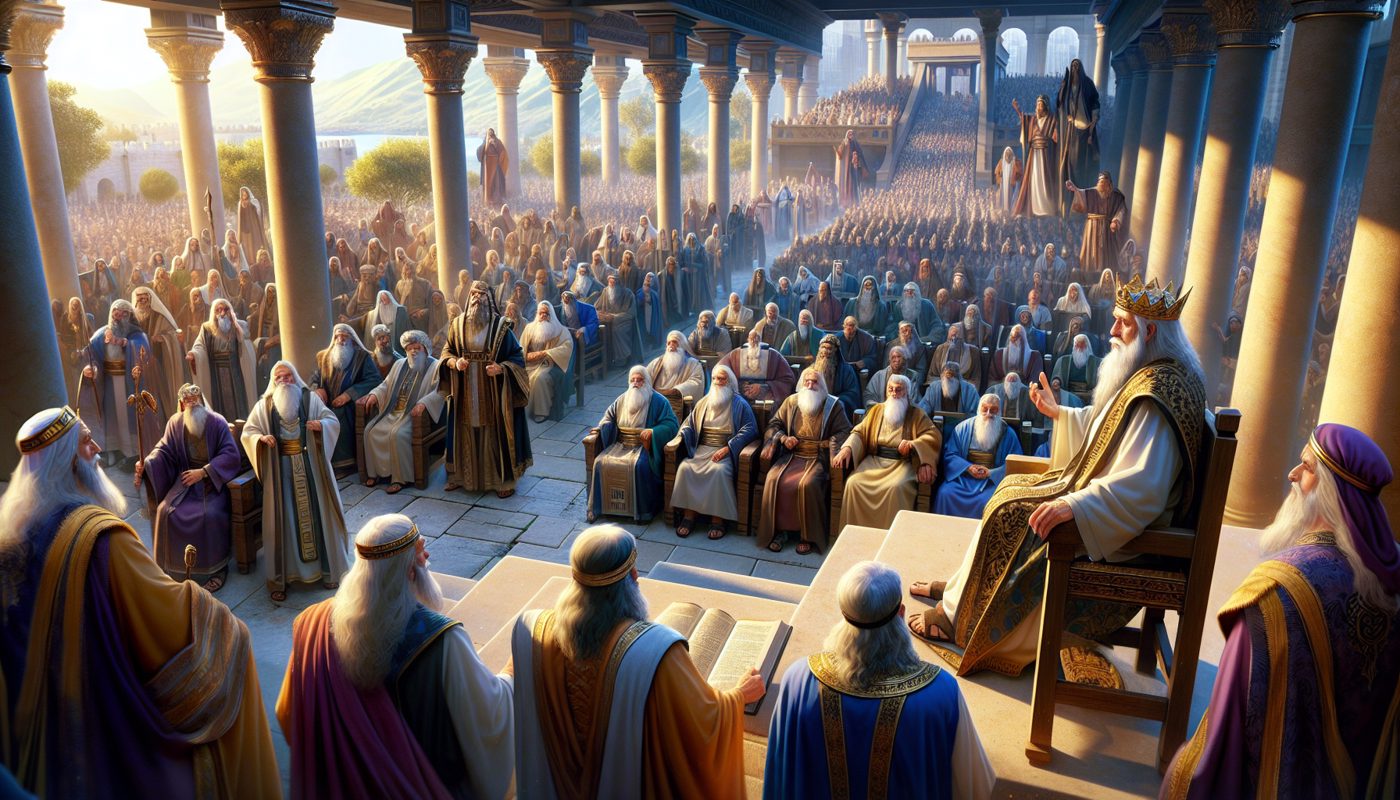
David was old and full of days, and he made Solomon his son king over Israel. That act of succession is the first fact the chapter gives, and it sets the frame for everything that follows. The aging king did not retire to wait for death. He gathered all the princes of Israel, the priests, and the Levites, and he put the house of the Lord in order while he still had breath.
The Levites were counted from thirty years old and upward, and the number came to thirty-eight thousand men. David did not leave them in a single undifferentiated mass. He assigned them by function. Twenty-four thousand were to oversee the work of the house of the Lord. Six thousand were officers and judges. Four thousand were doorkeepers. Four thousand were to praise the Lord with instruments that David himself said he had made for that purpose.
Then David divided the Levites into courses according to the three sons of Levi: Gershon, Kohath, and Merari. The chapter gives the genealogical lists with the heads of fathers’ houses, naming the sons of Ladan and Shimei among the Gershonites, the sons of Kohath including Amram, Izhar, Hebron, and Uzziel, and the sons of Merari, Mahli and Mushi. These are not ornamental names. They represent the actual men who would carry the work.
The text pauses at the sons of Amram to mark a separation. Aaron was set apart to sanctify the most holy things, he and his sons forever, to burn incense before the Lord, to minister to him, and to bless in his name forever. Moses the man of God appears in the same lineage, but his sons were named among the tribe of Levi without that priestly distinction. The chapter does not elaborate on why. It simply records the fact.
The census itself changed in its scope. David numbered the Levites from twenty years old and upward, not thirty. The reason is given in David’s own words. The Lord God of Israel had given rest to his people and dwelt in Jerusalem forever. The Levites would no longer need to carry the tabernacle and all its vessels for the service of the journey. The wilderness was over. The work was now stationary.
Their new office was to wait on the sons of Aaron for the service of the house of the Lord, in the courts, in the chambers, and in the purifying of all holy things. They were responsible for the showbread, the fine flour for the meal-offering, the unleavened wafers, the baked and soaked offerings, and all manner of measure and size. The work was detailed and concrete, not vague or ceremonial in the abstract.
Every morning and every evening they were to stand and thank and praise the Lord. They were to offer all burnt offerings to the Lord on the sabbaths, the new moons, and the set feasts, in number according to the ordinance concerning them, continually before the Lord. The rhythm was fixed and public, not spontaneous or occasional.
The chapter closes by stating that the Levites were to keep the charge of the tent of meeting, the charge of the holy place, and the charge of the sons of Aaron their brethren, for the service of the house of the Lord. The threefold repetition of “charge” underlines the seriousness. The work was not optional. It was assigned, numbered, and ordered by the king who had seen the tabernacle carried through forty years of wilderness and now saw it settled in Jerusalem.
David’s last words on this matter, as the chapter calls them, were not poetry or prophecy. They were an administrative reorganization that turned a mobile priesthood into a permanent temple staff. The genealogies and the numbers are the point. The chapter records who did what, when the wandering stopped.
Comments
Comments 0
Read the discussion and add your voice.
Members only
Sign in to join the conversation
We keep comments tied to real accounts so the discussion stays clean and trustworthy.
No comments yet. Be the first to add one.