The opening of Hosea 7 strikes a strange note: the Lord wants to heal Israel, but the moment He draws near, the nation’s wickedness is uncovered. Healing and exposure arrive together. Ephraim’s sin is not hidden from heaven; it is the very thing that blocks the cure. The chapter does not describe a nation stumbling in ignorance. It describes a people whose crimes are open, deliberate, and displayed before the Lord’s face.
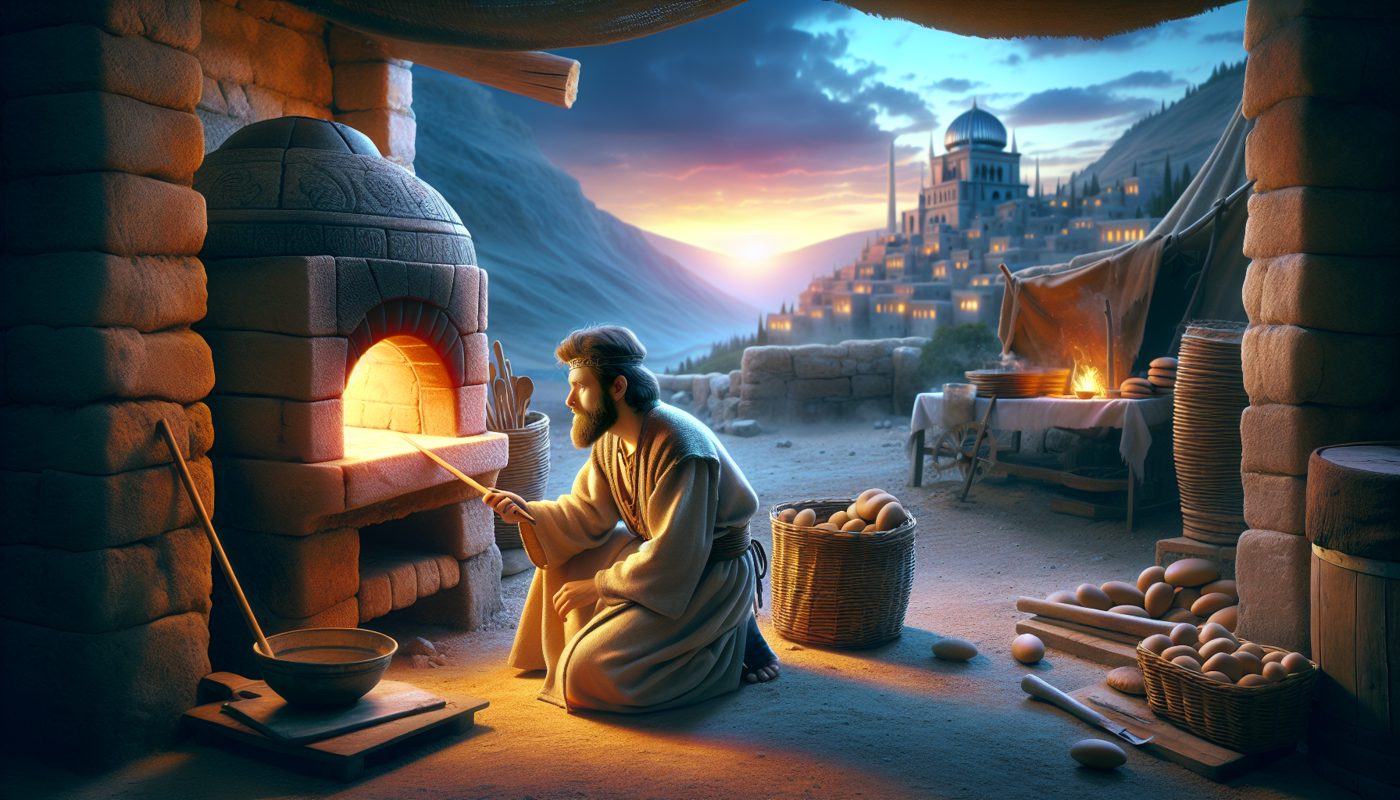
The prophet returns to an image that dominates the chapter: an oven. The princes and the people are like an oven heated by a baker. The baker stirs the fire from the moment the dough is kneaded until it is fully leavened. The image is not about baking bread. It is about sustained, intentional heat. The nation’s wickedness is not a sudden flare; it is a fire kept alive through the night by plotters who never let the coals die.
Verse 5 describes a royal festival. On the day of the king, the princes make themselves sick with the heat of wine. The king stretches out his hand with scoffers. The court is not governing; it is indulging. The celebration is a cover for conspiracy. The same hands that raise the cup are the hands that stoke the fire of rebellion and intrigue.
Verse 6 sharpens the metaphor. The princes make their heart like an oven while they lie in wait. Their baker sleeps all night, but the fire does not go out. In the morning, it blazes up as a flaming fire. The baker who sleeps is not negligent; he has banked the fire so well that it burns without him. The nation’s corruption is self-sustaining. No one needs to tend it. It feeds itself.
The result is that all of them are hot as an oven, and they devour their own judges. Kings fall. No one calls to the Lord. The political chaos is not accidental. It is the direct consequence of a society that has turned its heart into a furnace and fed it with lies, theft, and violence. The chapter does not blame foreign enemies for Israel’s collapse. It blames Israel’s own internal fire.
Then the image shifts. Ephraim is a cake not turned. A cake baked on one side only is burned on one side and raw on the other. It is useless. The picture is one of incompleteness and ruin. Ephraim has mixed himself among the peoples, adopting their alliances and their gods, but he has not become one of them. He is neither fully Israel nor fully like the nations. He is half-baked, and therefore worthless.
Strangers have devoured his strength, and he does not know it. Gray hairs are scattered on him, and he does not know it. The chapter describes a nation that has aged without wisdom. It has been weakened by foreign powers, but it refuses to recognize its own decline. The pride of Israel testifies against him, yet he does not return to the Lord. The diagnosis is stark: the nation is dying, and it will not admit it.
Ephraim is called a silly dove without understanding. The dove flies back and forth between Egypt and Assyria, calling to one, then to the other. The nation’s foreign policy is panic, not strategy. It flutters between powers, hoping for rescue, but the Lord says He will spread His net over them and bring them down like birds of the sky. The alliances they trust will become the trap that catches them.
Verse 13 is blunt: woe to them, for they have wandered from the Lord. Destruction to them, for they have trespassed against Him. The Lord says He would redeem them, but they speak lies against Him. The tragedy is not that God is unwilling to save. It is that the people refuse to be saved. They howl on their beds, but they do not cry out to God with their hearts. They assemble for grain and new wine, but they rebel against the Lord who gives those gifts.
The final verse describes a people who return, but not to the One on high. They are like a deceitful bow—a bow that appears ready to shoot but cannot send the arrow straight. Their princes will fall by the sword because of the rage of their tongue. And the chapter ends with a bitter note: this shall be their derision in the land of Egypt. The nation that ran to Egypt for help will become a joke in Egypt. The oven they stoked will consume them. The cake will be thrown away.
Comments
Comments 0
Read the discussion and add your voice.
Members only
Sign in to join the conversation
We keep comments tied to real accounts so the discussion stays clean and trustworthy.
No comments yet. Be the first to add one.