**The Story of Jeremiah and Pashhur: A Prophet’s Anguish and God’s Faithfulness**
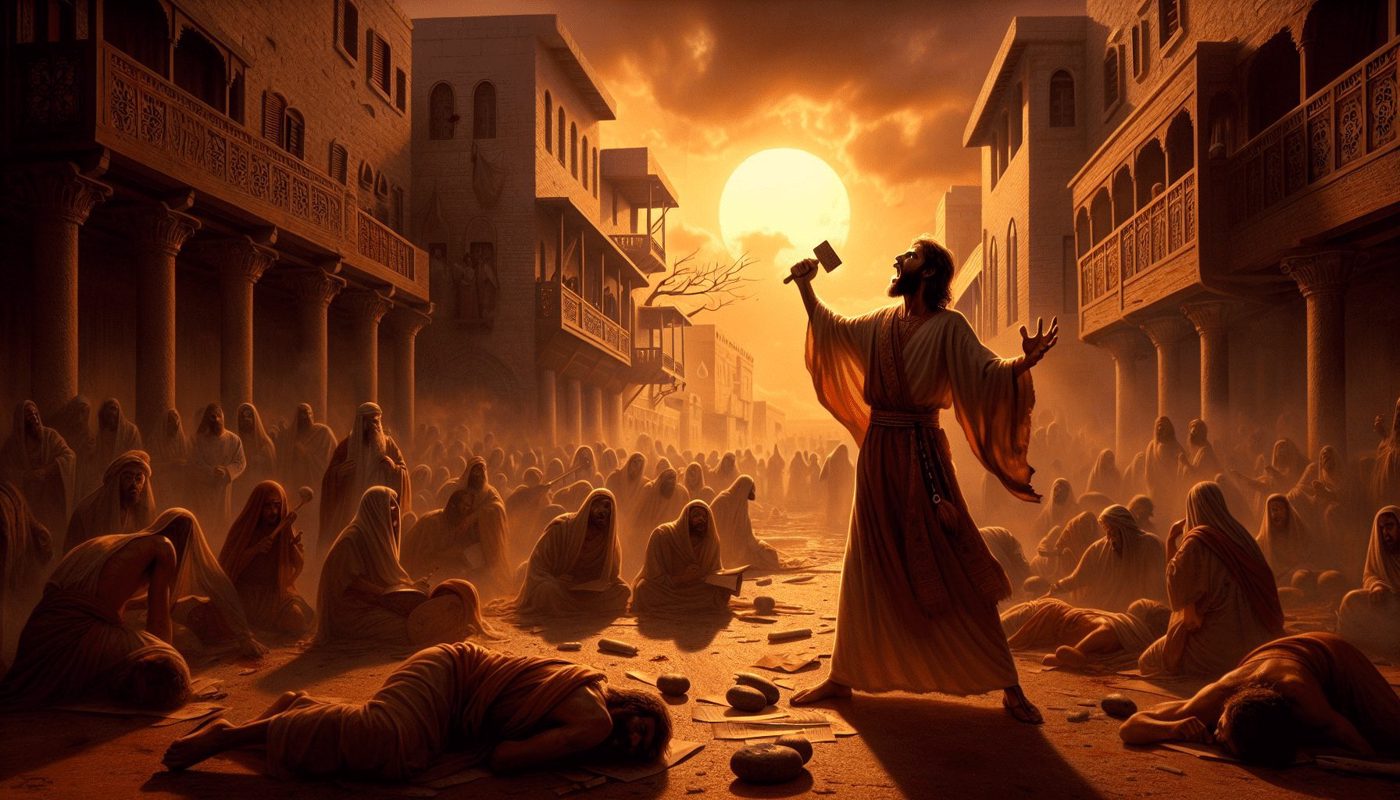
The sun hung low in the sky, casting long shadows over the streets of Jerusalem. The city bustled with life, but beneath the surface, a deep spiritual decay festered. The people had turned away from the Lord, worshiping idols and indulging in sin. In the midst of this rebellion, Jeremiah, the prophet of God, stood as a lone voice calling for repentance. His words were like fire, burning with the urgency of God’s message, but they often fell on deaf ears.
One day, as Jeremiah stood in the temple courtyard, he felt the weight of the Lord’s hand upon him. The Spirit compelled him to speak, and he could not remain silent. He raised his voice, declaring, “Thus says the Lord: ‘If you do not turn from your wicked ways, this city will be destroyed. The Babylonians will come like a storm, and Jerusalem will fall. The people will be taken captive, and the land will become desolate.’”
The words echoed through the temple, reaching the ears of Pashhur, the chief officer of the temple. Pashhur was a proud man, confident in his position and authority. He despised Jeremiah’s prophecies, for they challenged the false sense of security that the people clung to. Enraged by Jeremiah’s boldness, Pashhur ordered his guards to seize the prophet.
Jeremiah was dragged before Pashhur, who sneered at him. “You dare to speak such words in the house of the Lord? You are a troublemaker, spreading fear and despair among the people!” Without waiting for a response, Pashhur commanded his men to beat Jeremiah. The prophet was struck repeatedly, his body aching with each blow. When the beating was over, Pashhur ordered Jeremiah to be placed in the stocks at the Upper Gate of Benjamin, near the temple. There, Jeremiah was left exposed to the mockery and scorn of the people.
As the hours passed, Jeremiah’s physical pain was matched by the anguish in his heart. He cried out to the Lord, “Why have You made me a prophet? Why must I endure such suffering? Every time I speak Your word, I am met with ridicule and violence. I am weary, Lord, so weary.”
Yet even in his despair, Jeremiah could not escape the fire of God’s word burning within him. He knew that he had no choice but to continue proclaiming the truth, no matter the cost. The next morning, when Pashhur released him from the stocks, Jeremiah turned to him with a fierce determination in his eyes.
“The Lord has not called you Pashhur,” Jeremiah declared, “but ‘Terror on Every Side.’ For thus says the Lord: ‘I will make you a terror to yourself and to all your friends. They will fall by the sword of their enemies, and you will see it with your own eyes. I will hand over all Judah to the king of Babylon, and he will carry them away captive to Babylon and strike them down with the sword. I will give all the wealth of this city, its treasures, and its precious things into the hand of their enemies, who will plunder them and carry them to Babylon. And you, Pashhur, and all who dwell in your house, will go into captivity. You will die in Babylon, and there you will be buried, you and all your friends to whom you have prophesied lies.’”
Pashhur’s face turned pale, but he said nothing. Jeremiah’s words struck deep, for he knew they were not the words of a man but the judgment of the Almighty. Jeremiah turned and walked away, his body bruised but his spirit unbroken.
As Jeremiah returned to his home, the weight of his calling pressed heavily upon him. He felt the loneliness of his mission, the isolation of being a voice crying in the wilderness. He poured out his heart to the Lord in a raw and honest prayer. “O Lord, You deceived me, and I was deceived. You overpowered me and prevailed. I am ridiculed all day long; everyone mocks me. Whenever I speak, I cry out, proclaiming violence and destruction. The word of the Lord has brought me insult and reproach all day long.”
Jeremiah’s anguish was palpable. He felt trapped, caught between the compulsion to speak God’s word and the suffering it brought him. In a moment of despair, he even wished he had never been born. “Cursed be the day I was born! May the day my mother bore me not be blessed! Cursed be the man who brought my father the news, saying, ‘A child is born to you—a son!’ Let that man be like the cities the Lord overthrew without pity. Let him hear cries of distress in the morning and the battle cry at noon, because he did not kill me in the womb, so that my mother might have been my grave, and her womb forever enlarged. Why did I come out of the womb to see trouble and sorrow, to end my days in shame?”
Yet even in this darkest moment, Jeremiah’s faith did not completely falter. He remembered the power and faithfulness of the Lord. “But the Lord is with me like a mighty warrior,” he declared. “Therefore my persecutors will stumble and not prevail. They will be utterly ashamed, for they have not prospered. Their eternal dishonor will never be forgotten. O Lord of hosts, who tests the righteous and sees the heart and mind, let me see Your vengeance upon them, for to You I have committed my cause.”
Jeremiah’s prayer shifted from despair to a declaration of trust. He knew that God was just and that His purposes would prevail. Though the road ahead was fraught with suffering, Jeremiah resolved to continue his mission. He would not be silenced, for the word of the Lord was like a fire in his bones, and he could not hold it in.
The story of Jeremiah and Pashhur serves as a powerful reminder of the cost of faithfulness. Jeremiah endured ridicule, violence, and deep personal anguish, yet he remained steadfast in his calling. His life was a testament to the truth that God’s word cannot be silenced, even in the face of overwhelming opposition. And though the road was difficult, Jeremiah found strength in the knowledge that the Lord was with him, a mighty warrior who would ultimately bring justice and vindication.
In the end, Jeremiah’s prophecies came to pass. Jerusalem fell to the Babylonians, and the people were taken into captivity. Pashhur and his household experienced the judgment Jeremiah had foretold. Yet even in the midst of judgment, there was hope. For the Lord had promised to restore His people, to bring them back from exile and establish a new covenant with them. Jeremiah’s life and ministry pointed forward to the ultimate fulfillment of God’s promises in Jesus Christ, the true Prophet who would bear the suffering of His people and bring them eternal redemption.
Comments
Comments 0
Read the discussion and add your voice.
Members only
Sign in to join the conversation
We keep comments tied to real accounts so the discussion stays clean and trustworthy.
No comments yet. Be the first to add one.