**The Everlasting Covenant of Restoration: A Story Based on Isaiah 54**
In the days of old, when the people of Israel were scattered and their hearts heavy with sorrow, the Lord spoke through His prophet Isaiah, bringing a message of hope and restoration. The words were like a gentle rain upon parched land, soothing the weary souls of those who had endured the weight of exile and despair. The Lord’s voice echoed through the ages, promising a future filled with joy, abundance, and an unbreakable covenant of love.
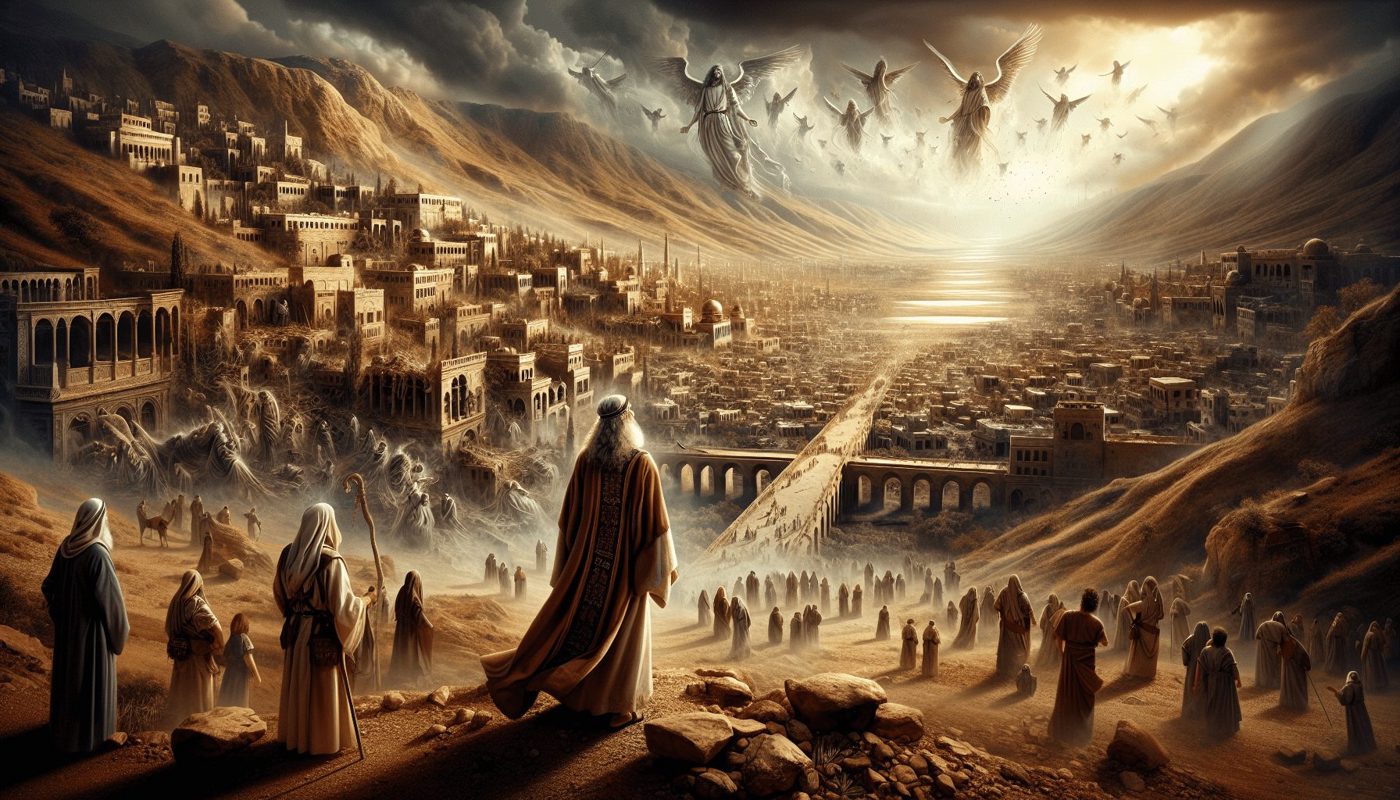
The prophet Isaiah stood on a barren hill, overlooking the desolate city of Jerusalem. The once-thriving streets were now silent, the temple in ruins, and the people dispersed to distant lands. Yet, as Isaiah gazed upon the emptiness, the Spirit of the Lord came upon him, and he began to proclaim a vision of what was to come.
“Sing, O barren one, you who have not borne children!” Isaiah cried out, his voice carrying across the hills. “Break forth into singing and cry aloud, you who have not been in labor! For the children of the desolate one will be more than the children of her who is married, says the Lord.”
The words were startling, for they spoke to a people who felt abandoned and forgotten. The nation of Israel, often depicted as a barren woman, had suffered greatly. Her children—her people—had been taken away, and her land lay in ruins. Yet the Lord declared that her future would be one of unimaginable blessing. She would no longer be barren but would become a mother of many nations, her descendants multiplying like the stars in the sky.
Isaiah continued, his voice rising with passion. “Enlarge the place of your tent, and let the curtains of your habitations be stretched out. Do not hold back; lengthen your cords and strengthen your stakes. For you will spread abroad to the right and to the left, and your offspring will possess the nations and will people the desolate cities.”
The imagery was vivid and powerful. The barren woman was called to prepare for an abundance she could scarcely imagine. Her tent, once small and confined, would stretch wide to accommodate the multitudes of her children. The desolate cities would be filled with life once more, and the land would flourish under the blessing of the Lord.
But the Lord’s message did not end there. He addressed the fears and shame that had gripped His people. “Fear not, for you will not be ashamed; be not confounded, for you will not be disgraced. For you will forget the shame of your youth, and the reproach of your widowhood you will remember no more.”
The people had carried the weight of their past failures and the consequences of their disobedience. They had been like a widow, abandoned and alone, bearing the reproach of their sins. Yet the Lord promised to wipe away their shame and restore them to a place of honor. Their past would no longer define them, for the Lord Himself would be their Redeemer.
“For your Maker is your husband,” Isaiah proclaimed, “the Lord of hosts is His name; and the Holy One of Israel is your Redeemer, the God of the whole earth He is called.”
The relationship between the Lord and His people was depicted as a marriage covenant—a bond of love, faithfulness, and unending commitment. Though Israel had been unfaithful, the Lord remained steadfast. He would not abandon His bride but would bring her back to Himself with compassion and mercy.
The prophet’s words grew even more tender as he described the Lord’s unwavering love. “For the Lord has called you like a wife deserted and grieved in spirit, like a wife of youth when she is cast off, says your God. For a brief moment I deserted you, but with great compassion I will gather you.”
The people had felt the sting of the Lord’s discipline, but it was not without purpose. Like a loving parent who corrects a child for their good, the Lord had allowed His people to experience the consequences of their actions. Yet His discipline was temporary, and His compassion would soon overflow. He would gather them from the ends of the earth and bring them back to their homeland.
“In overflowing anger for a moment I hid My face from you,” the Lord declared, “but with everlasting love I will have compassion on you, says the Lord, your Redeemer.”
The contrast between the Lord’s momentary anger and His everlasting love was striking. His wrath was but a fleeting shadow, while His love was an unshakable foundation. The people could take comfort in knowing that the Lord’s love for them was as enduring as the mountains and as vast as the sea.
Isaiah then turned his attention to the future, painting a picture of a restored and secure nation. “O afflicted one, storm-tossed and not comforted, behold, I will set your stones in antimony, and lay your foundations with sapphires. I will make your pinnacles of rubies, your gates of crystal, and all your wall of precious stones.”
The imagery was breathtaking. The Lord promised to rebuild His people with materials of unparalleled beauty and value. Their city would be adorned with precious stones, a symbol of the Lord’s favor and the glory He would bestow upon them. No longer would they be afflicted or storm-tossed; they would dwell in safety and peace.
“All your children shall be taught by the Lord,” Isaiah continued, “and great shall be the peace of your children. In righteousness you shall be established; you shall be far from oppression, for you shall not fear; and from terror, for it shall not come near you.”
The Lord’s promise extended to future generations. His people would not only be restored but would also live in a state of divine instruction and peace. The fear of oppression and terror would be removed, and they would dwell securely under the Lord’s protection.
Isaiah’s voice grew even more resolute as he delivered the final assurance. “If anyone stirs up strife, it is not from Me; whoever stirs up strife with you shall fall because of you. Behold, I have created the smith who blows the fire of coals and produces a weapon for its purpose. I have also created the ravager to destroy.”
The Lord made it clear that no weapon formed against His people would prosper. Those who sought to harm them would be defeated, for the Lord Himself was their shield and defender. He was the Creator of all things, and nothing could stand against His will.
The prophet concluded with a promise that would echo through the ages. “No weapon that is fashioned against you shall succeed, and you shall refute every tongue that rises against you in judgment. This is the heritage of the servants of the Lord and their vindication from Me, declares the Lord.”
The people of Israel, though once desolate and forsaken, were now called to rise in hope and faith. The Lord’s promises were sure, and His covenant with them was everlasting. He would restore them, bless them, and establish them as a beacon of His glory to the nations.
And so, the barren woman sang, her voice rising in joy and gratitude. The desolate cities were filled with laughter, and the land flourished under the Lord’s blessing. The people remembered the words of Isaiah and took comfort in the knowledge that their Redeemer lived, and His love for them would never fail.
Thus, the story of Isaiah 54 became a testament to the Lord’s faithfulness—a reminder that even in the darkest of times, His promises shine like the dawn, bringing hope, restoration, and everlasting peace.
Comments
Comments 0
Read the discussion and add your voice.
Members only
Sign in to join the conversation
We keep comments tied to real accounts so the discussion stays clean and trustworthy.
No comments yet. Be the first to add one.