**The Burden of the Valley of Vision: A Story of Jerusalem's Pride and Fall**
In the days when King Hezekiah reigned over Judah, the word of the Lord came to Isaiah, the prophet, concerning the Valley of Vision. The Lord spoke with a heavy heart, for the city of Jerusalem, though beloved, had turned away from Him. The people, once faithful, had grown proud and self-reliant, trusting in their own strength rather than in the God who had delivered them time and time again.
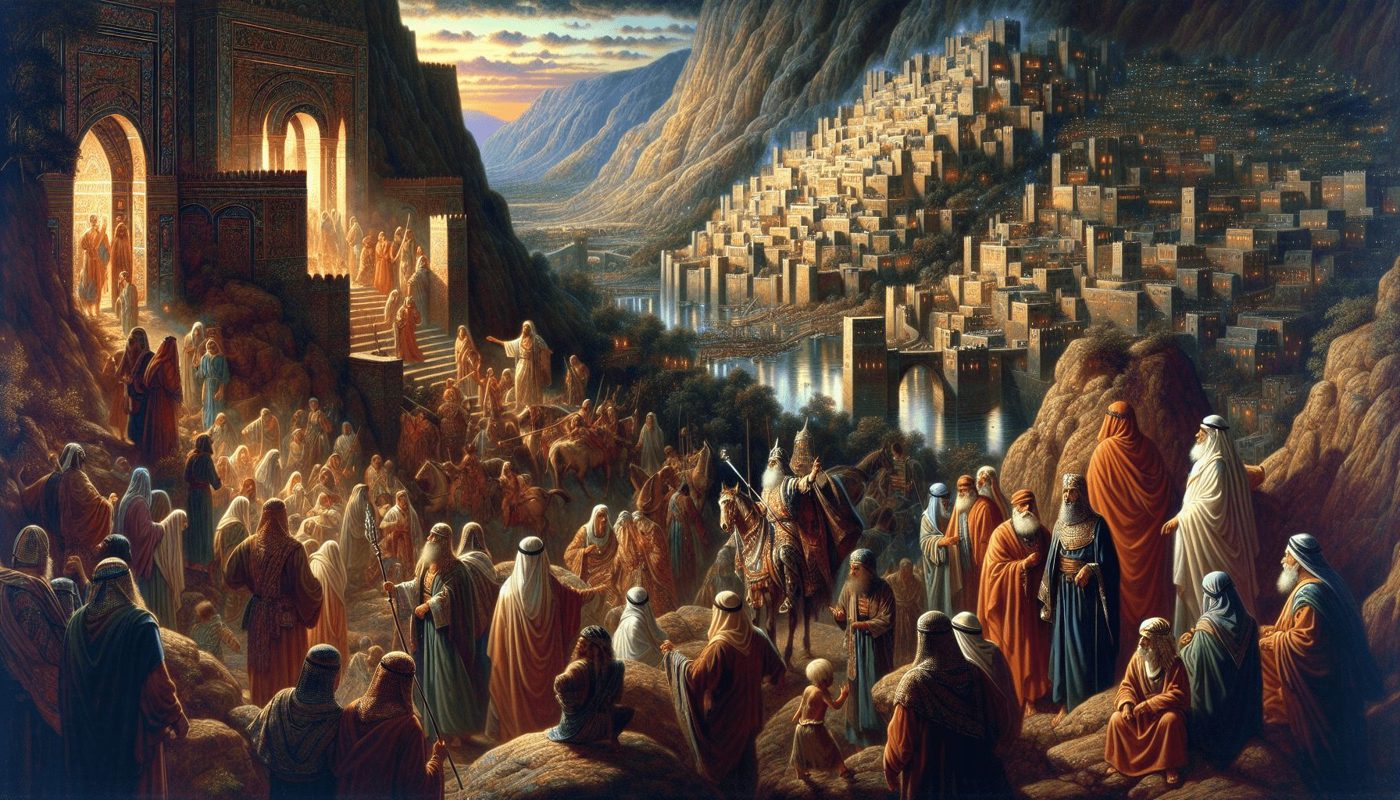
The Valley of Vision was no ordinary place. It was Jerusalem itself, nestled among the hills, a city set on a hill that could not be hidden. It was called the Valley of Vision because it was there that the Lord had revealed Himself to His people through His prophets. But now, the vision had grown dim, and the people had turned their eyes away from the Lord.
The Lord spoke through Isaiah, saying, "What troubles you now, that you have gone up to the housetops, you who are full of commotion, you tumultuous city? In your streets, the slain are not slain with the sword, nor are they dead in battle. Your rulers have fled together; they are captured without the bow. All who are found are taken captive, though they have fled far away."
The people of Jerusalem had seen the armies of Assyria encamped around their city. They had heard the taunts of the enemy, who boasted of their power and mocked the God of Israel. But instead of turning to the Lord in repentance and prayer, the people had busied themselves with preparations for war. They had fortified the walls, stored up water in the cisterns, and gathered weapons. They had even torn down houses to strengthen the defenses of the city.
But the Lord saw their hearts, and He knew that their trust was not in Him. He said to Isaiah, "In that day, the Lord God of hosts called for weeping and mourning, for baldness and wearing sackcloth. But instead, there was joy and gladness, killing oxen and slaughtering sheep, eating meat and drinking wine, saying, 'Let us eat and drink, for tomorrow we die.'"
The people had given themselves over to revelry, as if they had already won the victory. They had forgotten the Lord, who had delivered them from the hands of their enemies in times past. They had forgotten the covenant He had made with their fathers, Abraham, Isaac, and Jacob. They had forgotten the law of Moses, which commanded them to love the Lord with all their heart, soul, and strength.
The Lord continued, "Surely this iniquity will not be forgiven you until you die," says the Lord God of hosts. For the people had hardened their hearts, and their pride had become a stumbling block to their repentance. They had trusted in their own strength, and in the strength of their allies, rather than in the Lord.
The Lord then turned His attention to Shebna, the steward of the king's household. Shebna was a man of great influence and authority, but he had used his position for his own gain. He had built for himself a grand tomb, hewn out of the rock, as if to ensure that his name would be remembered for generations to come. But the Lord saw his pride and his greed, and He declared through Isaiah, "Behold, the Lord will hurl you away violently, O you mighty man. He will surely seize you and whirl you around and around, and throw you like a ball into a wide land. There you shall die, and there your glorious chariots shall be the shame of your master's house."
The Lord would remove Shebna from his position and give his authority to another, a man named Eliakim, the son of Hilkiah. The Lord said of Eliakim, "I will clothe him with your robe and strengthen him with your belt. I will commit your responsibility into his hand. He shall be a father to the inhabitants of Jerusalem and to the house of Judah. The key of the house of David I will lay on his shoulder; so he shall open, and no one shall shut; and he shall shut, and no one shall open."
Eliakim would be a faithful steward, a man who would honor the Lord and serve the people with integrity. He would be like a peg firmly fastened in a secure place, a reliable support for the house of David. But even Eliakim would not be able to save Jerusalem from the consequences of its sin. The Lord said, "In that day, the peg that is fastened in the secure place will be removed and be cut down and fall, and the burden that was on it will be cut off; for the Lord has spoken."
The people of Jerusalem had placed their trust in men, in their own strength, and in their alliances with foreign powers. But the Lord had declared that their trust was misplaced. Only He could deliver them, but they had turned away from Him. The burden of the Valley of Vision was heavy, for the Lord had seen the pride and rebellion of His people, and He would not overlook it.
Isaiah's heart was heavy as he delivered this message to the people. He longed for them to repent, to turn back to the Lord with all their hearts. But he knew that many would not listen. They would continue in their pride and their self-reliance, until the day of judgment came upon them.
And so, the word of the Lord through Isaiah stood as a warning and a call to repentance. The Valley of Vision, once a place of divine revelation, had become a place of spiritual blindness. The people had forgotten the Lord, but He had not forgotten them. He would discipline them, not out of anger, but out of love, that they might return to Him and live.
But for those who refused to repent, the burden of the Valley of Vision would remain, a reminder of their pride and their fall. And the words of the Lord would echo through the ages, a call to all who would hear: "Trust in the Lord with all your heart, and lean not on your own understanding. In all your ways acknowledge Him, and He shall direct your paths." (Proverbs 3:5-6)
Comments
Comments 0
Read the discussion and add your voice.
Members only
Sign in to join the conversation
We keep comments tied to real accounts so the discussion stays clean and trustworthy.
No comments yet. Be the first to add one.