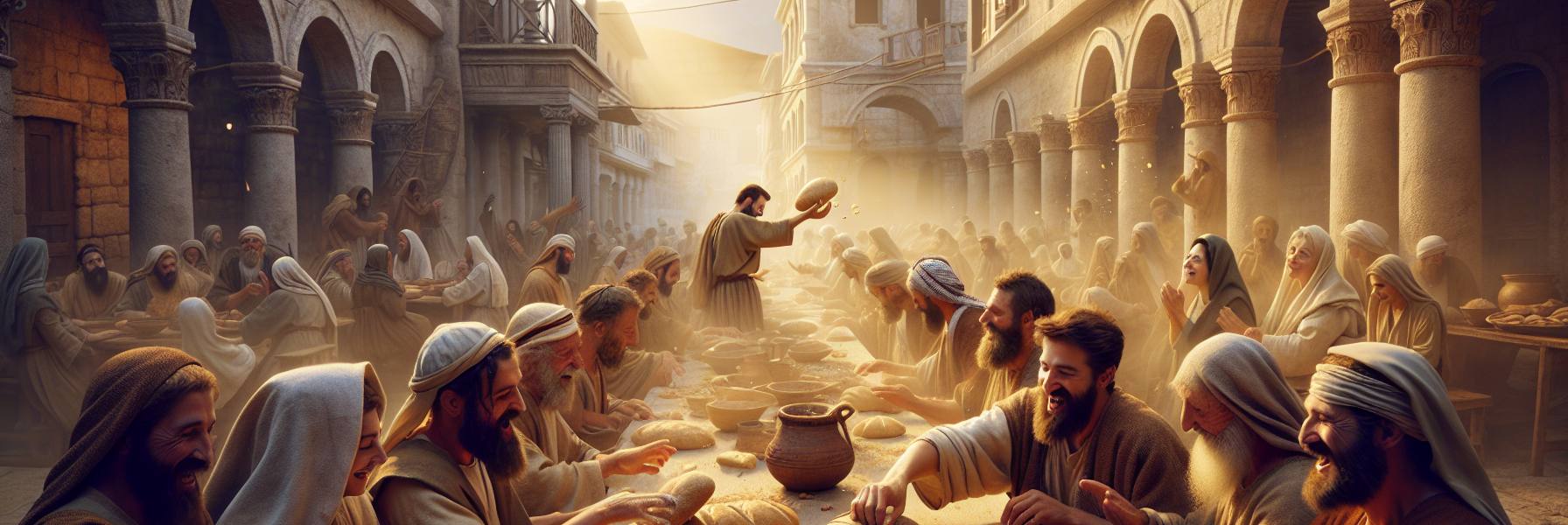

The dust of Antioch hung thick in the air, a fine golden haze that settled on cloaks and in the creases of a man’s hands. It was the dust of a thousand comings and goings, a city where worlds collided. And in the heart of it, we shared a table.
I remember the weight of those days. A letter had come from James in Jerusalem, carried by men whose faces were etched with the stern certainty of tradition. Their arrival was like a shift in the wind, a subtle chill that precedes a storm. Before they came, it had been simple. We ate together—those of us born Jews, and the Gentiles who had turned to the Messiah. We broke bread in the name of the one who had broken down every wall. Peter himself had sat with us, his fisherman’s hands tearing a loaf, laughing with a Greek merchant about the price of olives. The grace of God was a tangible thing in that room, a warmth that made all men brothers.
But when those men from James arrived, I saw a change come over Peter. It was a slow, creeping thing, like a shadow lengthening. At first, it was just a hesitation. He no longer sat quite so readily at the table where the Gentiles gathered. He would linger near the door, his eyes darting, his conversation growing clipped. Then, he withdrew completely. He separated himself. The word itself is a wound—*aphōrizēn*—to mark off a boundary, to build a wall with the quiet, brutal efficiency of a man saving his own skin.
Others followed his lead. Even Barnabas, that good man, my own companion in travel and tribulation, was swept away by their hypocrisy. I watched him, my heart a cold stone in my chest. He who had wept with joy at the faith of the Gentiles in Pisidian Antioch now would not meet their eyes. He turned his back, slowly, painfully, and walked to the other side of the room to stand with Peter and the men from Jerusalem.
It was not a loud betrayal. There were no shouts, no denunciations. It was a silence that screamed. It was the empty space on a bench where a friend used to sit. It was the message, clearer than any edict, that some were clean and some were not, that the old divisions still held power, that the cross was not, after all, enough.
I could not let it stand. To let it pass in silence would be to trample the truth of the gospel itself. So I confronted him, there, in front of everyone. The room was so quiet I could hear the sputter of the oil lamp.
“Cephas,” I said, using the name the Lord Himself had given him, anchoring my challenge in that sacred moment. “If you, though a Jew, live like a Gentile and not like a Jew, how can you force the Gentiles to live like Jews?”
The question hung in the air. He did not look at me. His gaze was fixed on the floor, on the patterns in the stone. I saw the muscle in his jaw tighten. He had no answer because there was none. His actions were a denial of the very freedom he had once celebrated.
And so I spoke, my voice low but carrying to every corner of that tense, still room. I spoke not to destroy a brother, but to defend a truth that was greater than any of us.
“We ourselves, who are Jews by birth and not ‘Gentile sinners,’ know that a person is not justified by the works of the law, but through faith in Jesus Christ. So we also have believed in Christ Jesus, in order to be justified by faith in Christ and not by the works of the law, because by the works of the law no one will be justified.”
I looked around at them all—at Peter’s downcast face, at Barnabas’s pained expression, at the smug certainty of the men from James, at the confused and wounded Gentiles.
“But if, in our own quest for justification, we ourselves are found to be sinners, is Christ then a servant of sin? Absolutely not! For if I rebuild what I destroyed, I prove myself to be a transgressor.”
I was speaking of the entire edifice of the law as a means of salvation—a wall I had helped to tear down. To rebuild it now would be the greatest transgression of all.
“For through the law I died to the law,” I continued, the words feeling like a confession dredged from the depths of my own soul. “I died, so that I might live to God. I have been crucified with Christ. It is no longer I who live, but Christ who lives in me. And the life I now live in the flesh I live by faith in the Son of God, who loved me and gave himself for me.”
I paused, letting the staggering truth of that union settle. It was not about my performance, my pedigree, my purity. It was about His life, His death, His resurrection life now pulsing through my mortal frame.
“I do not nullify the grace of God,” I said, my voice hardening again, “for if justification were through the law, then Christ died for no purpose.”
The finality of that statement seemed to suck the air from the room. If their path was right, then the cross was a cosmic blunder, a tragedy of infinite proportions. The silence that followed was different now. It was not the silence of hypocrisy, but the silence of a terrible, beautiful, and costly truth being faced at last.
No one spoke. Peter finally lifted his head, and in his eyes, I saw not anger, but a dawning, grievous understanding. The wall, for a moment, had been shown for the illusion it was. The dust of Antioch still swirled in the sunbeams, but in that quiet, something eternal had been defended.