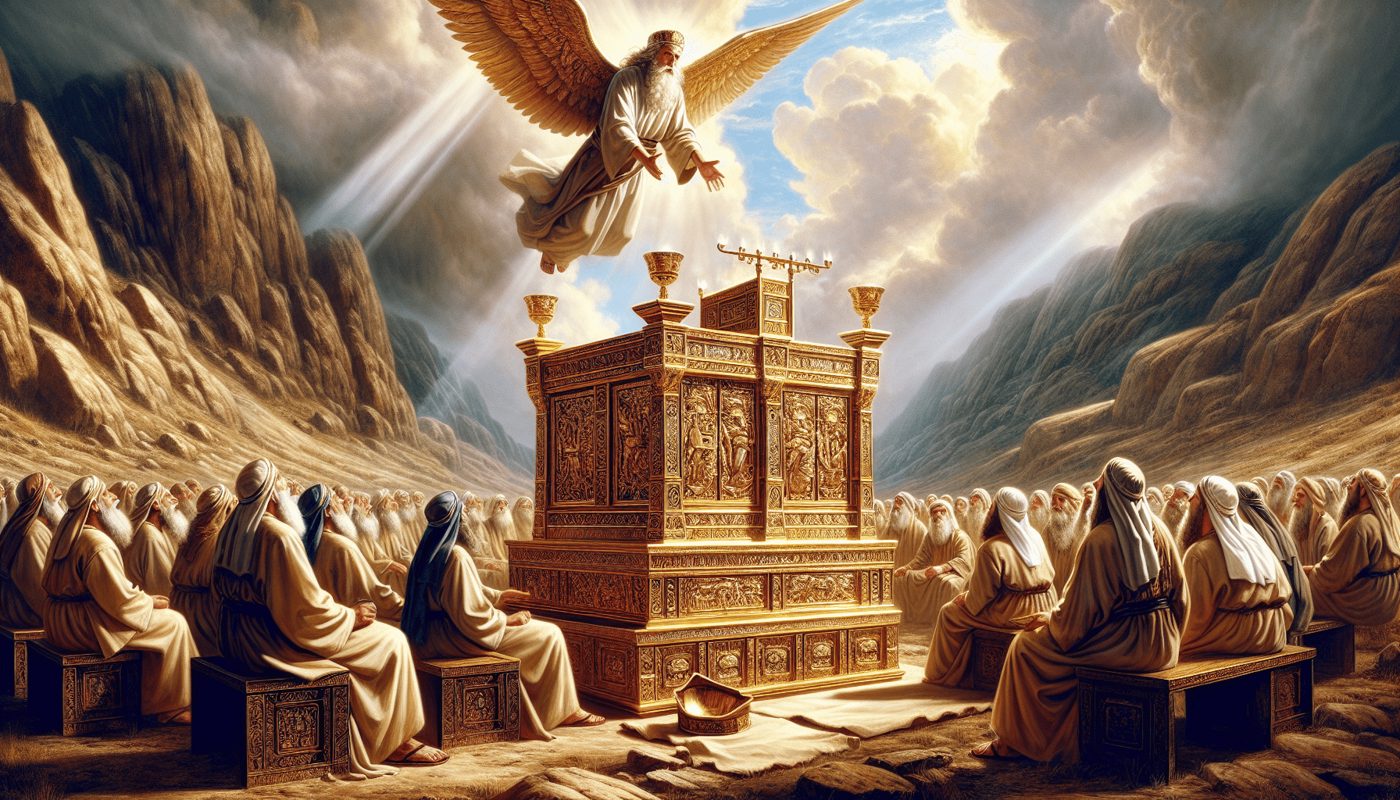
The Lord spoke to Moses on Sinai with a sequence of commands that moved from the golden altar of incense to a census ransom, a bronze laver, and the compounding of holy anointing oil and incense. Each instruction carried its own weight, and none was left to human judgment. The altar of incense came first: an acacia-wood frame, a cubit square and two cubits high, with horns rising from the same piece, overlaid entirely in pure gold. A gold crown ran around it, and two gold rings were fastened under that crown on opposite sides to hold carrying poles of acacia wood sheathed in gold.
The Lord placed this altar in front of the veil that screened the ark of the testimony, before the mercy seat where the Lord said he would meet with Moses. There Aaron was to burn sweet incense every morning when he trimmed the lamps and every evening when he lit them. That incense was to burn perpetually before the Lord throughout the generations. No strange incense, no burnt offering, no grain offering, no drink offering was permitted on it. Only once a year, on the Day of Atonement, Aaron was to apply the blood of the sin offering to its horns, purifying it as most holy to the Lord.
Then the Lord turned to the matter of the census. When Moses numbered the people of Israel, every man twenty years old and upward was to give a ransom for his life: half a shekel, weighed by the sanctuary shekel of twenty gerahs. The rich were not to give more, the poor were not to give less. That ransom money was to be used for the service of the tent of meeting, a memorial before the Lord to make atonement for their souls. The equality of the payment underlined that no one’s standing before the Lord depended on wealth.
The Lord also commanded a laver of bronze with a bronze base, to be placed between the tent of meeting and the altar, filled with water. There Aaron and his sons were to wash their hands and feet whenever they entered the tent or approached the altar to minister. The penalty for neglecting this was death. It was a perpetual statute for Aaron and his descendants.
Next the Lord instructed Moses to take the chief spices: five hundred shekels of flowing myrrh, half that amount of sweet cinnamon and sweet calamus, five hundred of cassia, and a hin of olive oil. These were to be compounded into a holy anointing oil, a perfume blended by a skilled perfumer. With this oil Moses was to anoint the tent of meeting, the ark of the testimony, the table and all its vessels, the lampstand and its vessels, the altar of incense, the altar of burnt offering and its vessels, and the laver and its base. Everything so anointed would become most holy, and whatever touched them would become holy. Moses was also to anoint Aaron and his sons to sanctify them for the priesthood.
The Lord gave strict restrictions for this oil. It was not to be poured on ordinary flesh, and no one was to make any like it for common use. Anyone who compounded a similar mixture or put it on an outsider would be cut off from his people.
Finally the Lord commanded a second mixture: sweet spices—stacte, onycha, galbanum, and pure frankincense, each in equal weight—compounded into incense, seasoned with salt, pure and holy. Moses was to beat some of it very fine and place it before the testimony in the tent of meeting, where the Lord would meet with him. This incense was most holy. No one was to make any like it for themselves. Whoever made it for his own enjoyment would be cut off from his people.
The chapter moves from the golden altar’s perpetual incense to the census ransom’s equal payment, from the laver’s washing under penalty of death to the anointing oil and incense that could not be duplicated. Each element was bound to the holiness of the Lord’s presence and to the survival of the people who served him. The instructions allowed no improvisation, no substitution, no private use of what belonged only to the Lord.
Comments
Comments 0
Read the discussion and add your voice.
Members only
Sign in to join the conversation
We keep comments tied to real accounts so the discussion stays clean and trustworthy.
No comments yet. Be the first to add one.