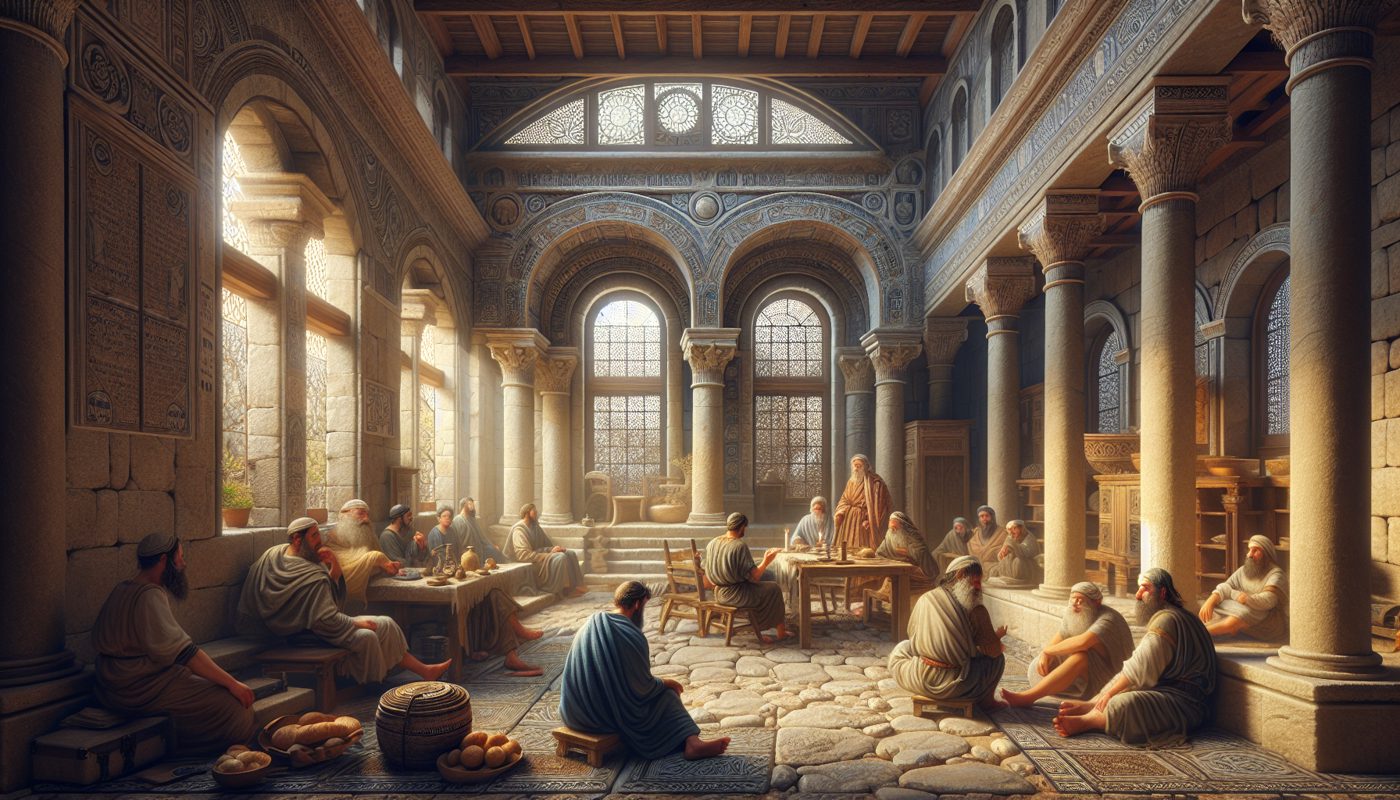
Paul’s account in this chapter is not a quiet theological lecture. It is a record of a direct, public confrontation. The pressure point is not an abstract doctrine but a table where men were eating—and then stopped. The issue was not what they believed about Christ but what they did when certain visitors arrived from James.
Fourteen years after his first visit to Jerusalem, Paul went up again with Barnabas, taking Titus, a Greek believer, as a living test case. He laid his gospel before the recognized leaders privately, not to seek their approval but to ensure that his labor among the Gentiles was not somehow misaligned. The result was clear: Titus, though a Greek, was not compelled to be circumcised. The gospel Paul preached stood on its own ground.
But the pressure came from another direction. False brothers had slipped in, Paul writes, to spy out the liberty believers had in Christ Jesus, aiming to bring them back into bondage. Paul did not yield to them for a single hour. He held that the truth of the gospel must remain intact for the sake of those who would hear it later.
The recognized leaders—James, Cephas, and John, those reputed as pillars—saw the grace given to Paul and extended the right hand of fellowship. Their agreement was practical: Paul and Barnabas would go to the Gentiles; they would go to the circumcised. The only request was that the poor be remembered, a thing Paul was already eager to do.
Then the scene shifts to Antioch. Cephas, also called Peter, had been eating freely with Gentile believers. He shared their tables, their bread, their community. But when certain men came from James, Peter drew back. He separated himself. He feared the party of the circumcision. And his withdrawal was not a private lapse—it was public, and it pulled others with it. The rest of the Jewish believers dissembled alongside him, and even Barnabas was carried away by their hypocrisy.
Paul saw what was happening. He did not write a letter about it later. He confronted Cephas face to face, before the whole assembly. His question cut to the heart of the contradiction: “If you, a Jew, live like a Gentile and not like a Jew, how can you compel the Gentiles to live like Jews?”
The issue was not about food laws themselves. It was about what the table revealed. By withdrawing, Peter was acting as though Gentile believers needed to adopt Jewish customs to be fully accepted. That was not the truth of the gospel. Paul’s confrontation was not personal anger; it was a defense of the ground on which both Jews and Gentiles stood before God.
Paul then lays out the logic that drove his stand. He and Peter were Jews by birth, not Gentile sinners. Yet they knew that no one is justified by works of the law but through faith in Jesus Christ. Even they had believed in Christ for justification, because no flesh will be justified by the works of the law. To rebuild the wall of the law after it had been torn down would make them transgressors—not of the law, but of the gospel.
Paul’s own life was now defined by a death. He had been crucified with Christ. It was no longer he who lived, but Christ living in him. The life he now lived in the flesh he lived by faith in the Son of God, who loved him and gave himself for him. This was not a mystical aside. It was the ground on which he refused to let anyone impose dietary separation as a condition of fellowship.
He ends the chapter with a sharp alternative: if righteousness could come through the law, then Christ died for nothing. The grace of God is not something to be supplemented. Either Christ’s death accomplished what the law could not, or it was wasted. Paul’s confrontation at Antioch was not about a meal. It was about whether the cross was enough.
Comments
Comments 0
Read the discussion and add your voice.
Members only
Sign in to join the conversation
We keep comments tied to real accounts so the discussion stays clean and trustworthy.
No comments yet. Be the first to add one.