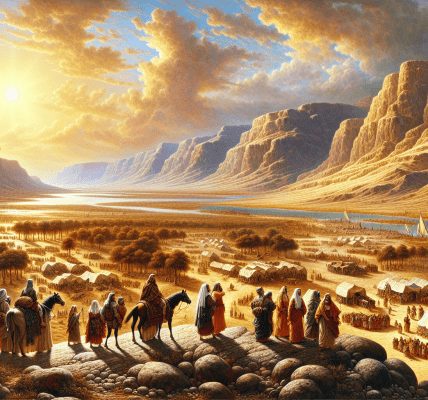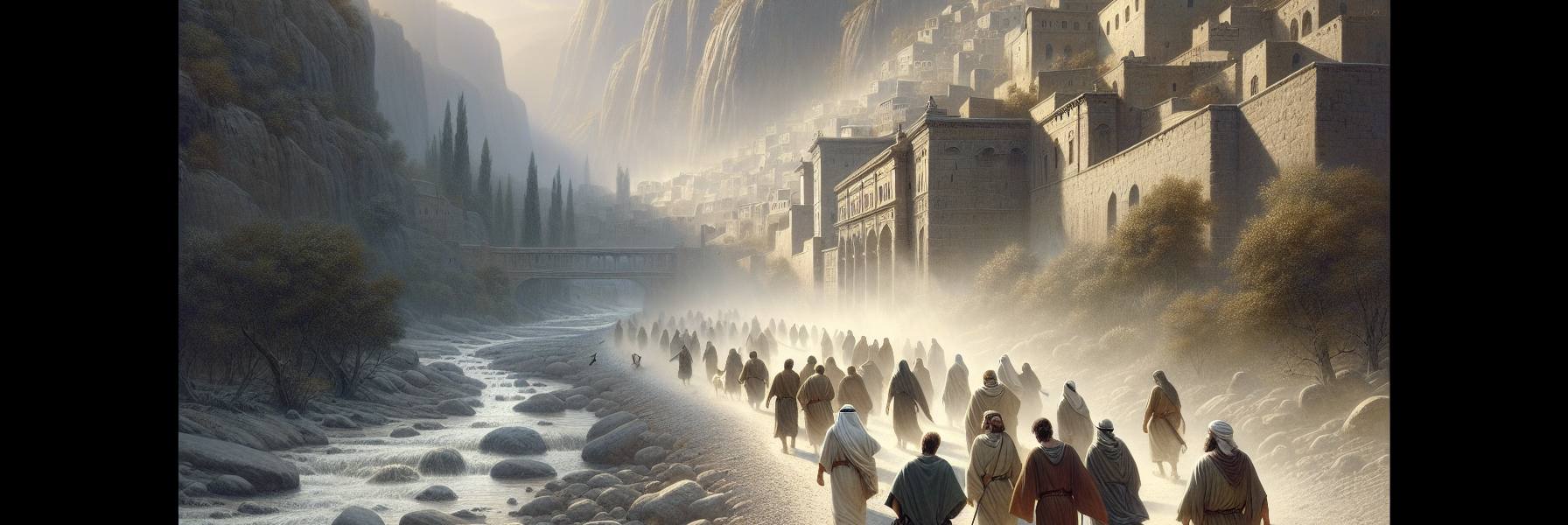

The road north had been long, and the dust of it clung to everything—to their sandals, to the hems of their cloaks, to the back of the throat. It wasn’t the dust of Judea, dry and golden, but a grey, gritty powder that seemed to rise from the very stones of this place. Caesarea Philippi. The name itself felt foreign on the tongue. They’d left the familiar, sun-bleached villages behind, climbing into a landscape of rushing water and sudden, cold shadows cast by the looming face of a cliff.
Jesus walked ahead, as he often did, his pace steady but unhurried. The usual chatter of the twelve had settled into a weary quiet, broken only by the crunch of gravel and the distant, perpetual roar of the springs that burst from the rock below the city. The air was different here. It smelled of damp stone and pine, and carried a chill that the Galilean sun never knew.
He stopped suddenly, turning to face them. The city, a glittering patchwork of marble and pagan temples dedicated to Pan and Caesar, was a smudge of white against the dark rock to their left. But Jesus wasn’t looking at the city. He was looking at them, his eyes moving from face to tired face. The question, when it came, was simple, yet it seemed to suck the very sound from the air around them.
“Who do people say that the Son of Man is?”
They glanced at one another, relieved at first for a question with ready answers. It was the talk of the marketplaces, the whispers in synagogues.
“Some say John the Baptist come back,” said Andrew, wiping his brow. “Though they can’t explain how.”
“Others are convinced you’re Elijah,” James added. “The prophet returned before the great day.”
“Or Jeremiah,” said Philip. “Or one of the old prophets, risen.”
Jesus listened, nodding slightly, his expression unreadable. The reports were nothing new. But then his gaze sharpened, focusing like a lens. It settled on Simon. Simon, who was shifting his weight from foot to foot, his broad fisherman’s hands opening and closing at his sides.
“But what about you?” Jesus asked, his voice lower now, intimate against the backdrop of the pagan waterfalls. “Who do you say that I am?”
There was a pause. A bird cried somewhere high above the cliff face. Simon felt the eyes of the others on him. He wasn’t the quickest thinker; he operated in surges of feeling, in deep, gut-level certainties that arrived whole and left him stumbling for the words to explain them. All the miles, all the words, all the impossible signs—the quieted storm, the multiplied loaves, the look in his eyes when he spoke of the Kingdom—it all coalesced in Simon in that moment into a solid, unshakable thing.
He stepped forward, the dust puffing around his feet. “You,” he said, the word rough and sure. “You are the Messiah. The Son of the living God.”
It wasn’t a shout. It was a declaration, heavy as a stone, dropped into the still pool of the afternoon.
Jesus’s face changed. A kind of fierce, joyful light broke across it, weary as he was. He reached out and gripped Simon by the shoulders. “Blessed are you, Simon son of Jonah! Flesh and blood didn’t reveal this to you. No man taught you this. It came from my Father who is in heaven.”
He held Simon’s gaze, and the fisherman felt a strange, trembling awe. “And I tell you, you are Peter.” *Petros*. A rock. “And on this rock I will build my church. And the gates of Hades will not overpower it.”
The words were staggering, immense. They spoke of foundations, of assemblies, of a force that death itself could not withstand. Peter—for that was his name now—felt the weight of it settle on him, a terrifying honor. Jesus spoke of keys, of binding and loosing. The others murmured, amazed, looking at their impulsive friend with new eyes. For a moment, standing there in the pagan shadow, they felt the future, God’s future, thrumming with impossible promise.
Then Jesus turned. The light in his eyes didn’t fade, but it deepened, sombered. He began to walk again, back toward the southern road, and they fell in beside him, the elation of the moment still buzzing in their veins.
He started to teach them, plainly now, without the veils of parable he used for the crowds. “The Son of Man must go to Jerusalem,” he said, and his voice had a dreadful rhythm to it. “He must suffer many things at the hands of the elders, the chief priests, and the teachers of the law. He must be killed.”
Peter, walking just beside him, stiffened. The glorious future of a church, of keys to a kingdom, shattered against these blunt, ugly words.
“And on the third day,” Jesus finished, “he will be raised to life.”
But Peter didn’t hear the last part. The word “killed” was echoing in his skull. This was wrong. A blasphemy against the moment they’d just shared. The Messiah didn’t suffer. The Messiah conquered. The Messiah threw off Romans, not submitted to priests. This was the talk of a defeated man, not the Son of the living God.
He acted before he thought—that was his nature. He grabbed Jesus by the arm, pulling him aside from the others, his voice a harsh, urgent whisper. “Never, Lord! This will never happen to you!”
Jesus stopped. He looked at Peter’s hand on his arm, then into his eyes. And the look there was not gratitude, not the warmth of a moment ago. It was something colder, sharper, more devastating than the cliff-face shadow.
“Get behind me, Satan.”
The word was a slap. It sucked the air from Peter’s lungs.
“You are a stumbling block to me.” Jesus’s voice was flat, carrying to the others who had frozen, watching in horror. “You are not setting your mind on the concerns of God, but on the concerns of men.”
Then Jesus turned to include them all, his voice rising, not in anger, but in a proclamation that cut to the very bone of what it meant to follow him. “If anyone wants to follow me, he must deny himself, take up his cross, and follow me. For whoever wants to save his life will lose it, and whoever loses his life for my sake will find it.”
Peter stood rooted, the two titles—Rock and Satan—clanging inside him like discordant bells. The road stretched out before them, no longer just a path back to Galilee, but a road that led, inexorably, to a hill outside Jerusalem. The keys to the kingdom felt cold in his imagination. The rock he was supposed to be felt like shifting sand. He understood nothing, and yet, in the raw, wounded silence of his spirit, he knew he would follow. Even into that darkness. Especially into that darkness. Because the words “living God” still hung in the air, and the man who had spoken them was already walking on, leaving him to wrestle with the terrifying, glorious contradiction of it all.