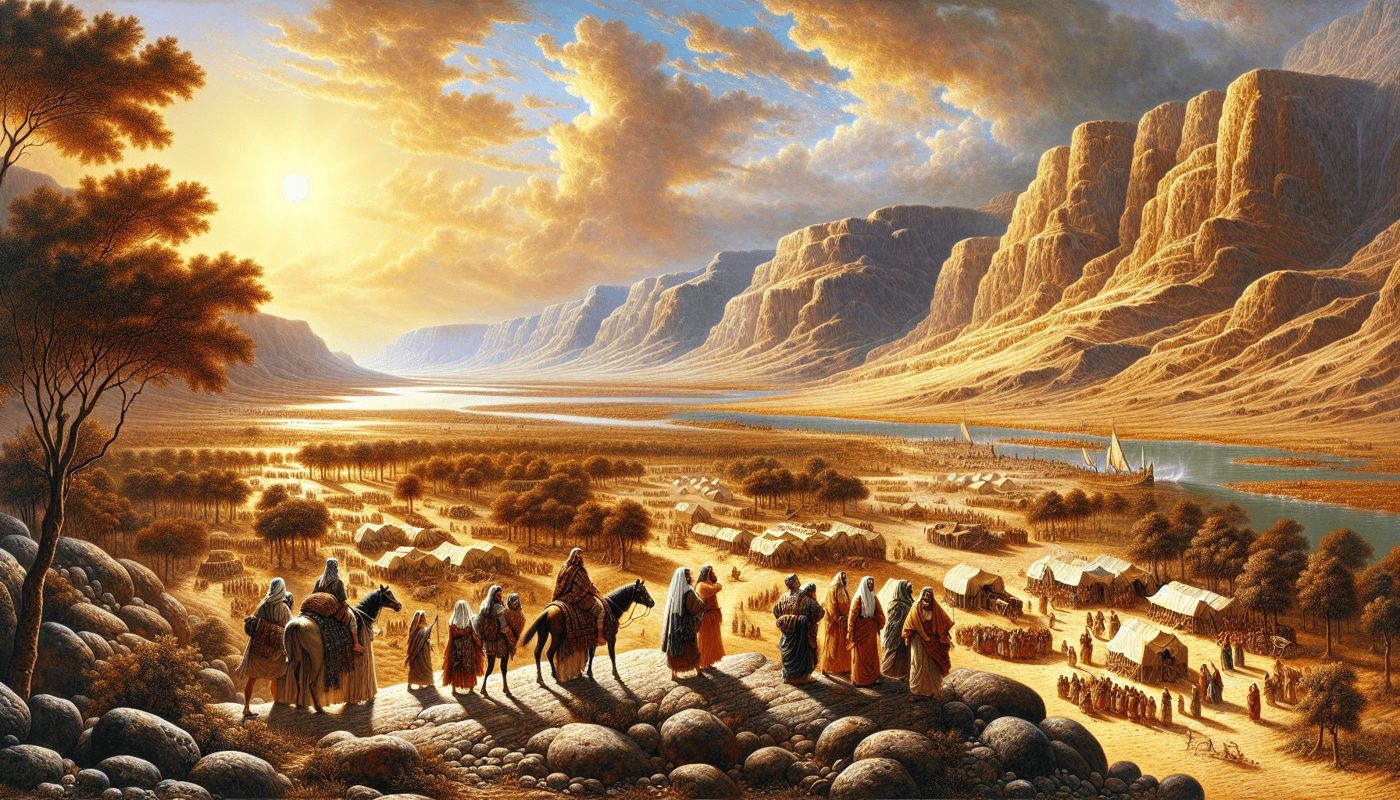
The chapter opens with five women—Mahlah, Noah, Hoglah, Milcah, and Tirzah—standing before Moses, Eleazar the priest, the princes, and the whole assembly at the door of the tent of meeting. They are the daughters of Zelophehad, a man of the tribe of Manasseh who died in the wilderness. They state plainly that their father was not among those who gathered against the Lord in the company of Korah; he died in his own sin, leaving no sons.
The women do not ask for mercy or special favor. They raise a legal question: Why should their father’s name be removed from his family simply because he had no son? They demand a possession among their father’s brothers. The force of their argument rests on the name—the inheritance is not merely land but the continuation of a family line within the promised territory.
Moses does not decide on his own authority. He brings their cause before the Lord. This is the crucial move: the lawgiver himself submits the case to the one who gave the land. The Lord answers directly, affirming that the daughters of Zelophehad speak rightly. He commands Moses to give them a possession of an inheritance among their father’s brothers and to transfer their father’s inheritance to them.
The Lord then establishes a statute for all Israel. If a man dies without a son, his inheritance passes to his daughter. If he has no daughter, it goes to his brothers. If no brothers, to his father’s brothers. If no uncles, to the nearest kinsman in his family. The law is precise, layered, and permanent—it becomes a statute and ordinance as the Lord commanded Moses.
Immediately after settling the inheritance law, the Lord turns to Moses himself. He tells Moses to go up into the mountain of Abarim and look at the land given to Israel. Moses will see it, but he will not enter. He will be gathered to his people as Aaron was, because both of them rebelled against the Lord’s word at the waters of Meribah in the wilderness of Zin.
Moses does not argue. He does not plead for entry. Instead, he speaks to the Lord about the congregation. He asks the Lord, the God of the spirits of all flesh, to appoint a man over the assembly—someone who will go out before them and come in before them, who will lead them out and bring them in, so that the congregation will not be like sheep without a shepherd.
The Lord responds by naming Joshua son of Nun, a man in whom is the Spirit. Moses is to take Joshua, lay his hand on him, set him before Eleazar the priest and the whole congregation, and give him a charge in their sight. Moses is to put some of his own honor on Joshua so that all Israel will obey him.
The Lord specifies how Joshua will lead. He will stand before Eleazar the priest, who will inquire for him by the judgment of the Urim before the Lord. At Joshua’s word the people will go out, and at his word they will come in—both Joshua and all Israel with him. The leadership is not autonomous but mediated through the priest and the sacred lot.
Moses does exactly as the Lord commands. He takes Joshua, sets him before Eleazar and the congregation, lays his hands on him, and gives him a charge, just as the Lord spoke through Moses. The transition is orderly, public, and rooted in divine instruction.
The chapter binds two distinct matters together: the inheritance rights of daughters and the succession of leadership. Both are resolved by the Lord’s direct word. The daughters of Zelophehad secure a legal precedent; Joshua is installed as Moses’ successor. Neither change comes from human initiative alone—both are brought before the Lord and answered with statute and command.
Comments
Comments 0
Read the discussion and add your voice.
Members only
Sign in to join the conversation
We keep comments tied to real accounts so the discussion stays clean and trustworthy.
No comments yet. Be the first to add one.