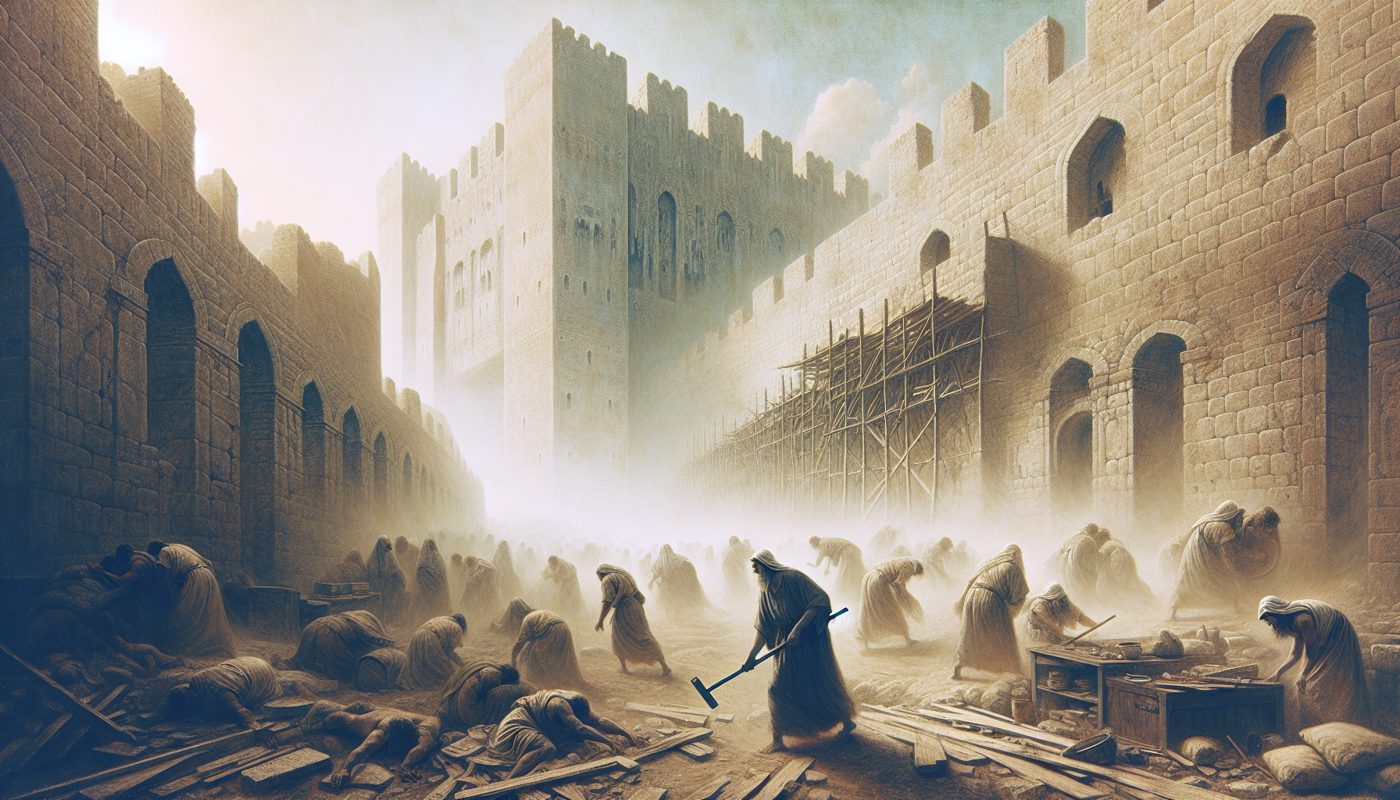
The vision begins with a man holding a measuring line. Zechariah sees him clearly—a figure with a weathered cord, the kind builders use to mark foundations and fix boundaries. When Zechariah asks where he is going, the man answers directly: to measure Jerusalem, to determine its breadth and length. It is a practical errand, the kind that makes sense after exile. A city in ruins needs a plan. Someone must draw the lines before the stones can be laid.
But the measuring line does not get far. Before the man can stretch it across the rubble, another figure intercepts the angel who is speaking with Zechariah. This second angel delivers a command that upends the entire project. The young man with the measuring line is to be stopped mid-stride. The message is urgent: run, speak to him, tell him that Jerusalem will not be measured by human hands.
The reason given is startling. Jerusalem will be inhabited like unwalled villages—open, sprawling, without defensive perimeters. The city will overflow with people and livestock, too many to contain within any measured boundary. The measuring line, which seemed so sensible a moment before, is suddenly exposed as inadequate. The city of God cannot be mapped by a builder's cord.
The Lord himself explains why no wall is needed. He will be a wall of fire around Jerusalem, and he will be the glory in her midst. The image is precise: fire that consumes attackers but does not burn the inhabitants. A wall that cannot be breached because it is not stone but presence. The glory in the midst is not a future promise but a present reality—the Lord dwelling where the temple once stood, filling the space that no wall can enclose.
Then the tone shifts. A cry goes out to those still in exile. The Lord calls them to flee from the land of the north, from Babylon, because he has scattered them like the four winds of heaven. The command is repeated with urgency: escape, you who dwell with the daughter of Babylon. The call is not to rebuild walls but to come home to a city that no longer needs them.
The Lord of hosts speaks through the prophet with a strange claim. He has been sent to the nations that plundered Israel, and the reason is personal. Those who touch Israel touch the apple of his eye—the pupil, the most vulnerable and guarded part of a person. The nations that thought they were attacking a broken people were actually striking the face of God. He will shake his hand over them, and they will become spoil for those they once enslaved.
The result of this judgment is not destruction for its own sake. It is recognition. The nations will know that the Lord of hosts has sent the prophet. And then the call to sing and rejoice goes out to the daughter of Zion. The Lord is coming to dwell in her midst. Not after the walls are finished. Not after the measuring is complete. Now.
The promise widens. Many nations will join themselves to the Lord in that day and become his people. The God of Israel will not remain the God of a single territory. He will dwell in the midst of his people, and they will know that he has been sent. The holy land, the portion of Judah, the chosen city—these are not abandoned but claimed again. The Lord will inherit Judah as his portion.
The chapter ends with a command to silence. All flesh is to be still before the Lord, because he has roused himself from his holy dwelling. The God who seemed distant during the years of exile is now awake and moving. The measuring line is abandoned. The wall of fire is already burning. The city is not yet rebuilt, but the glory has already returned.
Comments
Comments 0
Read the discussion and add your voice.
Members only
Sign in to join the conversation
We keep comments tied to real accounts so the discussion stays clean and trustworthy.
No comments yet. Be the first to add one.