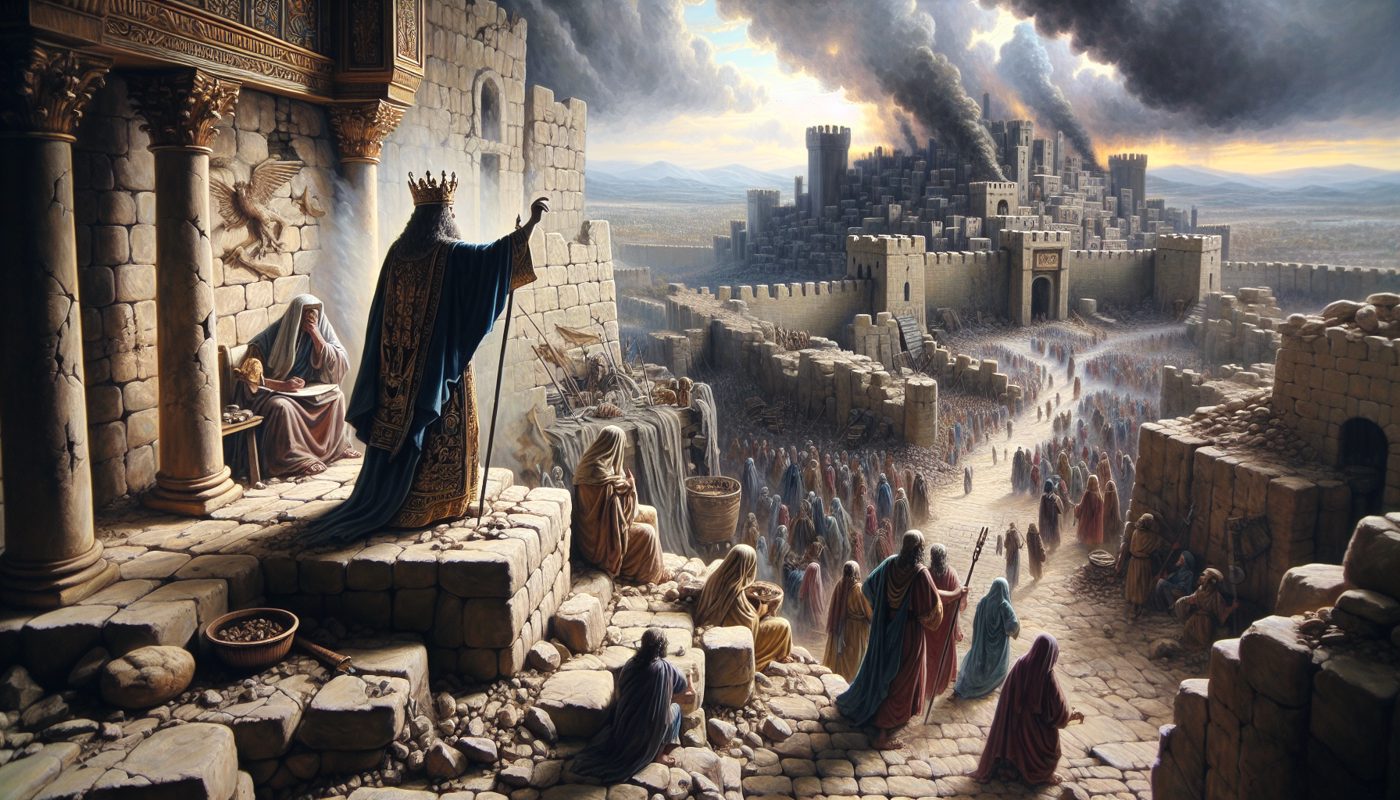
The ninth year of Zedekiah's reign, the tenth month, the tenth day. That is when Nebuchadnezzar's army arrived and began building siege forts around Jerusalem. For eighteen months, the city was locked in a tightening grip, and by the eleventh year, the famine had done what no battering ram could fully accomplish: bread vanished from the city, and the people of the land had nothing to eat.
On the ninth day of the fourth month, a breach was made in the wall. That night, under cover of darkness, Zedekiah and all the men of war fled through the gate between the two walls, near the king's garden, heading toward the Arabah. The Chaldeans were all around the city, but the king slipped out with his soldiers into the open country.
The escape did not last. The Chaldean army pursued, caught up with him in the plains of Jericho, and scattered his troops. Zedekiah was taken alive, brought to the king of Babylon at Riblah, and there judgment was passed. Before his eyes, his sons were slaughtered. Then his eyes were put out. Bound in bronze fetters, he was carried to Babylon.
One month later, in the fifth month on the seventh day—the nineteenth year of Nebuchadnezzar—Nebuzaradan, the captain of the guard and a servant of the king of Babylon, entered Jerusalem. He burned the house of the Lord, the king's house, and every great house in the city. The walls of Jerusalem were broken down all around by the Chaldean army.
The people who remained in the city, along with those who had already deserted to the king of Babylon and the rest of the multitude, were carried away captive. Only the poorest of the land were left behind, appointed as vinedressers and husbandmen to work the fields.
The bronze pillars of the house of the Lord, the bases, and the bronze sea that Solomon had made were broken into pieces and carried to Babylon. The pots, shovels, snuffers, spoons, and all the bronze vessels used in the ministry were taken. The firepans and basins, whether gold or silver, were removed by the captain of the guard. The bronze from these vessels was beyond weighing—the two pillars, each eighteen cubits high with capitals of three cubits adorned with network and pomegranates, all of bronze, were dismantled and hauled away.
Nebuzaradan also took Seraiah the chief priest, Zephaniah the second priest, and the three keepers of the threshold. From the city, he took an officer set over the men of war, five men who had seen the king's face, the scribe who mustered the people, and sixty men of the land found in the city. All were brought to the king of Babylon at Riblah, where they were struck down and put to death. So Judah was carried away captive out of its land.
Over the remnant left in Judah, Nebuchadnezzar appointed Gedaliah son of Ahikam, son of Shaphan, as governor. When the captains of the forces in the countryside heard this, they came to Gedaliah at Mizpah: Ishmael son of Nethaniah, Johanan son of Kareah, Seraiah son of Tanhumeth the Netophathite, and Jaazaniah son of the Maacathite, along with their men. Gedaliah swore to them, telling them not to fear the Chaldean officials, to dwell in the land and serve the king of Babylon, and it would go well with them.
But in the seventh month, Ishmael son of Nethaniah, son of Elishama, of the royal seed, came with ten men and struck down Gedaliah at Mizpah, killing him along with the Jews and Chaldeans who were with him. After that, all the people, both small and great, and the captains of the forces, rose up and fled to Egypt, terrified of the Chaldeans.
In the thirty-seventh year of the captivity of Jehoiachin king of Judah, in the twelfth month on the twenty-seventh day, Evil-merodach king of Babylon, in the year he began to reign, lifted up the head of Jehoiachin out of prison. He spoke kindly to him and set his throne above the thrones of the other kings with him in Babylon. Jehoiachin changed his prison garments and ate bread before the king continually all the days of his life. A regular allowance was given him by the king, a portion each day, all the days of his life.
Comments
Comments 0
Read the discussion and add your voice.
Members only
Sign in to join the conversation
We keep comments tied to real accounts so the discussion stays clean and trustworthy.
No comments yet. Be the first to add one.