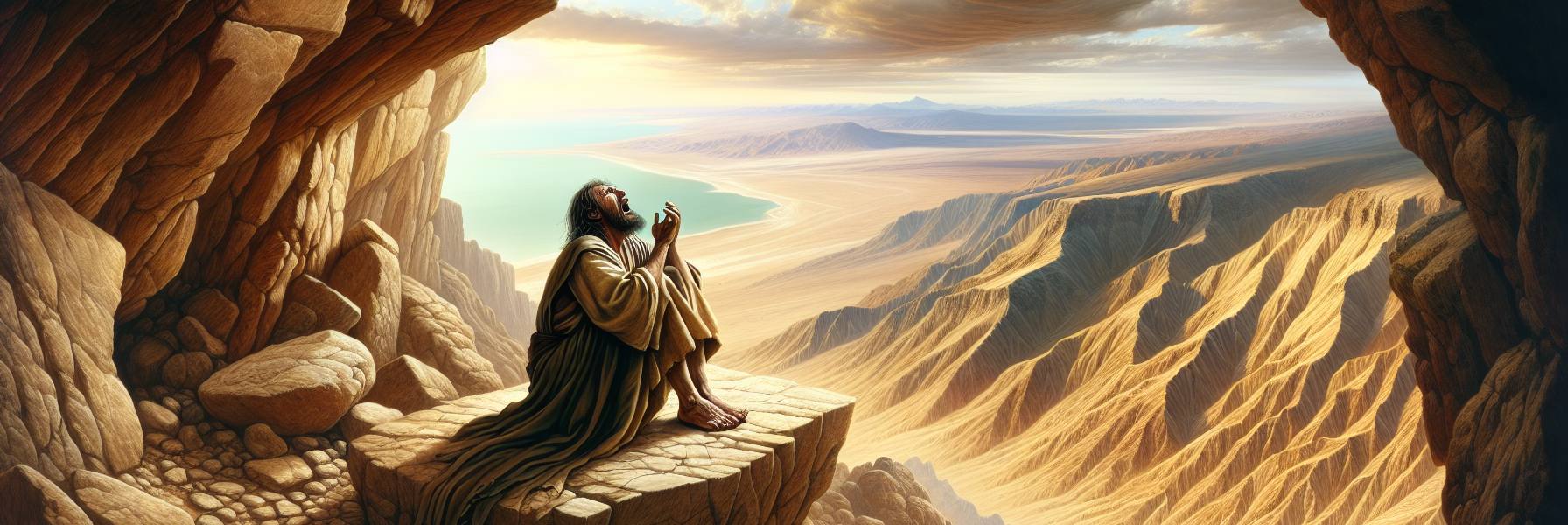

The wind here has a voice. It is not the gentle whisper that stirs the olive leaves in the vale of Rephaim, nor the cool breath that sweeps down from the Lebanon ranges at dusk. This is a dry, scraping wind, a thief of moisture, carrying the fine, pale dust of the wilderness. It whips around the outcrop of grey stone where I sit, pulling at the edge of my cloak. From this height, the land falls away in folds of barren brown and weary green, a rumpled blanket thrown down toward the distant salt-sea. It is a landscape of endings.
My throat is that dust. The cry, when it comes, is less a shout than a fracture, a crack in the parched vessel of my spirit. “Hear my cry, O God.” It is torn from me, not addressed to the empty sky, but downward, into the rock, as if the plea might travel through the bones of the earth to find the foundation of His throne. “Attend unto my prayer.”
I am a long way from the rock that is higher than I. The memory of it is a physical ache—that great, unshakable stone of Zion, where the Tabernacle stands. Not the physical tent of goats’ hair and acacia wood, but the truth of it: the place where mercy dwells, where the smoke of the sacrifice is a sweet scent and not a bitter reminder. Here, there is only exposure. I feel like the lowest twig on a tamarisk, bent and straining, roots clinging to a thin seam of soil. My heart is faint. The journey, the fleeing, the constant listening for the sound of pursuit in the night—it has worn the lining of my soul thin as worn leather.
I close my eyes against the glare. Behind my lids, I do not see the faces of those who hunt me. I see a path. A steep, winding track through scree and thorn, leading upward. Not to this barren prominence, but to a different kind of height. A strong tower. I have built such towers in the south, against the raiders of the desert. They are places of last resort, of final safety. The walls are thick, the door narrow, the view commanding and clear. “Lead me to the rock that is higher than I,” I whisper into the wind, and this time the words are not a fracture, but a request. A placing of my will into a hand not my own. For I cannot find that path myself. My own strength brought me to this desolate height; only His guidance can bring me to the true refuge.
The wind shifts, moaning through a crevice. For a fleeting moment, it carries a scent—not of dust, but of woodsmoke and myrrh, the ghost of a thousand campfires from the congregation of old. A memory of the Tabernacle courtyard, of being not an outcast, but a worshipper. “For you have been a shelter for me,” I say aloud, testing the truth of it. The past tense is not accidental. It feels like history. Yet, speaking it makes it present. His shelter is not a location abandoned, but a reality remembered, and in the remembering, invoked anew. “A strong tower from the enemy.”
And then, the thought unfolds, quiet and sure as the first star in the twilight that now begins to bleed into the eastern sky. It is not merely about *my* safety. The longing expands, pushes past the narrow confines of my own fear. “I will abide in your tabernacle forever.” Not as a visitor, not as a fugitive granted temporary asylum, but as a dweller. A permanent resident in the household of God. The imagery changes—from the stark, defensive strength of a tower to the intimate, covered security of a tent. His tent. “I will trust in the covert of your wings.” Like a fledgling chick, hopelessly vulnerable on its own, tucked under the immense, feather-soft protection of the parent. The might that creates a universe, gentled into a covering.
The final vow rises, not as a bargain, but as a consequence. It is what one does when one has been led to the high rock, when one dwells in the tent, when one rests under those wings. “So will I sing praise unto your name forever.” The ‘so’ is crucial. The praise is not a ticket to entry; it is the breath of the one who has entered. It is the sound of safe abiding. It will not be a solo in the wilderness, but a part of the great chorus of those who have also known this journey from the faint heart to the firm rock. “That I may daily perform my vows.”
The last of the sun catches the far western ridge, a line of molten gold. The wind has settled into a steady, cool stream. My throat is no longer dust. The faintness in my heart is still there, a tiredness deep in the bones, but it is no longer the whole story. It is overlaid by a different reality—a promised guidance, a remembered shelter, an abiding place prepared. The cry that began in the wilderness ends in a quiet certainty that spans eternity. I will wait. For the morning, for the path, for the fulfillment. And the waiting itself, here on this lesser rock, is now a kind of abiding.