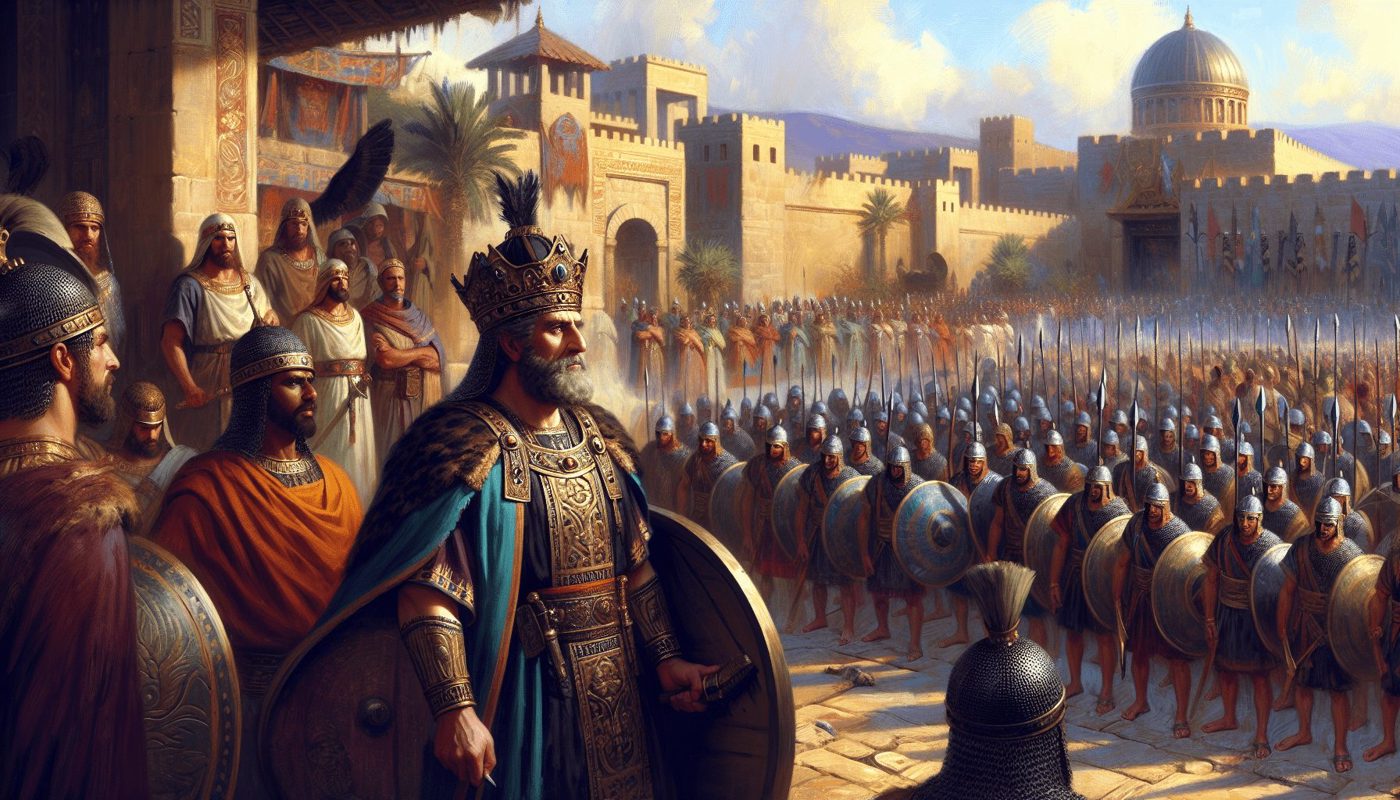
This chapter opens with a detail that matters: it was the time when kings go out to battle, but David stayed in Jerusalem. Joab led the army instead, wasting the Ammonite countryside and besieging the capital, Rabbah. Joab struck the city and overthrew it. The text does not explain why David remained behind. It simply records the fact, and the campaign proceeds under Joab’s command.
After the fall of Rabbah, David came to take the crown of the Ammonite king. The crown weighed a talent of gold—roughly seventy-five pounds—and was set with precious stones. It was placed on David’s head. The spoil from the city was exceedingly abundant. David brought it all out. The text does not say he wore the crown regularly, only that it was set upon his head at that moment, a visible sign that the Ammonite king had been deposed and David now ruled in his place.
David then brought out the people of Rabbah and set them to work with saws, iron harrows, and axes. He did the same to all the cities of the Ammonites. The language is blunt and violent. The chapter does not soften it or explain it away. After this, David and all the people returned to Jerusalem.
The narrative then shifts to a series of battles with the Philistines, all of which occurred after the Ammonite war. The first was at Gezer. There Sibbecai the Hushathite killed Sippai, one of the sons of the giant. The Philistines were subdued.
A second battle followed. Elhanan the son of Jair killed Lahmi, the brother of Goliath the Gittite. The spear of Lahmi was like a weaver’s beam—a detail that echoes the description of Goliath’s own weapon in earlier accounts. The text does not say Elhanan was David, nor does it correct any earlier story. It simply reports the event.
A third battle took place at Gath. There a man of great stature appeared, a man with six fingers on each hand and six toes on each foot—twenty-four digits in all. He too was descended from the giant. When he defied Israel, Jonathan the son of Shimea, David’s brother, killed him.
The chapter closes with a summary: these four men were born to the giant in Gath, and they fell by the hand of David and by the hand of his servants. The phrasing is careful. David himself is credited, but the actual killings were carried out by his men—Sibbecai, Elhanan, and Jonathan. The chapter does not glorify the violence. It simply records that the giant’s line was ended.
What stands out in this chapter is the compression. The fall of a major Ammonite city and the destruction of a Philistine giant’s bloodline are both told without elaboration. There is no moral commentary, no divine speech, no prophetic word. The events are reported as they happened. The reader is left to weigh the severity of David’s treatment of the Ammonites and the quiet, repeated pattern of Israel’s champions facing and killing the sons of the giant at Gath.
The chapter does not explain why these battles recurred or what the giant’s lineage meant. It does not say whether David’s absence from the initial campaign was significant. It simply gives the record: Rabbah fell, the crown was taken, the people were conscripted, and the Philistine giants were killed one by one until none were left. The text trusts the reader to see the shape of the story without having it spelled out.
Comments
Comments 0
Read the discussion and add your voice.
Members only
Sign in to join the conversation
We keep comments tied to real accounts so the discussion stays clean and trustworthy.
No comments yet. Be the first to add one.