The psalm does not begin with a prayer or a petition. It begins with a declaration, and the declaration is about clothing. The Lord is clothed with majesty, the Lord is clothed with strength. The language is not metaphorical in the way modern readers assume. It is the language of investiture, of a king putting on the visible signs of his office. The psalmist is not saying that the Lord possesses majesty and strength as abstract qualities. He is saying that the Lord has wrapped himself in them, that they are his public garments, the way a robe or a crown makes a sovereign visible to the court. The world is established, the text says, and it cannot be moved. The claim is absolute. It is not an observation about geology or political stability. It is a theological assertion about the ground beneath every foot.
Then the verse shifts. The throne is established of old, and the Lord is from everlasting. The word for “established” is the same root used for the world in the previous line. The earth is fixed, and the throne is fixed. They are not fixed in the same way, but they are both the work of the same hand. The psalmist is not speculating about the age of the earth. He is stating that the Lord’s rule predates the earth, that the throne was there before the foundations were laid. The phrase “from everlasting” is not a temporal measurement. It is a boundary statement. It means that the Lord is not contained by time, that his reign does not begin and does not end.
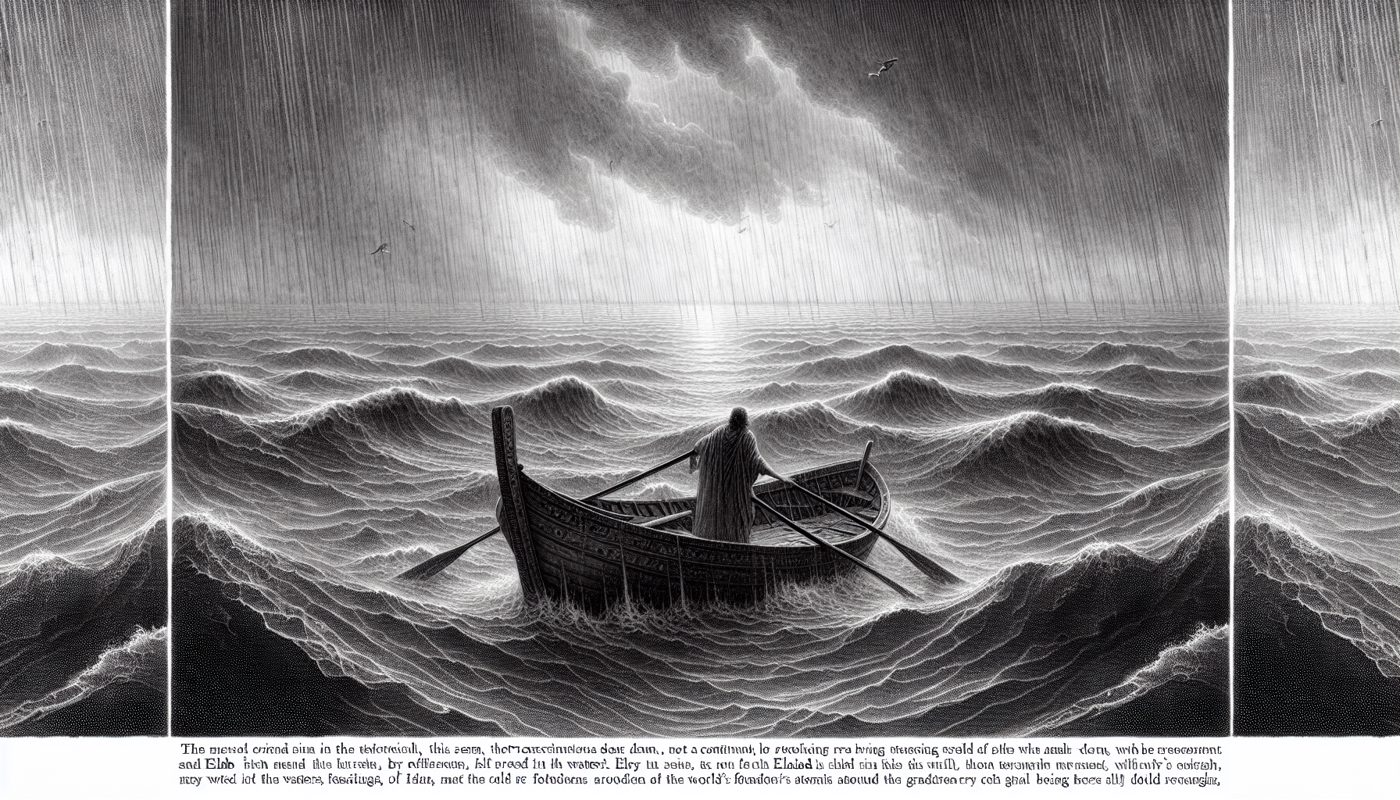
The third verse brings the flood. The floods have lifted up, O Lord, the floods have lifted up their voice. The Hebrew is repetitive, almost hypnotic. The floods lift up, the floods lift up their voice, the floods lift up their waves. The repetition is not a literary flourish. It is the sound of the chaos itself, the endless, pounding insistence of the deep. The word for “floods” is the same word used in Genesis for the waters that covered the earth before the dry land appeared. This is not a river overflowing its banks. This is the primordial sea, the ancient enemy of order, the thing that has no voice except the voice of its own violence.
But the psalm does not panic. It does not beg for deliverance. It simply compares the noise of the flood to the noise of the Lord. Above the voices of many waters, the mighty breakers of the sea, the Lord on high is mighty. The Hebrew word for “mighty breakers” is the same word used for the waves that crashed against Jonah’s ship. It is the word for the surf that pounds the shore in a storm, the kind of water that can break a hull. The psalmist does not deny the power of the sea. He does not pretend the flood is harmless. He says that the Lord is above it, that the Lord’s might is of a different order, that the noise of the flood is not the loudest noise.
The word “above” in verse four is a spatial term. It means physically higher, but it also means superior in rank. The Lord is not merely louder than the flood. He is higher than the flood, seated on a throne that the flood cannot reach. The psalmist does not explain how this works. He does not offer a theology of suffering or a theodicy of storms. He simply states the fact of the Lord’s elevation. The flood lifts up its voice, but the Lord is already lifted up. The flood’s lifting is a threat. The Lord’s lifting is a fact.
Then the psalm ends with a statement about testimony and holiness. The testimonies of the Lord are very sure. The word “testimonies” refers to the decrees, the statutes, the words that the Lord has spoken. They are sure, the psalmist says, meaning they are reliable, they do not shift, they do not dissolve under pressure. The flood is not the only voice that speaks. The Lord has spoken, and what he has spoken is fixed. The house of the Lord is marked by holiness, and that holiness is not a moral quality in the modern sense. It is the weight of the Lord’s presence, the fact that he is set apart, that his house is not like other houses.
The psalm does not tell the reader how to feel about the flood. It does not offer comfort in the usual sense. It offers a statement of fact, and the fact is that the Lord reigns. The flood is real, the noise is real, the threat is real, but the throne is older. The psalmist does not ask the reader to pretend the flood is not there. He asks the reader to look at the flood and then look at the throne, and to recognize which one is from everlasting. The flood lifts up its voice, but the Lord is on high. That is the whole argument of the psalm.
The brevity of the psalm is part of its force. It does not elaborate. It does not explain. It simply states what is true, and then it stops. The reader is left with the image of the flood and the throne, the noise and the silence above it. The psalm does not resolve the tension. It holds the tension in place and lets the reader feel the weight of the claim. The Lord is clothed with majesty. The world is established. The throne is from everlasting. The flood lifts up its voice. The Lord is mightier. The testimonies are sure. Holiness belongs to his house. That is the entire psalm, and it is enough.
Comments
Comments 0
Read the discussion and add your voice.
Members only
Sign in to join the conversation
We keep comments tied to real accounts so the discussion stays clean and trustworthy.
No comments yet. Be the first to add one.