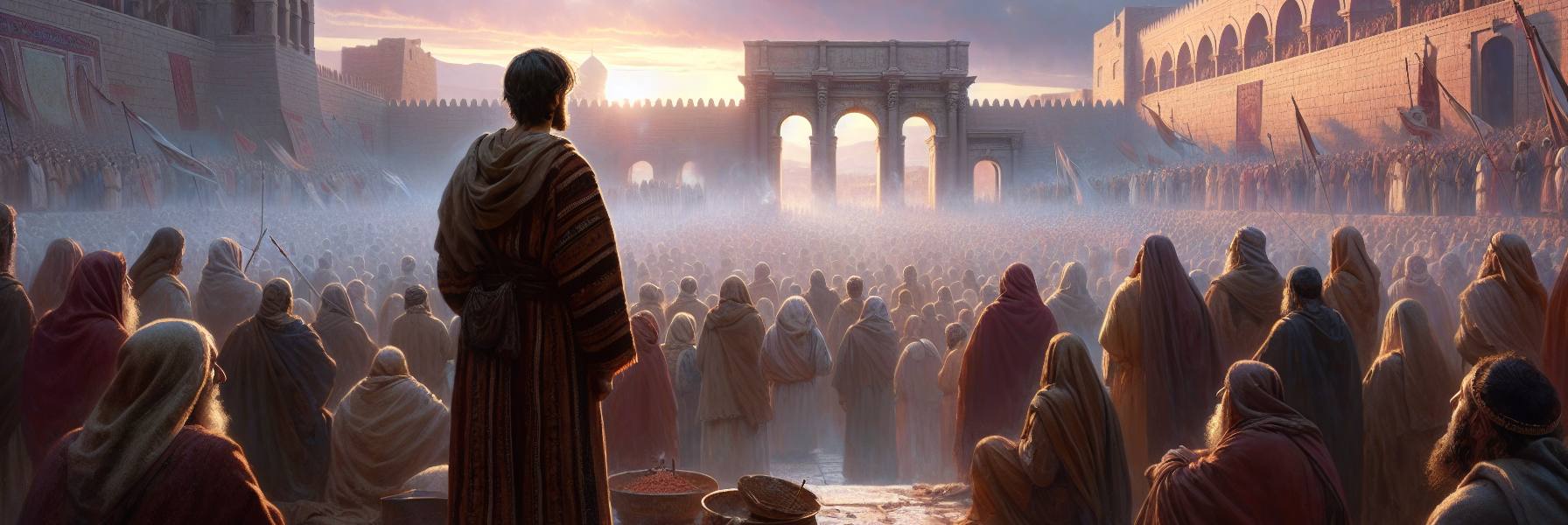

The memory of that morning is etched into me, not as a law carved on stone, but as a scent carried on the cold air—a mixture of incense, animal hide, and dew-damp earth. I was young then, serving among the Levites, my primary duty being to observe and to learn. The words of the prophet Ezekiel had settled over us like a new architecture of hope, a blueprint for a world restored. And on this day, the first of the month, the vision was to be given flesh and blood and breath.
The sky was the colour of a pale, newly washed fleece, streaked with pink, as we assembled in the outer court. The eastern gate, that magnificent and solemn entrance, stood shut, as it did on ordinary days. But today was not ordinary. A hush, thicker than the morning mist, lay over the gathered people. They clustered not in a chaotic throng, but in ordered families, their faces turned toward the inner court entrance. There was a rustle, a collective intake of breath, and then we saw him.
The prince—not a king, never a king, for the Lord alone was our king—came from the north side. He walked without a royal procession, without trumpets blaring for his own glory. A few attendants followed, leading the unblemished lambs, the fine flour, and the oil. He was a man of serious bearing, his robes simple but well-made, his focus entirely ahead of him. He did not wave to the crowd. His office was not one of spectacle, but of representation. He was the people’s representative, and in that moment, he looked weighed down by the honour, and by the cost.
The priest met him at the entrance to the inner court. The ritual began with a quiet efficiency that spoke of profound reverence. The young bull was offered as a sin offering, its blood applied with a solemn precision that spoke of atonement, of a barrier being washed away. I watched the prince stand by the gatepost, his hand resting on the stone. He watched the sacrifice not as a distant patron, but as a participant. His own offering, his own symbol of submission, was being made. The bull, the ram, the lambs—they were from his own flocks, from his own substance. This was no token tribute; it was a genuine transfer of wealth from his hand to God’s altar, a tangible relinquishment.
Then came the grain offering. The scent of crushed wheat and olive oil, mingling with the sharp, metallic scent of blood and the rich aroma of burning fat, created a perfume that was entirely unique to that place, to that purpose. It wasn’t a sweet smell; it was a serious one, a smell of commitment. The prince presented the basket, and the priest took a handful—a memorial portion. It was burned up entirely. No one ate of the prince’s grain offering that day. It was a gift, whole and complete, vanishing into smoke as a plea and a praise before the Lord.
When the sacrifices were complete, something remarkable happened. The prince did not retreat to a place of isolated privilege. He went back out through the same gate, but he did not depart. He turned and stood at the threshold of that eastern gate, the very gate through which the glory of the Lord had entered, according to the prophet’s vision. And there, from that sacred threshold, he worshipped. He bowed, his forehead nearly touching the stone of the entryway. The people, watching from the outer court, saw their representative in an act of pure, public devotion. It was a lesson in stone and flesh: leadership was for this. To stand in the gap, to offer, and then to bow.
Afterwards, the gates were shut. The rhythm of the week would hold. Six days of labour, of ordinary life. But the Sabbath… the Sabbath was different. On the Sabbath, the eastern gate itself was opened for the prince. I served on one such occasion. The morning sacrifice was doubled—two lambs instead of one, with twice the measure of flour and oil. It was as if the very day demanded a greater acknowledgement, a more substantial declaration of God’s sovereignty over time itself. The prince entered and exited through the gate’s vestibule, but the people? They remained outside, in the court, worshipping at that opened entrance. They could see in, could see the altar, the activity, the smoke rising. But they did not enter. The boundaries were clear, respected, and in their clarity, there was a strange safety.
The prince’s daily offering, we learned, was to be a lamb, a sixth of an ephah of flour, and a fixed measure of oil. Every. Single. Morning. A daily restitution, a daily gift, a daily acknowledgement that the nation’s life was sustained not by its own hands, but by the mercy received at dawn. It was a rhythm of dependence, written in smoke and grain.
I recall one festival, the Feast of Unleavened Bread. The courtyard was a controlled chaos of families and the smell of bread baked without the puffiness of leaven. The prince provided a bull as a sin offering for himself and for all the people. That phrase stayed with me: “for himself and for all the people.” His sin, and ours, were bound together in the need for atonement. He was not above us; he was one of us, chosen to bear the responsibility of the approach. The seven days of the feast saw a repetition of this costly, communal gift.
Years have passed since those days of service. I am an old man now. The temple Ezekiel saw remains a vision, a hope held close in exile and in return. But the principles of that morning are as real to me as the ache in my bones. I saw in that ritual a map for a holy society: a leader who gives rather than takes, who represents rather than dominates, who worships publicly at the gate of God’s presence. I saw a people who gave from their own inheritance, not from compulsion, but from a participated joy. And above all, I saw the unchanging truth—that approach to the Holy requires both a representative and a cost, a surrendered lamb and a bowed head. It is a system not of oppression, but of ordered grace, where every morning, without fail, the smoke of a gift rises to meet the dawn, a signal that someone, on behalf of everyone, remembers.