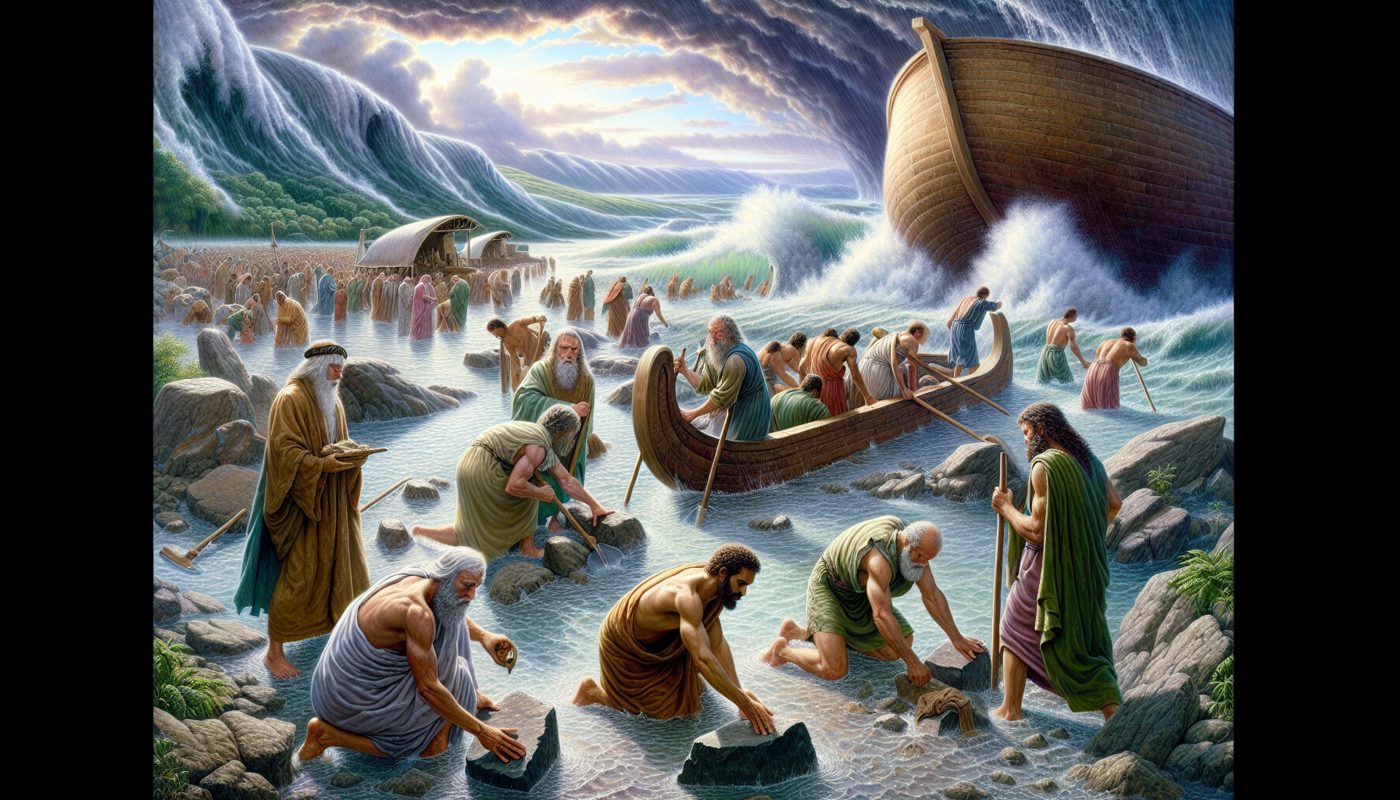
God blessed Noah and his sons as they stepped from the ark, repeating the command given at the beginning: be fruitful, multiply, and replenish the earth. But the world they entered was no longer the same one Adam knew. The Lord placed the fear and dread of man upon every beast, bird, and fish, delivering them into human hands. Every moving thing that lived was now given for food, as the green herb had been given before. Yet one restriction remained: flesh with its lifeblood still in it was not to be eaten.
The Lord then laid down a new and severe law concerning human life. Whoever shed the blood of man, whether beast or another man, would have his own blood required. The reason was explicit: God made man in His own image. The life of a man could not be taken without an accounting. This was not a suggestion or a principle left to interpretation—it was a requirement the Lord would enforce.
Then God spoke directly to Noah and his sons, establishing a covenant. He promised that never again would all flesh be cut off by floodwaters, and never again would a flood destroy the earth. This covenant was not only with Noah and his descendants but with every living creature that came out of the ark—the birds, the cattle, and every beast of the earth.
The Lord set a visible token in the sky as the sign of this covenant: His bow placed in the cloud. Whenever a cloud gathered over the earth and the bow appeared, God said He would look upon it and remember the everlasting covenant between Himself and every living creature. The waters would never again become a flood to destroy all flesh. The bow was the perpetual reminder that the Lord had bound Himself to the earth.
The narrative then shifts abruptly from the covenant to the household of Noah. Noah, who had been a righteous man and a husbandman, planted a vineyard. He drank of the wine and became drunk, lying uncovered inside his tent. Ham, the father of Canaan, saw his father's nakedness and went outside to tell his two brothers.
Shem and Japheth responded differently. They took a garment, laid it across both their shoulders, and walked backward into the tent to cover their father. They kept their faces turned away so they would not see his nakedness. Their act was deliberate and respectful, refusing to look upon what Ham had seen and reported.
When Noah awoke from his wine and learned what his youngest son had done, he did not curse Ham directly. Instead, he pronounced a curse on Canaan, Ham's son: “A servant of servants shall he be unto his brethren.” Then Noah blessed the Lord, the God of Shem, and declared that Canaan would be his servant. He also asked that God enlarge Japheth and let him dwell in the tents of Shem, with Canaan serving him as well.
Noah lived three hundred and fifty years after the flood, and his total days reached nine hundred and fifty years. Then he died. The chapter closes with the sobering reality that the man who had walked with God through the flood ended his days in a scene of drunkenness and family division, leaving a curse that would echo through the generations.
The covenant of the rainbow stands in stark contrast to the curse on Canaan. One is a divine promise of mercy for all flesh; the other is a human pronouncement born from shame and violation. The Lord set His bow in the clouds as a sign that He would remember His covenant, but the chapter does not end with that comfort alone. It ends with Noah's sons and the weight of what happened inside the tent.
The flood had cleansed the earth, but it did not cleanse the human heart. Noah, the same man whose sacrifice had been a pleasing aroma to the Lord, lay drunk and exposed. The same sons who had stepped onto the new earth together now carried a curse and a blessing that would shape the nations. The rainbow remained in the sky, but the ground beneath it was already troubled.
Comments
Comments 0
Read the discussion and add your voice.
Members only
Sign in to join the conversation
We keep comments tied to real accounts so the discussion stays clean and trustworthy.
No comments yet. Be the first to add one.