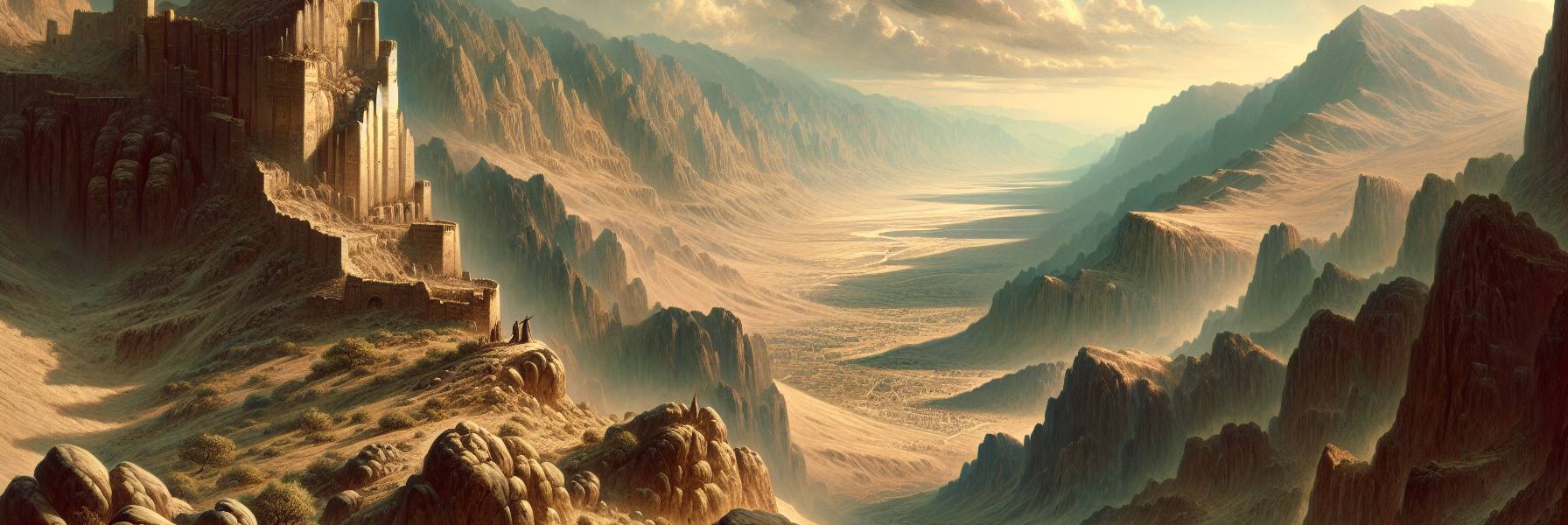

The high places of Seir were old before our grandfathers’ grandfathers drew breath. Wind-scoured stone, the color of dried blood, rose in jagged ridges against a sky bleached pale with endless sun. It was a land that hoarded silence, a kingdom of rock and thorn where the very air tasted of dust and ancient grudges. My name is Malak, and I was a watchman on the northern wall of Sela, the city carved from the mountain’s heart. From my post, I could see the trade routes snaking through the valleys below, routes my people, the Edomites, had controlled for generations. We were the sons of Esau, and the bitterness between us and the sons of Jacob was as old as the stones we stood upon.
It began not with a shout, but with a quietness that felt wrong. The desert has its own music—the scuttle of a lizard, the sigh of the wind through clefts in the rock, the distant cry of a hawk. That day, the music stopped. The air grew thick and heavy, pressing down on the lungs. The shadows, long in the late afternoon sun, seemed to deepen beyond their natural measure, clotting like old blood in the ravines. A few of the goats we kept in the lower pens grew restless, their bleating sharp with a fear they could not name.
I felt a chill, though the heat was fierce. It was a sensation of being watched by something vast and pitiless. I gripped the rough-hewn stone of the parapet, my knuckles white. Then the voice came. It did not come on the wind, for the wind had died. It did not echo from the canyon walls. It was simply *there*, inside the mind, a sound that bypassed the ears to settle in the marrow of the bones. It was a voice of crushing weight and absolute clarity, and it spoke a word that was not a name, but an identity, a verdict.
“Mount Seir.”
The words that followed were not for me, Malak the watchman, yet I heard them, and the hearing was a kind of dying. The voice addressed our mountain, our people, our very essence.
“I am against you,” the voice said, and the simplicity of the declaration held more terror than any thunderous threat. “I will stretch out my hand against you and make you a desolate waste.”
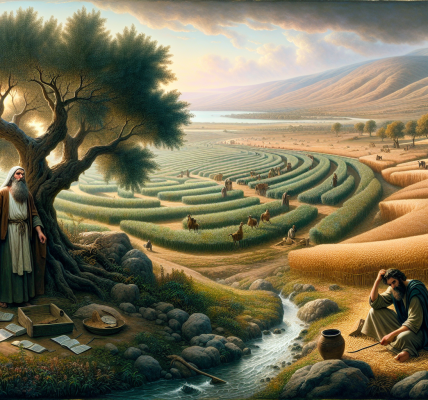
The vision unfolded then, not before my eyes, but within them. I saw our strongholds not as they were—proud citadels defying the sun—but as broken teeth in a skeletal jaw. I saw our terraced fields, which we had wrested from the stubborn rock, returned to scree and thistle. I saw the silence, not the quiet of a sleeping land, but the absolute, eternal silence of a place from which life has been utterly erased. No shepherd’s call, no laughter of children, no crackle of a cooking fire. Only the wind, which would have the final word.
The voice spoke of an ancient hatred, a perpetual enmity. It named our treachery against the house of Israel. I saw, in a flash of terrible understanding, the moments of our history laid bare: our glee when the Babylonians swept down upon Judah, our thought, ‘They are laid desolate, they are given to us to devour.’ We had not just been neutral observers in their calamity; we had coveted their land, their demise. We had said in our hearts, “These two nations and these two countries shall be mine, and we will take possession of them.” We saw their judgment as our opportunity.
The voice named this for what it was—not shrewd politics, but blood-guilt. “Because you have had a perpetual enmity and have given over the people of Israel to the power of the sword at the time of their calamity,” it declared. The words ‘perpetual enmity’ hung in the air, a chain linking our ancestor Esau to this very moment. Our hatred was not a fleeting passion; it was the foundation of our identity. And for that, the foundation would be shattered.
“Therefore, as I live,” the voice swore by its own eternal life, a vow that could not be broken, “I will prepare you for blood, and blood shall pursue you. Because you did not hate bloodshed, therefore bloodshed shall pursue you.”
The vision intensified. I saw the land not just empty, but *knowing* its emptiness. The mountains of Seir would become a desolation, and the voice promised, “All Edom, all of it, shall know that I am the Lord.” It was not merely a punishment of force, but of revelation. In our final, desolate hour, we would be forced to acknowledge the God we had spent a lifetime defying by our hatred of His people.
Then, as suddenly as it came, the presence lifted. The weight vanished from the air. The distant hawk cried again. The goats settled. The world returned to normal, but it was a lie. I slumped against the wall, my body trembling, my tunic soaked with a cold sweat. I looked out at the majestic, terrifying beauty of our land—the red cliffs burning in the sunset, the deep blue shadows pooling in the gorges. It was all a corpse, waiting for its burial.
I never spoke of what I heard. Who would believe the ravings of a sun-struck watchman? And a part of me, the proud Edomite heart, refused to accept it. We were the masters of the mountain. We were eternal, like the stone.
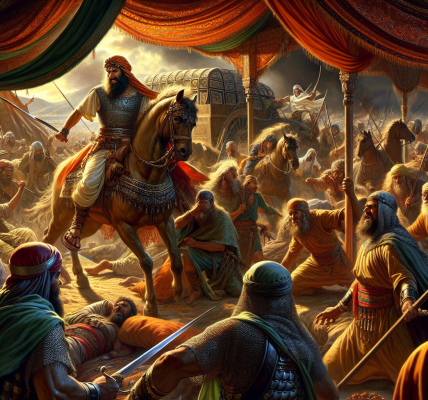
But the desolation did not come with trumpets and armies, not at first. It came as a whisper. A blight on the grapevines one year. A drought that lingered the next. The trade routes grew quieter as new paths were forged, bypassing our high passes. Then came the raiders, not a great army, but bands of hungry, desperate men from other desert tribes, smelling our weakness. They were like jackals, and we, who had once thought ourselves lions, found we could not fight them off. Our young men fell in skirmishes that felt less like battles and more like a slow bleeding.
Within a generation, Sela was no longer a city, but a memory. The cisterns cracked. The wind and sand scoured our carvings from the rock. The blood of our feuds and our hatreds soaked into the dust, and the land became what the voice had promised—a desolate waste.
Sometimes, nomadic tribesmen camp in the ruins, huddling in the lee of a broken wall. They tell stories of a people who dared to exult over the downfall of a nation chosen by God, and they speak of the mountain that was judged for its ancient, perpetual heart. They call it the judgment of the Lord. And in the utter silence that remains, it is a name that fits.