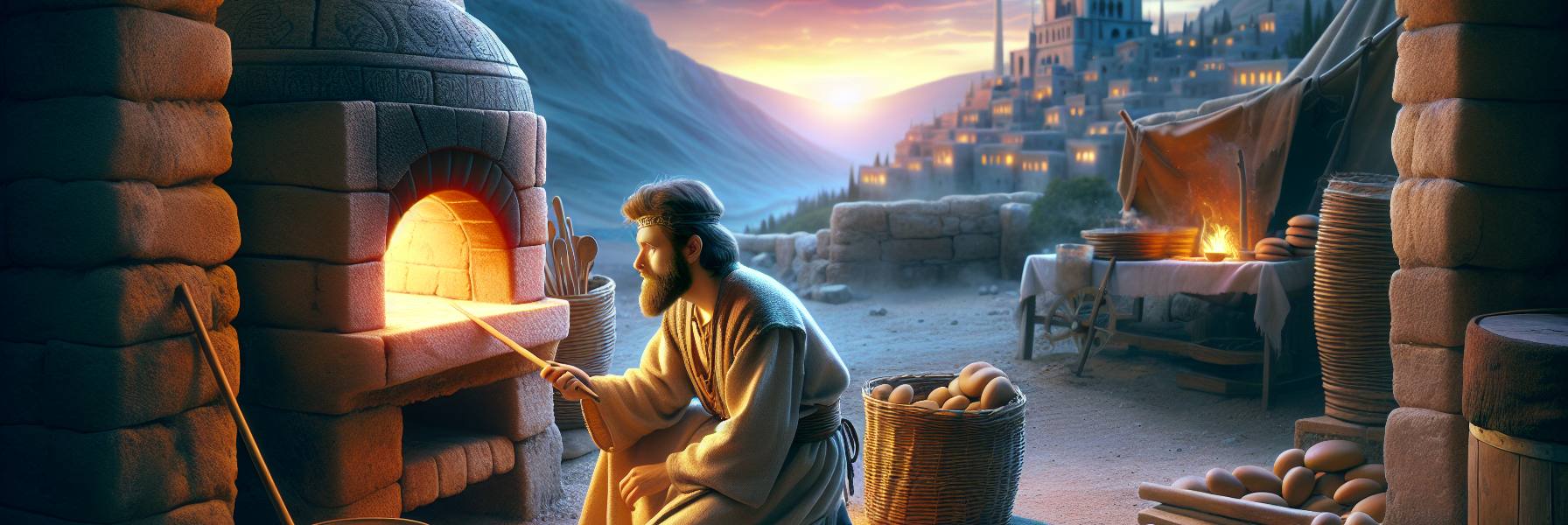

The fire had been banked, but the embers still glowed. In the pre-dawn chill of Samaria, a baker named Jared knelt before his oven, the heat warming his face as he prepared the day’s bread. He thought of the king’s palace, not far from his humble shop. They were all bakers in their own way now, he mused, shaping the kingdom to their own appetites.
This was the thought that often came to him, a quiet, persistent whisper beneath the morning’s routine. It was a whisper that sounded strangely like the voice of the prophet Hosea, a man whose words were as unsettling as a sudden cold draft. The prophet saw an oven in the heart of the nation, a metaphor Jared understood all too well. His own oven, he knew, was a tool. It served a purpose. But the oven Hosea spoke of was a different thing entirely—a self-consuming fire, stoked through the night by the hands of plotters and princes.
Jared slid the first loaves onto the hot stones, the dough sizzling as it met the heat. He imagined the scenes in the palace, the secret meetings that lasted long past midnight. The prophet had it right. The king and his courtiers were like bakers who slept through the night, but their fire—the fire of conspiracy, of ambition, of alliance with Egypt and flattery of Assyria—never went out. It smoldered in the dark, and in the morning, it blazed up, devouring its own makers. They thought they were stoking the fires of power, but they were only feeding a pyre.
He remembered the latest news, brought by a travel-stained merchant. Another official, a man of some standing, had been seized in a sudden purge. The court was a nest of intrigue, each man’s hand against the other. “Their anger smolders all night,” Hosea had declared, “in the morning it burns like a flaming fire.” Jared saw it. They consumed their own, like a fire consumes the wood that feeds it, leaving only ash and a memory of heat.
A little later, as the sun climbed and the city began to stir, a group of revelers stumbled past his shop, their faces flushed with wine, their laughter too loud, too early. They were men of influence, their fine robes slightly askew. They carried on toward a feast that seemed to have no end. Jared watched them, and the prophet’s words echoed again: “They are all hot as an oven, and devour their rulers.”
It was not just the politics. It was the soul of the place. The fever of their plotting was matched only by the fever of their indulgence. The city was drunk on more than wine; it was intoxicated with itself, with its own cleverness, its own ability to twist and turn. They mocked the covenant, this sacred bond with the God of their fathers, as if it were an old wives’ tale. They mixed with the nations, adopting their idols and their customs, thinking it made them sophisticated, strong. They were like a cake not turned, Jared thought, looking at a loaf he had momentarily forgotten. One side was burnt black, crusted and bitter, while the other side was raw, doughy, and useless. A thing unfit for its purpose.
The nation was that cake. Outwardly, there was a show of piety, a form of religion. They went through the motions at the high places. But inwardly, they were raw with unfaithfulness, their hearts turned not toward the Lord, but toward every passing power and pleasure. They had not been turned by the Baker’s hand. They were ruined.
As the day wore on, a commotion arose in the square. A royal courier, his face grim, announced yet another shift in policy. An appeal had been sent to the great king of Assyria. They were like a silly, senseless dove, Hosea said, fluttering between Egypt and Assyria, calling out first to one, then to the other. They sought salvation in foreign palaces, in treaties written on papyrus, in the strength of chariots they did not build. They did not cry out to the One who held their very breath in His hand.
Jared wiped the flour from his hands, a deep sorrow settling in him. The prophet’s lament was not just a condemnation; it was a funeral dirge. “Woe to them,” Hosea cried, “for they have strayed from me! Destruction to them, for they have rebelled against me!” It was the anguish of a husband betrayed, a father scorned. God was not a distant judge merely noting down offenses. He was the one who had bound their wounds, who had sought to heal them, and they did not even realize how sick they were. They were like a faulty bow, a weapon that looked serviceable but, when drawn, would twist and send the arrow veering wildly off target, humiliating the archer and failing in its one purpose.
As dusk fell and Jared prepared to bank his own oven for the night, the city was quiet, but it was the quiet of exhaustion, not peace. The feasting would begin again soon. The plotting would resume in shadowed rooms. The dove’s wings were tired, but it would fly again tomorrow, seeking a perch that did not exist.
He looked up at the darkening sky, a canopy of stars that the God of Abraham, Isaac, and Jacob had set in place. They had forgotten the Maker of that sky. They had trusted in everything but Him. And the fire they had so carefully stoked, the oven of their own hearts, was even now consuming them from within. It was a tragedy written not in thunder and lightning, but in the quiet, desperate, and unheeded rhythms of a fallen city, a people asleep while their world burned down around them.