
In the ancient city of Jerusalem, during the latter years of King Solomon’s reign, there lived a wise elder named Ethan. His hair had turned the color of winter frost, and his eyes held the deep knowing of one who had walked many seasons under the sun. One afternoon, as the heat of the day began to wane, a group of young nobles gathered in his courtyard, seeking wisdom for their youthful pursuits.
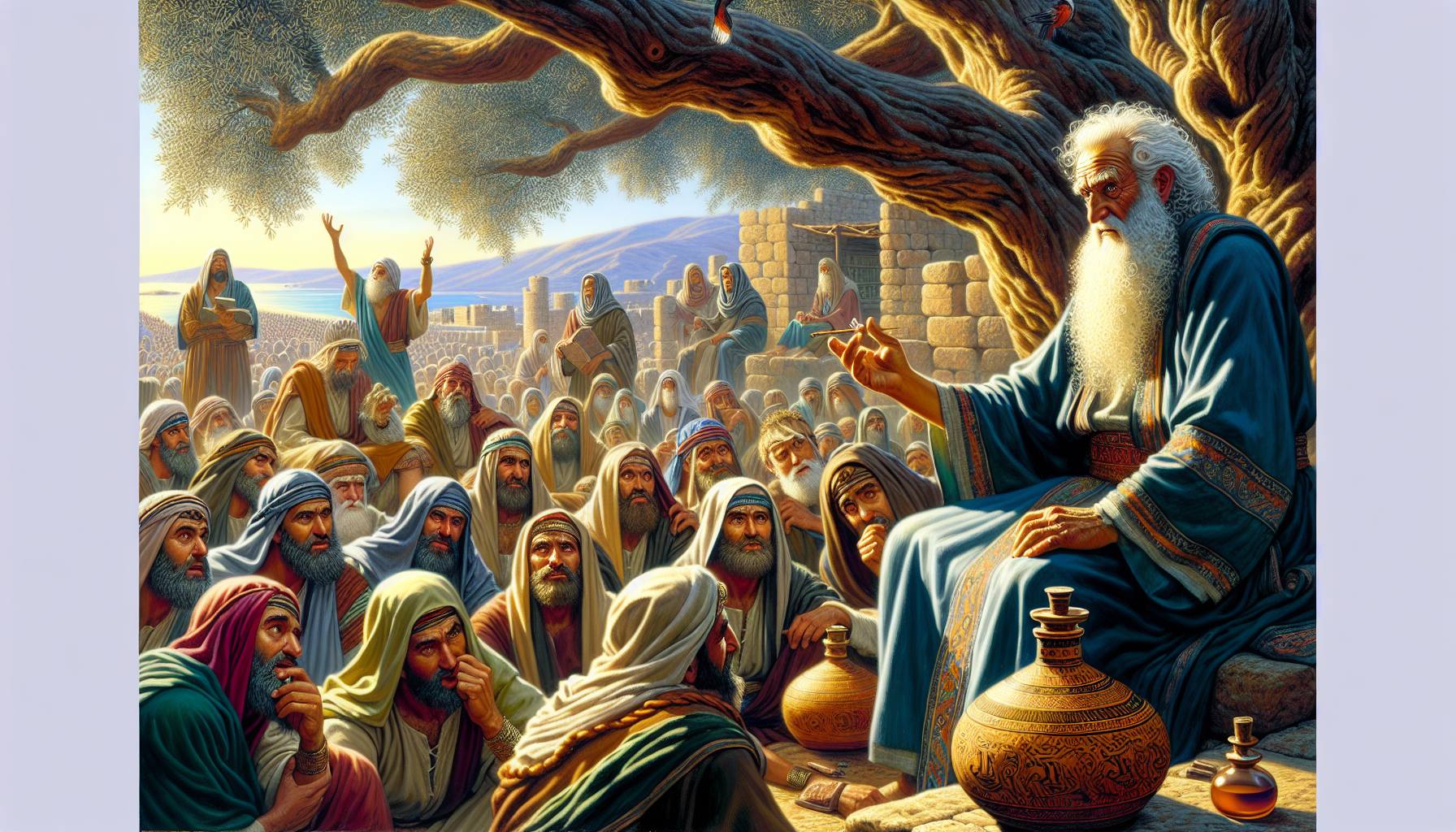
Ethan sat beneath an ancient olive tree, its gnarled branches casting intricate shadows upon the ground. He watched as the young men arrived with boisterous laughter and ambitious talk of building grand houses and acquiring great wealth.
“A good name,” Ethan began, his voice carrying the weight of weathered stones, “is better than precious ointment.” He gestured to a flask of spikenard oil one youth carried, whose fragrance filled the courtyard. “This perfume may delight for an evening, but a reputation built on integrity perfumes every room you enter and outlives your mortal days.”
The young men grew quiet as Ethan continued. “The day of one’s death reveals more than the day of one’s birth.” He pointed toward the city gates where a funeral procession passed. “Observe how death silences the marketplace and turns hearts toward eternity. Birth brings celebration, but death brings contemplation of what truly matters.”
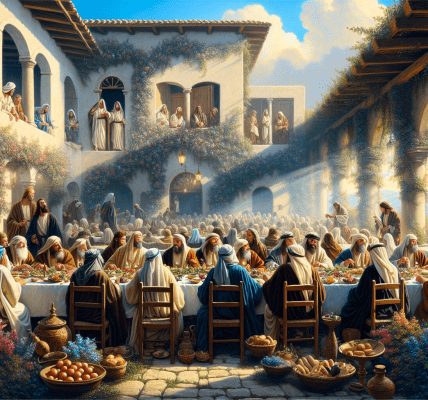
Ethan led them to the house of mourning nearby, where lamentations rose like evening mist. “It is better to go to the house of mourning than to the house of feasting,” he taught. “For sorrow carves depth into the soul, while constant mirth leaves it shallow as a brook in summer drought. The wise heart learns in rooms of grief what foolish hearts miss in halls of revelry.”
One young man named Reuben protested, “But teacher, should we not enjoy life’s pleasures while we have vigor?”
Ethan nodded slowly. “The rebuke of the wise is more valuable than the song of fools.” He recounted how in his youth, a mentor’s stern correction had saved him from ruin, while flatterers had nearly led him to destruction. “The laughter of fools is like thorns crackling under a cooking pot—loud and brief, providing no lasting warmth.”
He led them past the king’s palace where officials grew restless waiting for royal favor. “Patience is better than pride,” Ethan observed. “Do not be quick to anger in your spirit, for anger lodges in the bosom of fools. I have seen a man destroy his inheritance in a moment of rage what took his fathers generations to build.”
Looking toward the western hills where shadows lengthened, Ethan murmured, “Do not say, ‘Why were the old days better than these?’ For it is not wise to ask such questions. Each age carries its own measure of joy and sorrow, and nostalgia often gilds memory with false gold.”
He pointed to a craftsman patiently refining silver in his shop. “Wisdom, like this artisan’s craft, provides protection and preserves life. Consider God’s work: who can straighten what He has made crooked? In the day of prosperity be joyful, but in the day of adversity consider this: God has made the one as well as the other, so that no one can discover anything that will come after them.”
As twilight descended, Ethan spoke of righteousness. “I have seen both the righteous perishing in their righteousness and the wicked living long in their wickedness. Do not be overly righteous or excessively wise—why should you destroy yourself? But do not be overly wicked either, nor be foolish—why should you die before your time?”
One youth asked about the women they saw drawing water at the well. Ethan’s face grew solemn. “I have discovered that a woman whose heart is snares and nets is more bitter than death. Whoever pleases God escapes her, but the sinner is taken by her. Behold, this I have found, searching one by one to find the scheme of things—which I am still seeking but have not found—one upright man among a thousand I have found, but an upright woman among all these I have not found.”
The young men stirred uncomfortably, but Ethan raised his hand. “See, this only have I found: that God made mankind upright, but they have sought out many schemes.”
As stars began to pierce the velvet sky, Ethan concluded, “Who is like the wise? Who knows the interpretation of a matter? A man’s wisdom makes his face shine, and the hardness of his face is changed. Keep the king’s command because of your sacred oath, and do not be terrified of the royal presence. Though a man’s misery weighs heavily upon him, no one knows what is coming—who can tell him what will be after him?”
The young nobles departed in thoughtful silence, their earlier merriment replaced by sober reflection. The fragrance of spikenard had faded from the courtyard, but Ethan’s words lingered like the scent of rain on thirsty ground, watering souls that had not known they were parched.