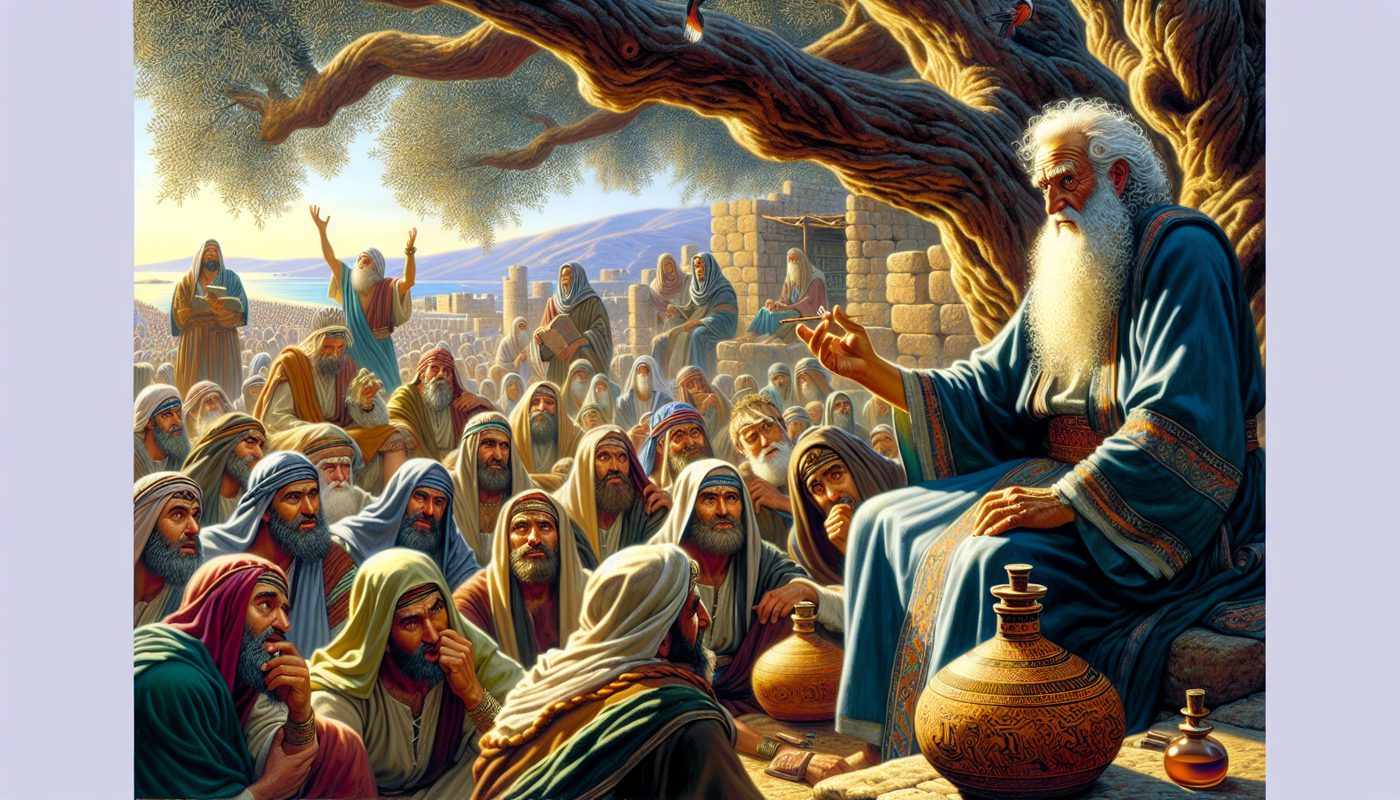
The Preacher does not begin this chapter with a parable or a proverb offered to a listening crowd. He begins with a blunt claim: a good name is better than precious oil, and the day of death is better than the day of birth. This is not sentiment. It is a calculated reversal of how men normally measure value. Oil glistens, perfumes a room, and signals honor at a feast. But a name—what a man actually leaves behind—outlasts the scent. The Preacher forces the reader to ask whether the things they chase will survive the moment they stop breathing.
He then presses harder: it is better to go to the house of mourning than to the house of feasting. Feasting is loud, crowded, forgetful. Mourning is quiet, stripped, and honest. The Preacher says that the house of mourning forces the living to lay the end of all men to heart. He does not say it is pleasant. He says it is useful. The living need to look at death, not because they enjoy it, but because feasting never taught anyone what they actually are.
Sorrow, he writes, is better than laughter. This sounds like a contradiction until he explains: by the sadness of the countenance the heart is made glad. The Preacher is not praising misery. He is saying that sorrow carves out a deeper capacity for joy than constant mirth ever can. The heart of the wise is in the house of mourning. The heart of fools is in the house of mirth. The fool stays where the noise is loudest and the thought shallowest. The wise man goes where the silence teaches something.
The Preacher also values rebuke over flattery. It is better to hear the rebuke of the wise than to hear the song of fools. The song of fools, he says, is like the crackling of thorns under a pot—loud, brief, and useless for cooking. It sounds like celebration but produces nothing. Rebuke, by contrast, is uncomfortable but sharpens a man. The Preacher will not let the reader settle for comfort that costs nothing.
He then shifts to a warning about corruption. Extortion makes the wise man foolish. A bribe destroys the understanding. The Preacher has seen men who once had judgment trade it for gain. He does not romanticize wisdom as something that cannot be lost. It can be traded away for money or power, and the man who does it does not even notice he has become a fool.
The Preacher also warns against the habit of nostalgia. Do not say, Why were the former days better than these? He calls that an unwise question. The past is not purer because it is past. The Preacher has seen enough to know that every age has its own crookedness. The man who pines for yesterday is usually avoiding the work of living well today.
He compares wisdom to an inheritance, and says wisdom is a defense just as money is a defense. But he adds a distinction: wisdom preserves the life of the man who has it. Money can be stolen or spent. Wisdom stays with the man and keeps him from ruin. Yet the Preacher immediately turns to the limits of wisdom. Consider the work of God, he says. Who can make straight what He has made crooked? The Preacher does not say the crookedness is evil. He says it is God's work, and man cannot undo it. The wise man learns to live within the crooked lines instead of exhausting himself trying to straighten them.
The Preacher then makes an observation that unsettles easy moral formulas. He has seen a righteous man perish in his righteousness and a wicked man prolong his life in his evil-doing. This is not a glitch. It is the actual shape of the world under the sun. The Preacher does not try to explain it away. He simply reports it and then warns against two opposite errors: do not be righteous overmuch, and do not be overmuch wicked. The first destroys a man by self-righteousness; the second destroys him by folly. The Preacher recommends the fear of God as the only position that escapes both traps.
He concludes with a confession. He set his heart to seek wisdom and the reason of things, but it was far from him. That which is, he says, is far off and exceeding deep. Who can find it out? The Preacher does not pretend to have cracked the code. He found that God made man upright, but men have sought out many inventions. The inventions are the problem—not the search for wisdom itself, but the endless human schemes that twist what was originally straight. The Preacher leaves the reader not with a solution, but with a sober recognition that the fear of God is the only ground that holds.
Comments
Comments 0
Read the discussion and add your voice.
Members only
Sign in to join the conversation
We keep comments tied to real accounts so the discussion stays clean and trustworthy.
No comments yet. Be the first to add one.