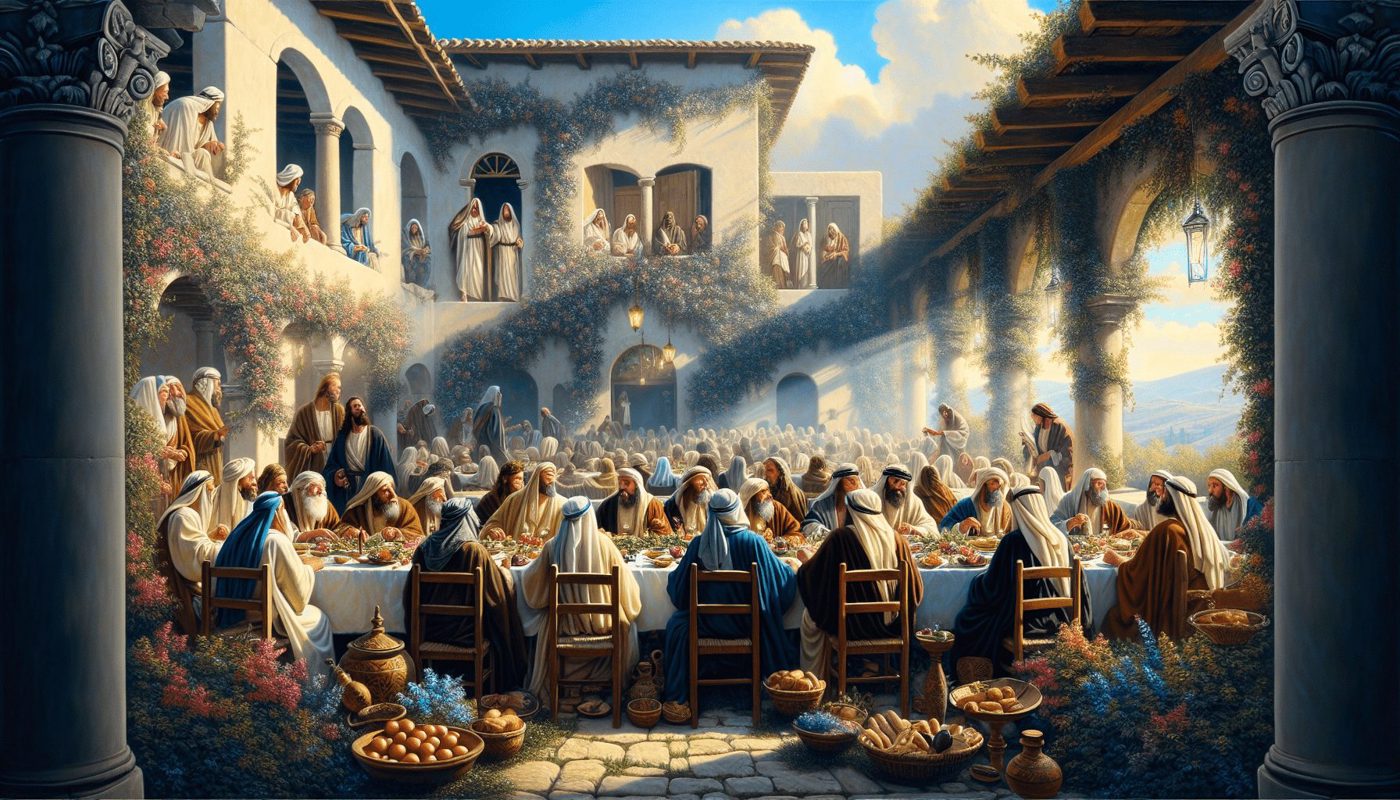
The chapter opens with a Sabbath meal at the house of a prominent Pharisee. Jesus is being watched. A man with dropsy appears before him, and Jesus puts a direct question to the lawyers and Pharisees: Is it lawful to heal on the Sabbath or not? They say nothing. He heals the man and lets him go. Then he asks about an ox or a son fallen into a well on the Sabbath—would they not pull him out immediately? They have no answer. The silence is the only reply the trap gets.
Jesus then watches how the invited guests choose the best seats, and he speaks a parable about a wedding feast. Do not take the chief seat, he says, because a more honorable man may be invited, and you will be told to move down in shame. Instead, take the lowest place, so the host may say, Friend, go up higher. The rule is exact: everyone who exalts himself will be humbled, and the humble will be exalted. The lesson is not about etiquette. It is about how the kingdom reorders status.
He turns to the host and says something harder. Do not invite your friends, brothers, relatives, or rich neighbors when you give a dinner or supper, because they can repay you. Instead, invite the poor, the maimed, the lame, and the blind. They cannot repay you. Your blessing will come at the resurrection of the just. The meal table becomes an image of where blessing actually lives—not in reciprocal favors, but in hospitality that expects nothing back.
One of the guests hears this and says, Blessed is the one who will eat bread in the kingdom of God. Jesus answers with a parable about a man who prepared a great supper and sent out many invitations. At supper time the servant tells the invited guests that everything is ready. But they begin to make excuses. One says he has bought a field and must go see it. Another has bought five yoke of oxen and needs to test them. Another says he has married a wife and cannot come. The excuses are not emergencies. They are ordinary life choices treated as urgent.
The master becomes angry and orders his servant to go into the streets and lanes of the city and bring in the poor, the maimed, the blind, and the lame. The servant does this and reports that there is still room. The master then sends him to the highways and hedges and tells him to compel people to come in, so the house may be filled. The final line is blunt: none of those originally invited will taste the supper. The invitation is not withdrawn. It is simply handed to people who were never on the list.
Large crowds are now traveling with Jesus. He turns and speaks directly to them. The conditions are severe. Anyone who comes to him must hate his own father, mother, wife, children, brothers, sisters, and even his own life, or he cannot be a disciple. The word is deliberately shocking. It means that every natural loyalty must be treated as secondary to allegiance to Jesus. There is no room for a soft version of discipleship that keeps family as the highest claim.
He adds that anyone who does not carry his own cross and follow him cannot be a disciple. The image is not metaphorical in the sense of a personal burden. A cross is an instrument of execution. The crowd knows what carrying a cross means: a condemned man on the way to death. Jesus is saying that following him means accepting the kind of public shame and death that the world gives to those it rejects.
He gives two parables about counting the cost. A man who wants to build a tower first sits down and calculates whether he has enough to finish it. If he lays a foundation and cannot complete the work, everyone mocks him. A king going to war against a larger army first considers whether he can win. If he cannot, he sends an envoy to ask for terms of peace. The point is the same: do not start something you cannot finish. Discipleship is not a casual decision. It requires renouncing everything a person has.
Salt is good, he says, but if salt loses its saltiness, it is useless—not fit for the land or the dunghill. It gets thrown out. The warning is for those who begin to follow but then lose the quality that makes disciples distinct. The chapter ends with the same call that runs through the Gospels: He who has ears to hear, let him hear.
Comments
Comments 0
Read the discussion and add your voice.
Members only
Sign in to join the conversation
We keep comments tied to real accounts so the discussion stays clean and trustworthy.
No comments yet. Be the first to add one.