**The Lost Scroll and the Awakening of a King**
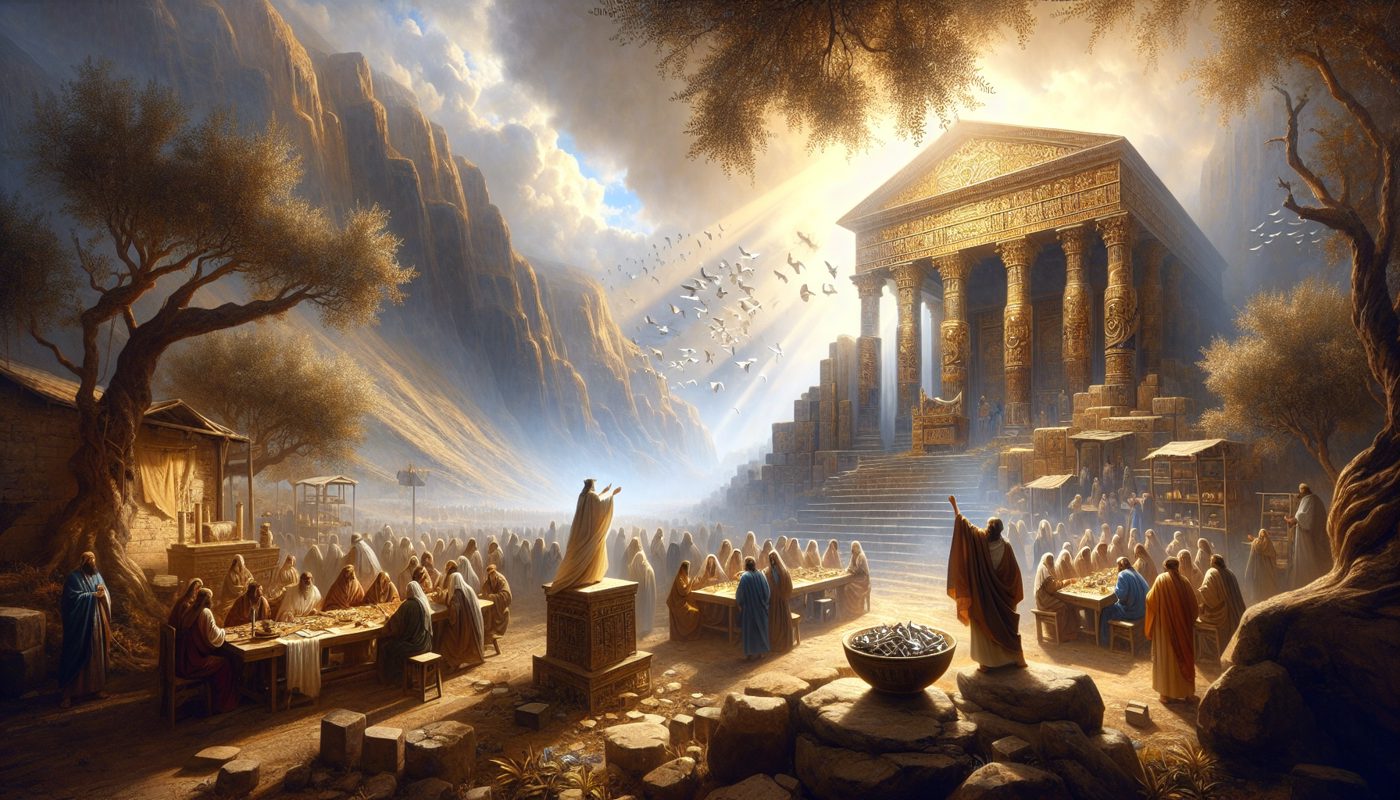
In the eighteenth year of the reign of King Josiah of Judah, when the crisp winds of early spring whispered through the olive groves and the scent of incense still lingered from the morning sacrifices, a great work was underway in the house of the Lord. The temple, once neglected under the wicked reigns of Manasseh and Amon, had fallen into disrepair—its walls cracked, its gold dulled by time, and its sacred vessels tarnished by neglect. But Josiah, a king unlike his fathers, had set his heart on restoring the glory of the Lord’s dwelling place.
He summoned Shaphan the scribe, a man of steady hands and unwavering faith, and commanded him, “Go up to Hilkiah the high priest and have him account for all the silver that has been brought into the house of the Lord—the offerings of the people, given willingly for the repair of the temple.”
Shaphan bowed low, his robes brushing the polished stone floor of the palace, and departed at once. The streets of Jerusalem bustled with merchants and pilgrims, but his mind was fixed on the task ahead. When he reached the temple courts, Hilkiah greeted him with a solemn nod. The high priest’s face was lined with years of service, yet his eyes burned with quiet fervor.
“The silver has been gathered,” Hilkiah said, motioning to the heavy chests stacked near the altar. “It shall be given to the workmen who oversee the repairs—the carpenters, the builders, the masons—so that the house of the Lord may be made strong again.”
But as the high priest counted the silver, his fingers brushed against something unexpected—a scroll, hidden away in the recesses of the temple, its edges frayed with age. With trembling hands, he unrolled it, and his breath caught in his throat. The ink, though faded, bore the unmistakable words of the Law—the very covenant of the Lord given through Moses.
Hilkiah’s voice was hushed as he turned to Shaphan. “I have found the Book of the Law in the house of the Lord.”
Shaphan’s heart pounded as he took the scroll. The weight of it in his hands felt like the weight of generations—of promises made and forgotten, of blessings forsaken and judgments looming. Without delay, he returned to the king and spoke with urgency.
“Your servants have gathered the silver in the temple and have delivered it into the hands of the workmen,” he began. Then, his voice dropping to a reverent whisper, he added, “But Hilkiah the priest has given me a book.”
Josiah, seated upon his throne of cedar inlaid with gold, leaned forward. “Read it to me.”
And so Shaphan read. The words poured forth like a river long damned, breaking through the silence of years. He read of the Lord’s commandments, of His statutes, of the blessings for obedience and the terrible curses for rebellion. The king’s face grew pale as the words struck his soul like arrows of fire.
When Shaphan reached the warnings—the prophecies of desolation, of exile, of a land forsaken because its people had turned to idols—Josiah could bear it no longer. With a cry, he tore his robes, the rich fabric rending in his grasp. His advisors and servants stood frozen, for they had never seen their king so undone.
“Go,” Josiah commanded, his voice thick with grief, “inquire of the Lord for me, for the people, and for all Judah concerning the words of this book. Great must be the wrath of the Lord that is kindled against us, because our fathers have not obeyed the words of this book, to do all that is written concerning us!”
The priests and scribes hurried to carry out his command, seeking out Huldah the prophetess, a woman of wisdom who dwelt in the lower quarters of Jerusalem. When they found her, they relayed the king’s anguish.
Huldah listened, her aged eyes seeing beyond the walls of her chamber, into the heart of heaven itself. Then she spoke, and her words were heavy with divine truth.
“Thus says the Lord, the God of Israel: ‘Tell the man who sent you to me that I will indeed bring disaster upon this place and its inhabitants—all the words of the book which the king of Judah has read. Because they have forsaken Me and burned incense to other gods, provoking Me to anger with all the works of their hands, My wrath will be poured out on this place and will not be quenched.’”
A silence fell upon the messengers, their hearts sinking. But then Huldah continued, her tone softening.
“But to the king of Judah, who sent you to inquire of the Lord, say this: ‘Because your heart was tender, and you humbled yourself before the Lord when you heard what I spoke against this place and its people, and you tore your robes and wept before Me, I have heard you. Therefore, behold, I will gather you to your fathers in peace, and your eyes shall not see all the disaster which I will bring upon this place.’”
When the messengers returned and delivered Huldah’s words, Josiah bowed his head. The judgment of the Lord was certain, yet in His mercy, He had granted the king reprieve. But Josiah was not content with personal salvation—he would lead his people in repentance.
Gathering all the elders of Judah and Jerusalem, he ascended to the temple and read aloud the words of the covenant. Then, standing before the assembled multitude, he pledged himself anew to the Lord, to walk in His ways with all his heart and soul. The people, stirred by their king’s devotion, joined him in the covenant.
And so began a great reformation—a purging of idols, a restoration of the Passover, a turning back to the God of their fathers. Though the storm of judgment loomed on the horizon, in Josiah’s days, the light of repentance burned bright, a testament to a king who, upon hearing the lost word of God, dared to heed its call.
Comments
Comments 0
Read the discussion and add your voice.
Members only
Sign in to join the conversation
We keep comments tied to real accounts so the discussion stays clean and trustworthy.
No comments yet. Be the first to add one.