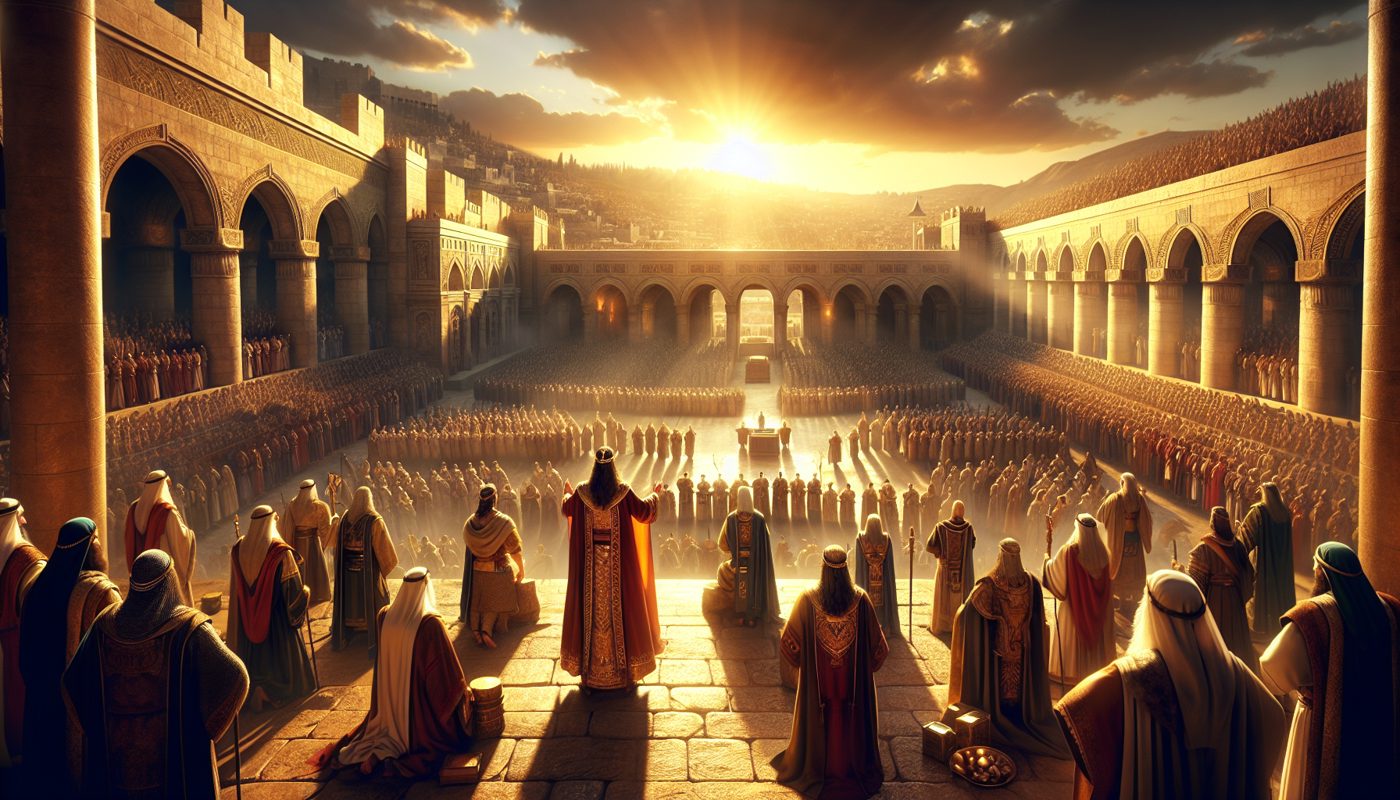
King David did not leave the throne in silence. He gathered the entire assembly of Israel—the commanders, the officials, the judges, the mighty men, and every leader of the people—and spoke directly about the work that remained. Solomon, he said, was young and untested, and the house they were building was not for any man but for the Lord God. The scale of the task pressed on the old king, and he answered that pressure not with hesitation but with a full accounting of what he had already set aside.
David listed the materials he had prepared with all his might: gold for the gold work, silver for the silver, bronze, iron, wood, onyx stones, stones for setting, stones for inlay, stones of many colors, every kind of precious stone, and marble in abundance. He did not speak in vague terms. He named the weights and the metals. Three thousand talents of gold from Ophir. Seven thousand talents of refined silver for overlaying the walls. He had given out of his own private treasury, over and above the public stores, because his affection for the house of God was that specific and that costly.
Then David turned the question outward. Who among the people would offer willingly today, consecrating themselves to the Lord? The response was immediate. The princes of the fathers' houses, the tribal leaders, the captains of thousands and hundreds, and the overseers of the king's work all gave freely. They contributed five thousand talents of gold, ten thousand darics, ten thousand talents of silver, eighteen thousand talents of bronze, and one hundred thousand talents of iron. Those who had precious stones brought them to Jehiel the Gershonite, who kept the treasury. The people rejoiced because they gave with a perfect heart, and David himself rejoiced with great joy.
Standing before the entire assembly, David blessed the Lord. His prayer was not a request. It was an acknowledgment that everything belonged to God already. He declared that the greatness, the power, the glory, the victory, and the majesty were the Lord's. The heavens and the earth were his. The kingdom was his. Riches and honor came from him. Power and might were in his hand, and he alone could make great or give strength. David did not pretend that the offerings were a gift from nothing. He said plainly that all things come from God, and what they had given was simply what had already been given to them.
David pressed further into the honesty of that moment. He called himself and the people strangers and sojourners before the Lord, their days on earth like a shadow with no abiding. The store they had gathered for the temple came from God's hand and was God's own. He told the Lord that he knew the heart was tested and that uprightness pleased him. David had offered willingly in the uprightness of his heart, and he had seen the people do the same with joy.
Then David prayed for what would come after him. He asked the Lord to keep this willingness forever in the thoughts and hearts of the people, to prepare their hearts toward God. He asked specifically for Solomon: a perfect heart to keep the commandments, the testimonies, and the statutes, and to build the palace for which David had made provision. The prayer was not abstract. It was tied directly to the work, the law, and the son who would carry it forward.
David commanded the assembly to bless the Lord their God. They bowed their heads and worshiped the Lord and the king. The next day they offered sacrifices: a thousand bulls, a thousand rams, a thousand lambs, with drink offerings and sacrifices in abundance for all Israel. They ate and drank before the Lord with great gladness. Then they made Solomon the son of David king a second time, anointing him as prince before the Lord, and anointing Zadok as priest.
Solomon sat on the throne of the Lord as king in place of David his father. He prospered, and all Israel obeyed him. Every prince, every mighty man, and every one of David's sons submitted themselves to Solomon. The Lord magnified Solomon exceedingly in the sight of all Israel and gave him royal majesty such as no king before him in Israel had possessed.
David the son of Jesse reigned over Israel forty years—seven in Hebron and thirty-three in Jerusalem. He died in a good old age, full of days, riches, and honor. Solomon his son reigned in his place. The acts of David, first and last, were written in the records of Samuel the seer, Nathan the prophet, and Gad the seer, along with all his reign, his might, and the times that passed over him, over Israel, and over all the kingdoms of the lands.
Comments
Comments 0
Read the discussion and add your voice.
Members only
Sign in to join the conversation
We keep comments tied to real accounts so the discussion stays clean and trustworthy.
No comments yet. Be the first to add one.