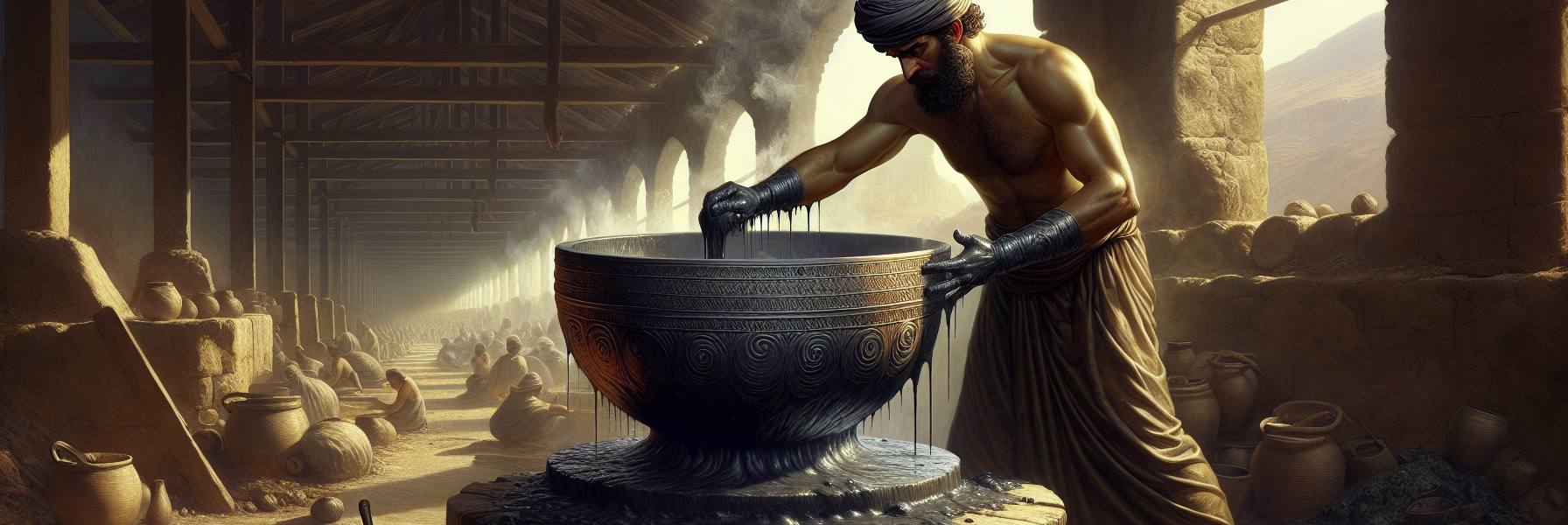

The air in the foundry at the clay grounds near the Jordan was thick, a haze of charcoal smoke and the hot, metallic scent of molten bronze. Huram-abi wiped his forearm across his brow, leaving a dark streak. Before him, the great Sea was not yet a sea, but a colossal, inverted bell of clay and wax, a negative space waiting to be filled. He could hear Solomon’s words again, delivered by the king’s own stewards: *“A basin for the priests to wash, ten cubits from brim to brim, perfectly round.”* The words were simple. The making was not.
His father, a Tyrian craftsman before him, had spoken of form following function, but here, in this project for the God of Israel, function was only the beginning. The bronze, once poured, must hold more than water; it must hold meaning. Ten cubits. A complete number. Round, with no beginning and no end, like the covenant. The brim had to be shaped like a lily, they said. A lily. He’d walked the hillsides until he found one, cupping the delicate, flaring bloom in his calloused hand, studying how the petals curled back, how strength and delicacy could exist in a single form. Translating that into clay, then into wax, then into bronze—it was a kind of prayer he didn’t know the words to.
Weeks later, under a sky bleached pale with heat, the cast was broken. The rough, fiery ingot of the Sea emerged, and the years of polishing began. Men worked in shifts, their muscles bunching and stretching as they dragged abrasive sands across the vast curve, until finally, the day came. Huram stood back as oxen, lowing and straining against the yokes, began the slow, perilous haul up to the high place of Jerusalem. The bronze, now cool and eternally fixed, caught the morning sun. It wasn’t a mere sheen; it was a deep, liquid glow, as if it had captured a piece of the sun’s own fire and tempered it into something still and waiting.
They placed it in the court, to the south, and only then did its true scale reveal itself. It stood five cubits high, a towering wall of reflected sky and temple stone. The lily-work brim, a masterwork of cast foliage, seemed to float. Beneath it, the twelve oxen, three facing each cardinal point, were more than supports. They were a silent congregation. Cast in one piece with the basin itself, their backs bore the immense weight without strain, their flanks sleek and powerful, their faces turned outward as if watching the horizons for the approach of… something. Or Someone. Huram remembered the old stories of the twelve tribes, a people borne through a wilderness. This sea rested on them.
Then they filled it. Water, drawn from the Gihon springs, was poured in, two thousand baths’ worth. The still, polished bronze became a perfect mirror, doubling the height of the temple walls, swallowing the blue of the sky. A priest, approaching for the first time, would see his own face reflected back from the heavens, distorted slightly by the gentle, unseen curve. The laver was for washing, a ritual cleansing before service. But seeing that vast, still expanse, Huram thought it was also for seeing. For remembering that the one who served approached not just a duty, but a mystery.
The other pieces stood in ordered ranks: the ten smaller basins on their wheeled stands, each a marvel of mobility and artistry—lion, ox, cherub, and wreath-work chasing around the panels. The shovels, the sprinkling bowls. The lampstands of pure gold, five to the south and five to the north before the inner sanctuary, their pure flower-cups waiting for the flame that would turn them into constellations of captive light.
But his eyes kept drifting back to the Sea. In the stillness of the evening, when the workmen’s shouts had faded and the rhythmic *clink* of final adjustments ceased, he walked over to it. The water was perfectly calm now. A first star, faint and pure, appeared in its bronze-held sky. It was just a vessel, made by his hands from ore dug from the earth. Yet, as he gazed into its impossible depth—a depth of metal, water, and reflection—he felt a peculiar stillness. He had made a shore. A limit for an infinite requirement. The priests would wash here, and the water would be disturbed, the stars shattered into ripples. But the Sea itself, the great, round, lily-crowned Sea, would remain. Holding, waiting, reflecting whatever heaven chose to show it. He picked up his tools, the familiar weight of them a comfort, and turned for home. The work was good. It was finished.