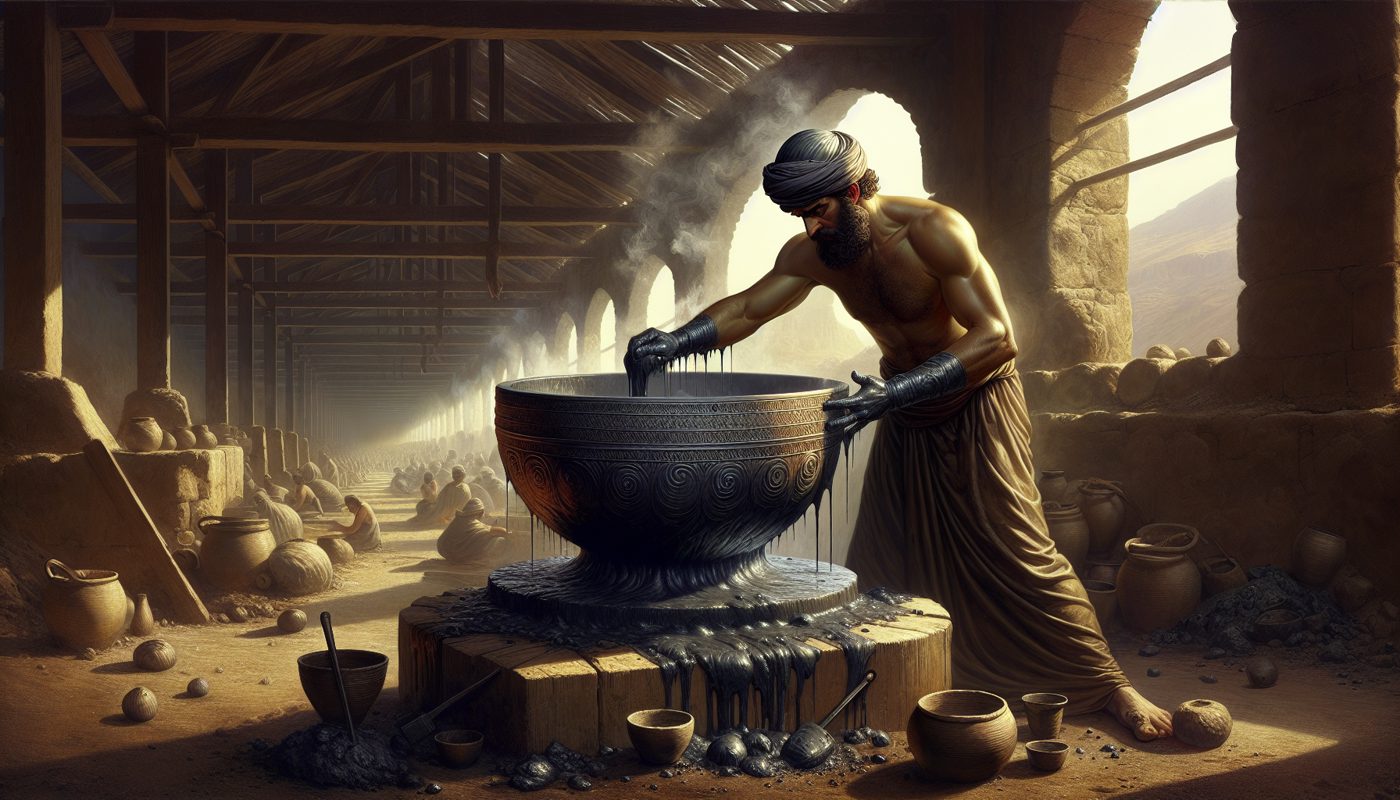
The chapter does not pause for poetry. It opens with an altar of brass—twenty cubits square, ten cubits high—and then moves to the molten sea. The numbers are given without commentary, as if the dimensions themselves carry the weight of the work. But the sea is not merely a basin. It is ten cubits from brim to brim, round, thirty cubits in circumference, and five cubits deep. The measurements are precise, and the shape is deliberate.
Under the sea, the chronicler notes, there were oxen—two rows of them, cast when the sea itself was cast. Twelve oxen stood beneath it, three facing each direction: north, west, south, east. Their hinder parts were turned inward, toward the sea, so that the animals faced outward, as if bearing the weight of the water on their backs. The image is not decorative; it is structural. The sea rested on living forms, and those forms were oriented to the four winds.
The brim was wrought like the brim of a cup, like the flower of a lily. The chronicler does not explain why a lily, only that the bronze was shaped that way. The sea held three thousand baths. That is the capacity given, and it is not a round number for effect. It is a fact of the casting. The sea was for the priests to wash in. The ten lavers, five on each side, were for washing the burnt offerings. The sea was for the priests themselves.
The chapter then lists the ten candlesticks of gold, set five on the right and five on the left in the temple. Ten tables, also gold, placed the same way. A hundred basins of gold. The court of the priests, the great court, the doors overlaid with brass. The sea was set on the right side of the house, eastward, toward the south. The chronicler is not telling a story; he is inventorying a sanctuary. But the inventory itself is a kind of witness.
Huram is named again. He made the pots, the shovels, the basins. He made an end of doing the work that he wrought for king Solomon in the house of God. The list resumes: the two pillars, the bowls, the capitals, the networks, the four hundred pomegranates in two rows for each network. The bases, the lavers upon the bases. One sea, and the twelve oxen under it. The pots, shovels, and flesh-hooks of bright brass.
The casting was done in the plain of the Jordan, in the clay ground between Succoth and Zeredah. The chronicler gives the location as if it matters where the bronze was poured. The clay ground held the molds. The heat of the furnace and the weight of the metal are not described, but the place is named. The work was done there, not in Jerusalem, not in the temple precincts, but in the lowlands east of the river, where the soil was thick enough to hold the forms.
Solomon made all these vessels in great abundance. The weight of the brass could not be found out. That is the chronicler's way of saying the scale was beyond accounting. The golden altar, the tables for the showbread, the candlesticks with their lamps of pure gold, the flowers, the lamps, the tongs, the snuffers, the basins, the spoons, the firepans—all of gold, and that perfect gold. The inner doors for the most holy place, and the doors of the temple, were of gold.
The chapter ends with the doors. Not with a ceremony, not with a dedication, not with a prayer. The doors of gold. The chronicler has moved from the clay ground to the inner sanctuary, from the molten sea to the firepans, from the oxen to the golden flowers. The work is finished. The house of God is furnished. The chapter does not say whether anyone was satisfied. It only says what was made, and that the weight of the brass could not be found out.
Comments
Comments 0
Read the discussion and add your voice.
Members only
Sign in to join the conversation
We keep comments tied to real accounts so the discussion stays clean and trustworthy.
No comments yet. Be the first to add one.