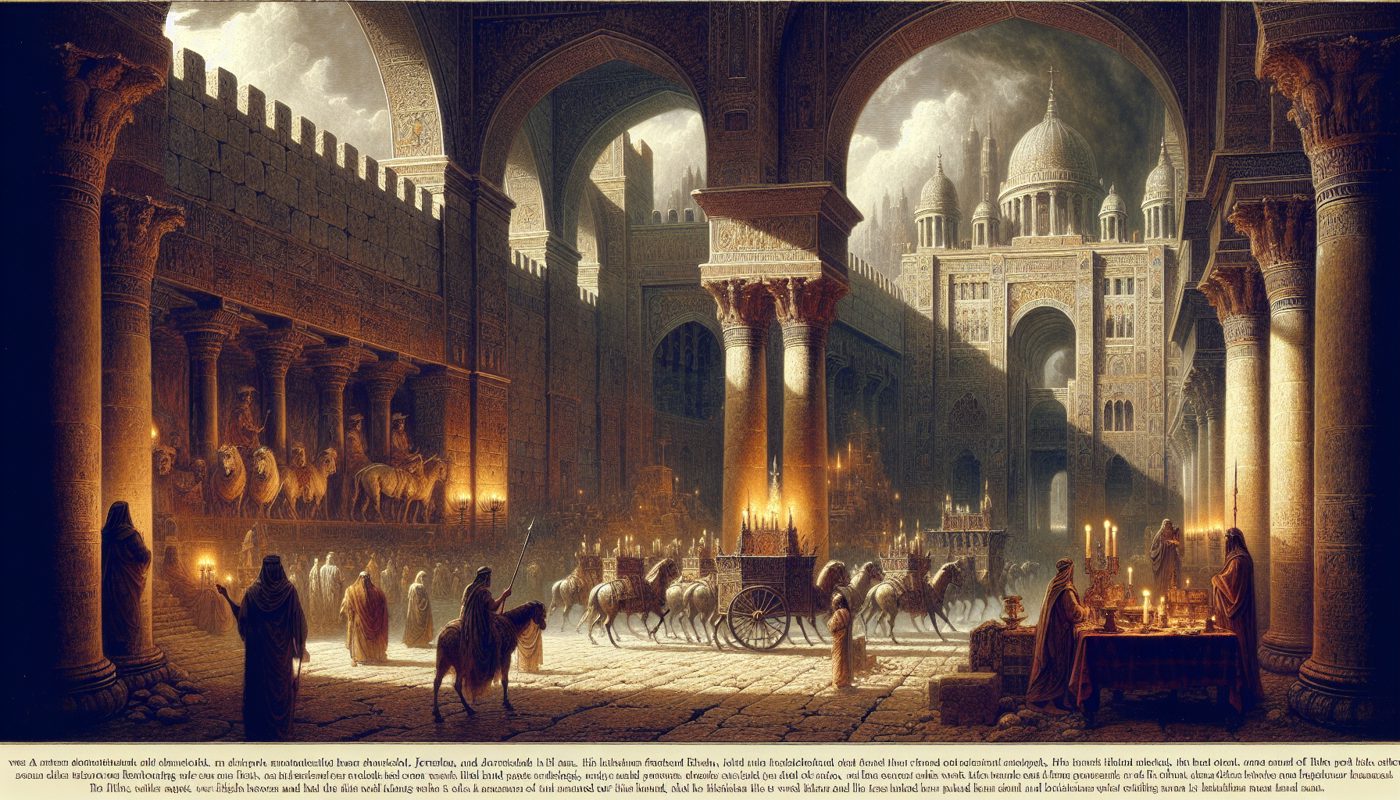
The chapter opens with a king made by the people, and closes with a king raised by a foreign power. Between them, the throne of David became a revolving door, and the house of the Lord was stripped, burned, and left to the weather. The chronicler does not linger on the glory of the temple; he records its emptying.
Jehoahaz reigned three months. The king of Egypt deposed him in Jerusalem itself, fined the land a hundred talents of silver and a talent of gold, and carried Jehoahaz to Egypt. That was the first deportation, small and personal, but it set the pattern: a king removed, a king installed, a king renamed. Neco changed Eliakim’s name to Jehoiakim, as if to say that even the name of a king belonged to the empire.
Jehoiakim reigned eleven years, and the chronicler sums him up in a single phrase: he did that which was evil in the sight of the Lord his God. No reform, no repentance, no repair of the temple. Instead, Nebuchadnezzar came up against him, bound him in fetters, and carried him to Babylon. And with the king went the vessels of the house of the Lord, placed in the temple of a Babylonian god.
Jehoiachin followed, eight years old, reigning three months and ten days. The chronicler does not explain how a child ruled; he simply records the evil and the outcome. Nebuchadnezzar sent for him at the turn of the year, brought him to Babylon, and took the goodly vessels of the house of the Lord. Then he made Zedekiah, another brother, king over Judah and Jerusalem.
Zedekiah reigned eleven years, and the chronicler gives the reason for his fall: he did evil, he did not humble himself before Jeremiah the prophet, and he rebelled against Nebuchadnezzar, the king who had made him swear by God. The language is precise: he stiffened his neck and hardened his heart against turning to the Lord, the God of Israel.
But the chronicler does not blame only the king. The chiefs of the priests and the people trespassed greatly, following the abominations of the nations, and they polluted the house of the Lord which he had hallowed in Jerusalem. The corruption was not a palace secret; it was public, priestly, and pervasive.
The Lord sent his messengers, rising up early and sending, because he had compassion on his people and on his dwelling place. But they mocked the messengers, despised his words, and scoffed at his prophets, until the wrath of the Lord arose against his people, till there was no remedy. That phrase—no remedy—is the hinge of the chapter.
So the Lord brought upon them the king of the Chaldeans. He slew their young men with the sword in the house of their sanctuary. He had no compassion on young man or virgin, old man or hoary-headed. He gave them all into his hand. The temple that had been polluted became the place of slaughter.
All the vessels of the house of God, great and small, the treasures of the house of the Lord, the treasures of the king and his princes—all were brought to Babylon. Then they burned the house of God, broke down the wall of Jerusalem, burned all the palaces, and destroyed all the goodly vessels. The city that had been hallowed was made desolate.
Those who escaped the sword were carried away to Babylon, and they became servants to Nebuchadnezzar and his sons until the reign of the kingdom of Persia. The chronicler adds a theological note: this fulfilled the word of the Lord by the mouth of Jeremiah, until the land had enjoyed its sabbaths. For as long as it lay desolate it kept sabbath, to fulfill seventy years.
Then the chapter turns. In the first year of Cyrus king of Persia, the Lord stirred up his spirit to make a proclamation throughout all his kingdom. Cyrus declared that the Lord, the God of heaven, had given him all the kingdoms of the earth and had charged him to build a house in Jerusalem. Whoever among the Lord’s people wished to go up, let him go. The sieve of Babylon had sifted the nation, but the word of the Lord held the final shape.
Comments
Comments 0
Read the discussion and add your voice.
Members only
Sign in to join the conversation
We keep comments tied to real accounts so the discussion stays clean and trustworthy.
No comments yet. Be the first to add one.