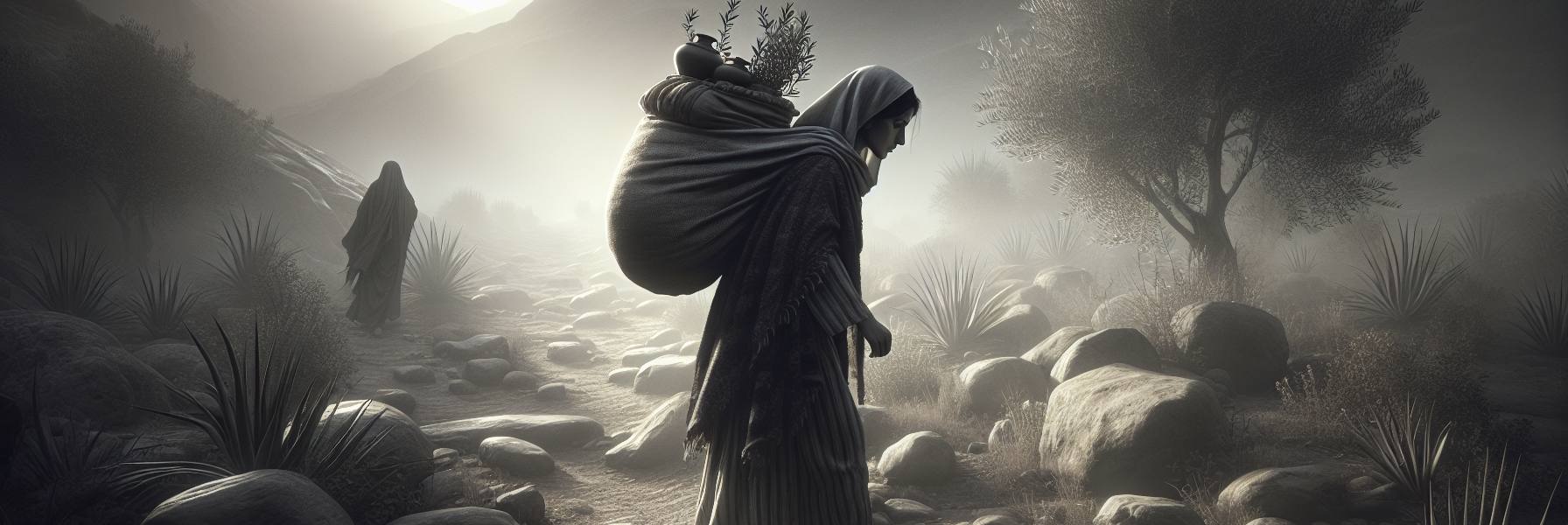

The first hint of light was not the sun, but a slow, grey leaching of the night. It found the edges of the world—the sharp rocks of the garden, the pale leaves of the gnarled olive trees—and sketched them into being. For Mary of Magdala, the darkness had been total, a thick shroud wrapped around her heart since Friday afternoon. She hadn’t slept. The memory of his face, broken and still, played against her closed eyelids. So she rose while it was yet dark, her movements stiff with a grief that felt more like a physical weight, and gathered the other Mary. The spices they carried were a futile gesture, she knew. The tomb would be sealed. The body would already be… but it was a thing to do, the last act of love they could perform.
The walk was quiet, save for the crunch of their sandals on the path and the distant cry of a waking bird. The air held the deep, clean chill that comes just before dawn. As they neared the place, a new worry pricked at her. The stone. Who would roll it away for them? It was a massive thing, set in a groove to seal the entrance. They were powerless against it.
Then the ground trembled. Not a violent quake, but a deep, resonant shudder, as if the earth itself took a great breath. A light, not of the approaching sun, flashed from the direction of the tomb—a swift, silent radiance that was gone before they could truly comprehend it. They hurried now, fear lending speed to their feet.
The stone was gone. Not rolled aside, but flung back, lying at a distance like a discarded pebble. The black mouth of the tomb was open. Mary Magdalene, her heart a wild drum against her ribs, ran forward and peered in. The niche where they had laid him was empty. The linen wrappings were there, collapsed in upon themselves, orderly but vacant. The cloth that had been around his head was folded neatly, set apart.
She didn’t understand. She thought only of theft, of a final, cruel indignity. A sob tore from her throat, and she turned and ran back toward the city, leaving the other women standing there, bewildered.
As she ran, the others remained, trembling, staring into the void. Then a young man was there, sitting on the right side of the stone bench where the body had been. He was clothed in a robe so blindingly white it seemed to drink the dim light of the tomb and give it back tenfold. They froze, falling to the ground in terror, shielding their faces.
“Do not be afraid,” he said, and his voice was strangely normal, calm, cutting through their panic. “You are looking for Jesus the Nazarene, who was crucified. He is not here. See the place where they laid him. But go, tell his disciples—and Peter—that he is going ahead of you into Galilee. There you will see him, just as he told you.”
The words, ‘and Peter’, echoed with a particular kindness, a specific grace for the one who had denied him. The women fled the tomb, their earlier sorrow now mixed with a terror and a wild, disbelieving joy. They said nothing to anyone at first, for the fear was still upon them. It was too vast, too impossible.
Meanwhile, Mary Magdalene had found Peter and the disciple Jesus loved. Gasping, tears streaking the dust on her face, she could only manage, “They have taken the Lord out of the tomb, and we don’t know where they have put him!”
The two men erupted into motion, a desperate race through the waking streets. The younger disciple outran Peter, reaching the tomb first. He stooped, looked in at the linen cloths lying there, but didn’t enter. Then Peter arrived, breathless, and without hesitation plunged into the cool darkness. He saw the linens, and the head cloth folded separately. The younger disciple entered then, and seeing, he believed. For the first time, the scripture—the cryptic promises he had heard but never grasped—pierced his understanding: *he must rise from the dead*. Yet this belief was a silent, awestruck thing. They went back to their own homes, carrying a mystery too great for words.
But Mary stood outside the tomb, weeping. She had followed them back, and now, alone again, the grief returned, redoubled. She stooped to look once more into the shadows, as if her eyes had deceived her.
Two angels in white sat where Jesus’ body had been, one at the head and one at the feet. “Woman,” they asked, “why are you weeping?”
“They have taken my Lord away,” she said, the words raw and simple. “And I don’t know where they have put him.”
Saying this, she turned around, perhaps sensing another presence. A man stood there, outlined against the grey dawn. She assumed he was the gardener. Perhaps he had seen something.
“Woman,” he said, “why are you weeping? Who is it you are looking for?”
Through her tears, her mind clouded with loss, she pleaded, “Sir, if you have carried him away, tell me where you have put him, and I will get him.”
Then he spoke a single word. Her name. “Mary.”
It was the way he said it. Not a question, but a declaration. A voice that carried the weight of all creation and the tenderness of a close friend. A voice that had called her out of darkness once before. The world tilted. The gardener’s form dissolved, and she knew.
“Rabboni!” My Teacher. The word was a gasp, a cry of recognition. She moved to clutch him, to hold this reality fast.
“Do not hold on to me,” he said gently, but with a firmness that halted her. “For I have not yet ascended to the Father. But go to my brothers and tell them, ‘I am ascending to my Father and your Father, to my God and your God.’”
The instruction was clear. This was not a return to how things were. It was the opening of something entirely new. The embrace she longed for was to be replaced by a message, a commissioning. Her grief was gone, evaporated in the warmth of his presence. The tears on her face were already drying.
Mary Magdalene went to the disciples, her face transformed. “I have seen the Lord!” she told them. And she repeated what he had said to her. They listened, but their faces were a tapestry of doubt, hope, confusion, and fear. It was too much to take in.
Later, as the eleven gathered behind locked doors, paralyzed by fear of the religious authorities, he came. Not through the door, but simply was there, standing among them. The familiar voice broke the silence of their terror. “Peace be with you.”
He showed them his hands and his side. The wounds were real, but they were not marks of death. They were seals of identity, proof of the price paid and the victory won. The room, once thick with dread, filled with a disbelieving joy.
“Peace be with you,” he said again, and the words now carried a new weight. “As the Father has sent me, I am sending you.” And he breathed on them. It was an intimate, powerful act, a creation anew. “Receive the Holy Spirit. If you forgive anyone’s sins, they are forgiven; if you do not forgive them, they are not forgiven.”
One of them, Thomas, had been absent. When the others told him, “We have seen the Lord!” he met their joy with hard-edged skepticism. “Unless I see the nail marks in his hands and put my finger where the nails were, and put my hand into his side, I will not believe.”
A week later, they were together again, Thomas with them. The doors were still locked, but locks were irrelevant. He came and stood among them. “Peace be with you,” he said. Then he looked directly at Thomas. “Put your finger here; see my hands. Reach out your hand and put it into my side. Stop doubting and believe.”
Thomas didn’t need to touch. The sheer, loving specificity of the invitation shattered his resistance. He fell to his knees, the greatest confession bursting from his lips. “My Lord and my God!”
Jesus said, “Because you have seen me, you have believed; blessed are those who have not seen and yet have believed.”
The story did not end in that locked room. They went to Galilee, to the mountain he had designated. When they saw him, some worshipped, but even then, some hesitated, doubt and wonder still at war within them. He came close, his authority undimmed by their frailty.
“All authority in heaven and on earth has been given to me,” he said, and the statement hung in the air, vast and undeniable. “Therefore go and make disciples of all nations, baptizing them in the name of the Father and of the Son and of the Holy Spirit, and teaching them to obey everything I have commanded you.”
He paused, letting the immensity of the task settle upon them. They were a handful of frightened men and women, facing the whole world. Then he finished, and his final words were not a burden, but a promise that stretched across all of time, all of distance, into every locked room and every fearful heart.
“And surely I am with you always, to the very end of the age.”
The dawn that had begun in a garden of grief had broken into an unending day. They stood there, on the mountain, with the wind in their hair and a commission in their hearts, knowing the world had just been unmade and remade. And he was with them.