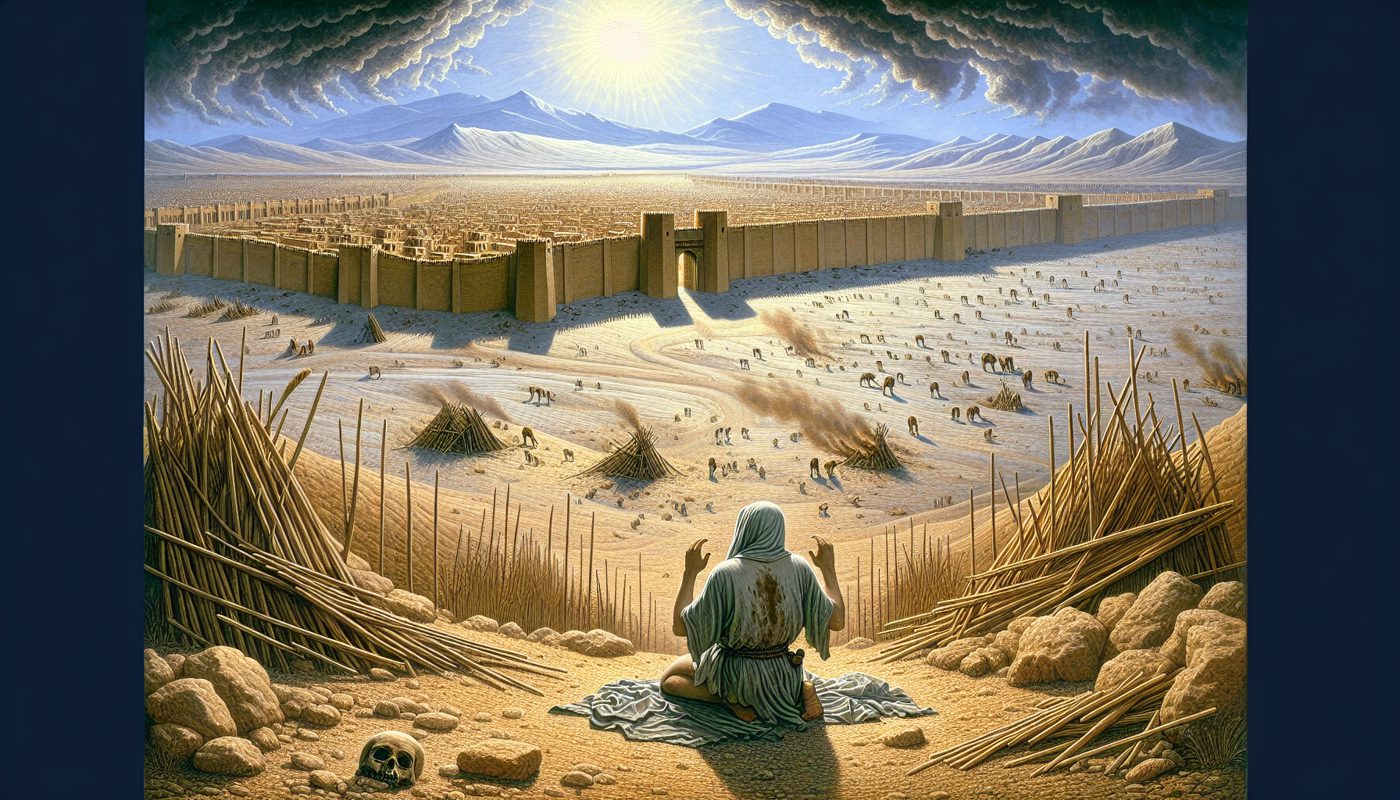
The chapter opens with a blunt statement: Jonah was displeased, and he was angry. Not angry at the Ninevites for their cruelty, not angry at the king for his hypocrisy, but angry at the Lord for being merciful. The text does not soften this. Jonah prays, and his prayer is a complaint. He reminds the Lord that this is exactly why he fled to Tarshish in the first place. He knew the Lord was gracious, merciful, slow to anger, abundant in lovingkindness, and ready to relent from disaster. These are the very attributes that Israel sang about in the wilderness. Jonah recites them as an accusation.
Jonah asks the Lord to take his life. He says it is better for him to die than to live. The Lord answers with a question: Do you do well to be angry? The question is not rhetorical. It stands open, waiting for an answer. Jonah does not answer it. Instead, he leaves the city, goes to the east side, builds a booth, and sits in its shade to watch what will become of Nineveh. He is waiting for the judgment he still believes should fall.
The Lord prepares a gourd. The plant grows up over Jonah to shade his head and deliver him from his evil case. Jonah is exceedingly glad because of the gourd. The text does not say he thanks the Lord. It says he is glad for the plant. His joy is tied to a small, personal comfort, not to the survival of a hundred and twenty thousand people.
The next morning, the Lord prepares a worm. It attacks the gourd, and the gourd withers. Then the Lord prepares a sultry east wind. The sun beats on Jonah's head. He faints and again asks to die. He says it is better for him to die than to live. The Lord asks again: Do you do well to be angry for the gourd? Jonah answers this time. He says he does well to be angry, even to death.
The Lord draws the comparison. Jonah had regard for the gourd, a plant he did not labor over, did not make grow, which came up in a night and perished in a night. The Lord asks why He should not have regard for Nineveh, that great city. The city contains more than one hundred and twenty thousand persons who cannot discern between their right hand and their left hand, and also much cattle.
The chapter ends there. There is no record of Jonah's reply. The Lord's question is the final word. The reader is left with the weight of that question. Jonah's anger is not resolved. The Lord's mercy is not explained away. It simply stands, larger than Jonah's booth, larger than the withered gourd, larger than the prophet's own sense of justice.
The text does not tell us what Jonah thought of the cattle. It does not tell us whether he ever accepted the Lord's reasoning. The chapter is a confrontation, not a conclusion. Jonah's anger is laid bare, and the Lord's mercy is laid bare alongside it. The two do not reconcile in the text. The reader is left to sit in the heat with that tension.
The Lord's final question is not a gentle suggestion. It is a challenge. Jonah had regard for a plant that gave him shade for a day. The Lord had regard for a city full of people who did not know their right hand from their left. The comparison is stark. The Lord's mercy extends beyond the boundaries of Jonah's comfort, beyond the boundaries of Israel, beyond the boundaries of what Jonah considers just.
The chapter does not explain why the Lord chose to spare Nineveh. It does not explain why Jonah's anger was wrong. It simply presents the two realities side by side. Jonah's anger is real. The Lord's mercy is real. The chapter forces the reader to sit with both, without resolution, without a neat moral. The Lord's question hangs in the air, unanswered.
Comments
Comments 0
Read the discussion and add your voice.
Members only
Sign in to join the conversation
We keep comments tied to real accounts so the discussion stays clean and trustworthy.
No comments yet. Be the first to add one.