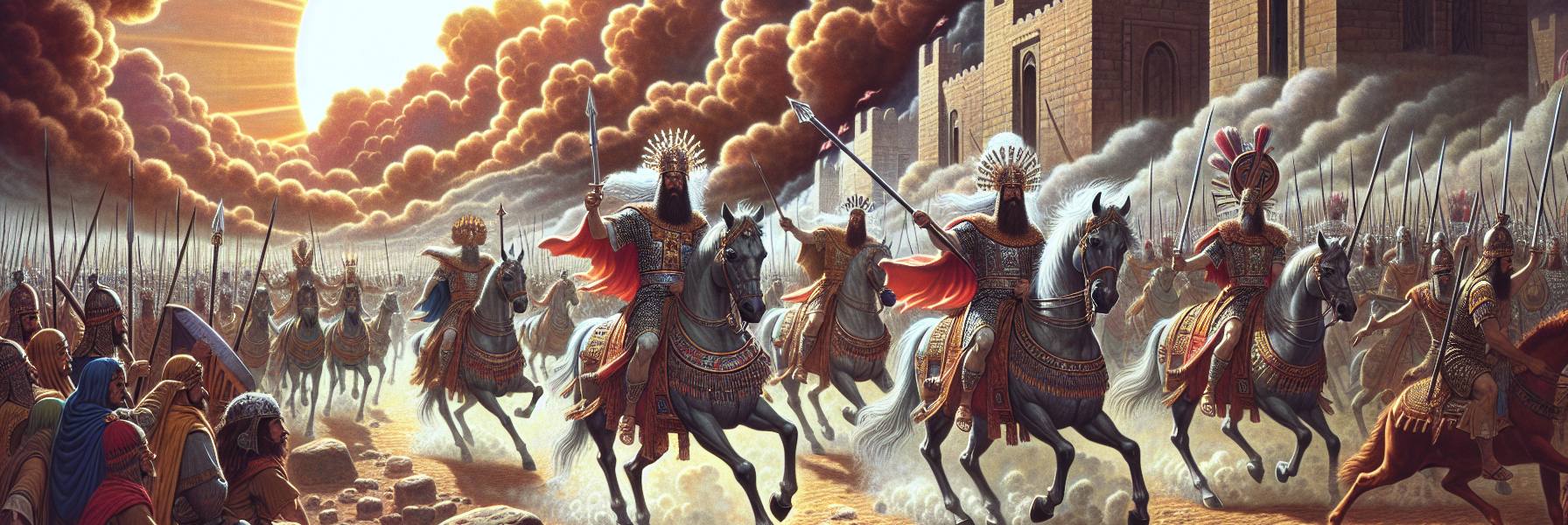

The sun was a hammer on the bronze sky, and the dust of the dry way rose in bitter plumes behind the feet of three armies. Jehoram of Israel, newly crowned and restless, had marched from Samaria with a force that clattered with the arrogance of a king who did not walk in the ways of his father Ahab, but not far enough from them. He had sent word south, to Jehoshaphat in Jerusalem, whose reputation for piety was a garment he wore uneasily over the mantle of a ruler. The request was simple: join against Mesha, king of Moab, a vassal who had stopped his tribute of a hundred thousand lambs and the wool of as many rams. The rebellion was a stone in Jehoram’s shoe.
Jehoshaphat, ever the cautious diplomat, gave the same weary answer he had once given Ahab. *I am as you are, my people as your people, my horses as your horses.* But there was a tightness around his eyes when he said it. The third force was the silent, sullen host of the king of Edom, dragged into the alliance by a geography that offered no neutrality.
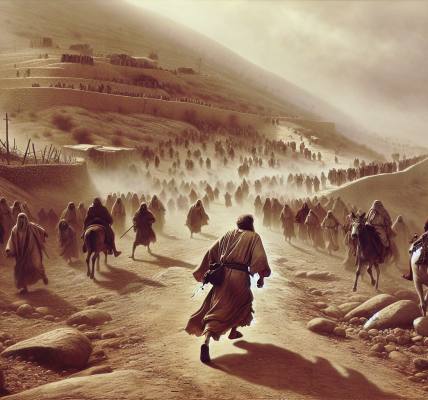
Seven days they marched, the long way around the Salt Sea, through the terrible desolation of Edom. The caravan of men and animals became a slow, dying serpent. The wadis they had counted on, the maps whispered of, were dry gullies of cracked mud and bleached stone. Not a seep, not a puddle. The horses began to sway on their feet. The infantry’s lips cracked and bled. The dust coated their throats.
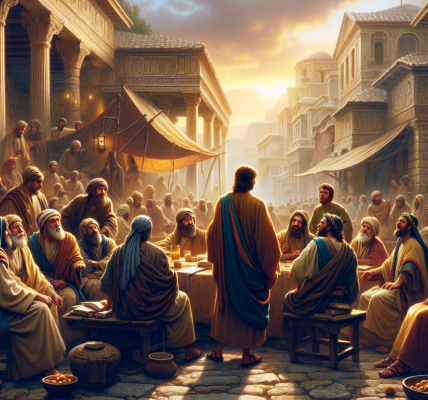
In a scorched valley, the armies ground to a halt. The kings, their finery grey with dust, dismounted. The crisis was plain. Jehoram, the instigator, felt the first cold claw of panic. “Alas!” he cried, the sound a rasp in the dry air. “Has the Lord called these three kings together only to deliver us into the hand of Moab?” His theology was transactional, a curse born of convenience.
Jehoshaphat, though afraid, moved from a different place. A memory stirred in him—of another desert, another prophet. “Is there no prophet of the Lord here,” he asked, “that we may inquire of the Lord through him?”
One of Jehoram’s officers, a man with a face seamed by more than sun, spoke up. “Elisha son of Shaphat is here, who poured water on the hands of Elijah.” The description was humble, a servant’s task, but it carried the weight of legacy.
“The word of the Lord is with him,” Jehoram conceded, bitterness shading his hope. So the three kings, stripped of pretense, went down to find him.
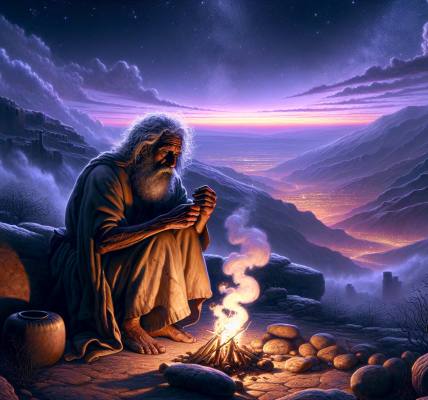
They found Elisha at the edge of the camp, where the desperation was thinnest. He was not in a tent of state, but sitting in the scant shade of a cliff, his face unreadable. When he saw Jehoram, his spirit hardened visibly. “What do I have to do with you?” he said, his voice low and sharp as a flint. “Go to the prophets of your father and the prophets of your mother.” The rebuke was for the calf-idols of Bethel and Dan, the inherited apostasy.
But Jehoram, cornered, showed a shred of kingly acuity. “No,” he said, the word quiet. “For it is the Lord who has called us three kings together to deliver us into the hand of Moab.”
The honesty, or the desperation it revealed, changed the air. Elisha’s gaze shifted to Jehoshaphat. “As surely as the Lord Almighty lives, whom I serve, if I did not have respect for the presence of Jehoshaphat king of Judah, I would not look at you or even notice you.” The favor was borrowed, a mercy for the sake of one flawed but seeking man. “Now bring me a harpist.”
It was an odd request in a dying camp. But a man was found, a lyre produced. The harpist began to play, a thin, questing melody that seemed foolish against the vast silence of the drought. Elisha listened, his eyes closed. The tension in his shoulders eased. Then the hand of the Lord came upon him.
He spoke, and his voice was different, carrying a resonance that cut through the music. “This is what the Lord says: ‘Make this valley full of ditches.’” It was an absurd command. Dig for water that wasn’t there? It was a labor that would drain their final strength. But Elisha continued, the prophecy weaving a tapestry of mundane and miraculous. “You will see neither wind nor rain, yet this valley will be filled with water, and you and your flocks and herds will drink. This is an easy thing in the eyes of the Lord; he will also deliver Moab into your hands.”
The promise hung in the hot air. Then he detailed the coming victory with a soldier’s precision: felling every fortified city, ruining every good field, stopping every spring, felling every good tree.
They obeyed. All that day and into the evening, the sound of bronze tools biting into the hardpan echoed through the valley—a symphony of foolish faith. Men dug with the last of their strength, scoffing whispers passing between them. At twilight, they collapsed by their shallow, empty trenches, expecting to die in them.
But in the morning watch, when the world was darkest and coldest, a sound came from the direction of Edom. Not rain. A distant, gathering roar, like a great company marching. It was water. A flood, sent by the Lord from some distant, unseen storm in the hills, coursing through the dry riverbeds of Edom, filling the wadis, and rushing into the ditches they had dug. It flowed red with Edomite clay, a river of blood in the pre-dawn gloom, pooling in their trenches, a miracle of timing and provision.
The sun rose on an army drinking, laughing, shouting, plunging their faces into the life-giving mud. The same dawn light, however, gleamed on the heights of Moab. The Moabite lookouts, seeing the water red in the low sun, the armies milling around it, came to a logical, fatal conclusion. “That is blood!” they cried to King Mesha. “The kings have surely fought and slaughtered each other. Now to the plunder, Moab!”
So the Moabites, every man who could bear arms, poured down from their high places, disorganized and greedy, expecting to strip corpses. They came shouting, crashing into the valley, and found not a camp of the dead, but a refreshed and waiting army of Israel, Judah, and Edom. The shock was total. Trumpets blared. The allied forces rose up and struck them with the force of a hammer. The Moabites broke and fled, the Israelites driving them back into their own land, pursuing, taking town after town as Elisha had foretold, filling the good fields with stones, stopping the springs, felling the trees. Only the capital, Kir Hareseth, remained, its stone walls besieged, surrounded by slingers who hurled stones with a relentless, grinding rhythm.
On the wall, King Mesha stood. He saw the ruin of his land, the inexorable tightening of the siege. Desperation of a different kind seized him. In a final, horrific act of pagan devotion, seeking to summon the fury of his god Chemosh, he took his firstborn son, the crown prince, and on the wall in full view of both armies, he offered him as a burnt offering.
A great wrath, a palpable and terrible dismay, fell upon the Israelite camp. It was not the wrath of Chemosh, but a profound, collective revulsion. The act was so abhorrent, so beyond the pale of war, that it broke the spirit of the siege. The campaign, successful by every measure, suddenly felt cursed, unclean. A decision passed through the ranks like a cold wind. The armies withdrew. They turned their backs on the smoldering ruin of Kir Hareseth and the haunting smoke of that awful sacrifice, and began the long march home, victorious and utterly empty.
The water in the ditches would soon dry up. The story would be told, but always with a shadow at its edge—a miracle of provision, a gift of victory, and at the end, a reminder of the terrible cost of kings and the dark altars to which desperation can lead. They returned to their kingdoms not with a triumphant shout, but with the taste of dust and ashes.