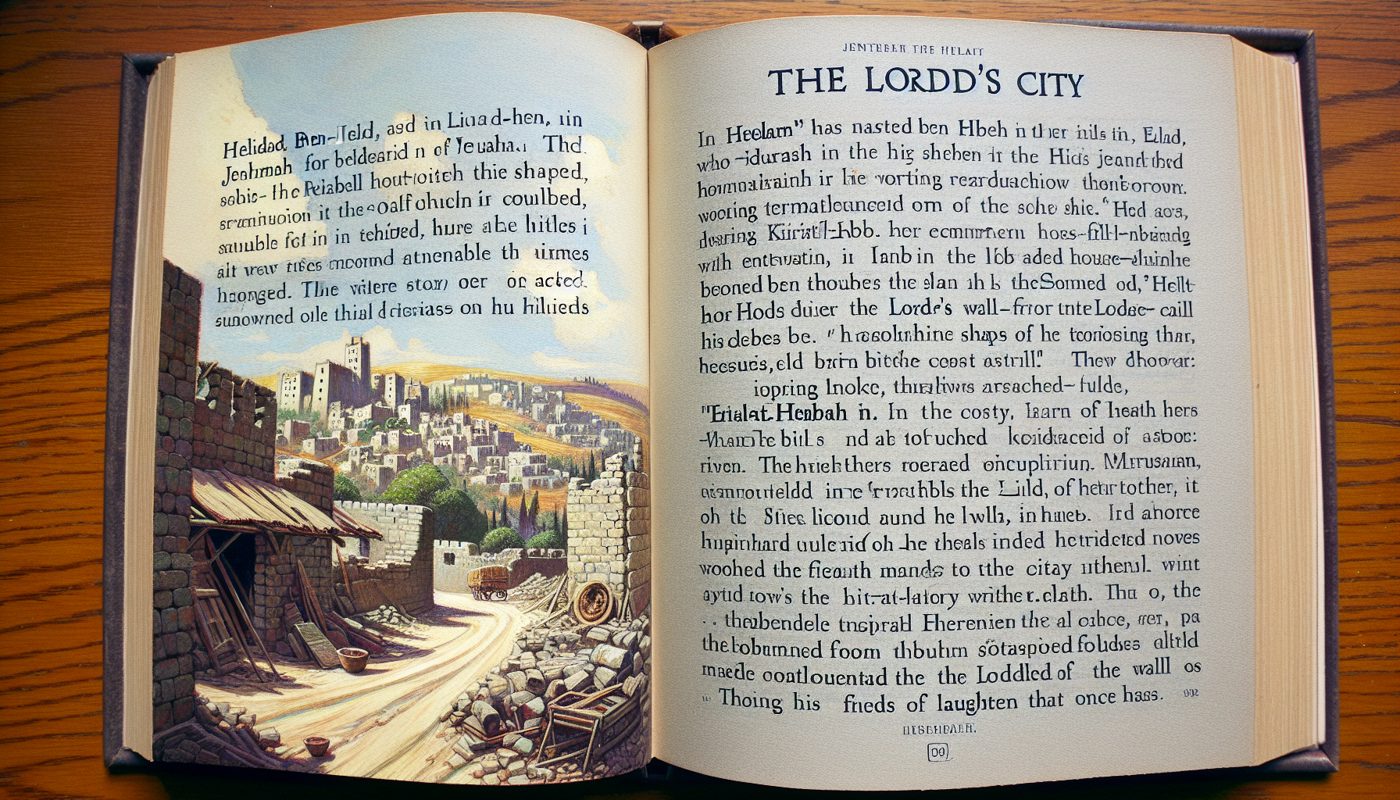
The chapter opens with a blunt administrative fact: the leaders were already living in Jerusalem, but the rest of the people had to be compelled. The walls stood, the gates hung, but the city itself was underpopulated. The solution was a lottery. One out of every ten families would be chosen by lot to move into Jerusalem, the holy city. The other nine parts would remain in their towns. This was not a voluntary migration. It was a civic and religious necessity, decided by chance, enforced by the governor.
Yet the text immediately records a second group. The people blessed all the men who willingly offered themselves to dwell in Jerusalem. The lottery produced the required number, but the volunteers received a public blessing. The chapter does not say how many volunteered, only that their choice was honored. The lottery was the law; the volunteers were the gift.
The rest of the chapter is a register. It lists the chiefs of the province who lived in Jerusalem, then the families of Judah and Benjamin who settled there. The numbers are precise: 468 men of the sons of Perez from Judah, 928 men of Benjamin, 822 priests who did the work of the house, 242 chiefs of fathers' houses among the priests, 128 mighty men of valor among the priests, 284 Levites, and 172 porters who kept watch at the gates. These are not round numbers. They are the actual count of men who moved into the city.
The list includes names and lineages. Athaiah, Maaseiah, Sallu, Gabbai, Sallai, Joel, Judah, Jedaiah, Seraiah, Adaiah, Amashsai, Shemaiah, Shabbethai, Jozabad, Mattaniah, Bakbukiah, Abda, Akkub, Talmon, Uzzi, Pethahiah. These are not famous names. They are the men who left their ancestral towns and took up residence in a city that was still partly rubble. The chapter records them because their move mattered.
The Levites are given special attention. Mattaniah was the chief to begin the thanksgiving in prayer. Bakbukiah was second among his brethren. The singers had a settled provision from the king, a daily requirement that was commanded. This is not a spontaneous worship revival. It is a funded, organized liturgical structure. The house of God needed singers, and the king had already arranged for their support.
Pethahiah, of the sons of Zerah, was at the king's hand in all matters concerning the people. This is a political detail. The governor Nehemiah was not the only authority. There was a royal representative, a Judahite who stood before the Persian king on behalf of the people. The chapter does not explain how this worked, only that it was the arrangement.
The Nethinim, the temple servants, lived in Ophel. Ziha and Gishpa were over them. These were the lowest rank of temple personnel, but they had their own overseers and their own quarter. The chapter treats them as part of the settled order, not as an afterthought.
The chapter then shifts to those who did not move. The residue of Israel, the priests, and the Levites stayed in all the cities of Judah, each in his inheritance. The lottery did not empty the countryside. It only thinned it. The villages and their fields remained occupied. The chapter lists the towns where the children of Judah lived: Kiriath-arba, Dibon, Jekabzeel, Jeshua, Moladah, Beth-pelet, Hazar-shual, Beer-sheba, Ziklag, Meconah, En-rimmon, Zorah, Jarmuth, Zanoah, Adullam, Lachish, Azekah. The Benjaminites lived in Geba, Michmash, Aija, Beth-el, Anathoth, Nob, Ananiah, Hazor, Ramah, Gittaim, Hadid, Zeboim, Neballat, Lod, Ono. The chapter ends with a note that certain courses of Levites in Judah were joined to Benjamin.
The list is the point. The chapter is not a story. It is a record of a people being rearranged by lot and by choice. The lottery removed the randomness of personal preference. The volunteers added the element of willingness. Together, they filled the holy city with men who could trace their lines, men who could guard the gates, men who could lead the thanksgiving, men who stood at the king's hand. The city was no longer a ghost town. It was a census of named families, each one a stone in the wall of the living community.
Comments
Comments 0
Read the discussion and add your voice.
Members only
Sign in to join the conversation
We keep comments tied to real accounts so the discussion stays clean and trustworthy.
No comments yet. Be the first to add one.