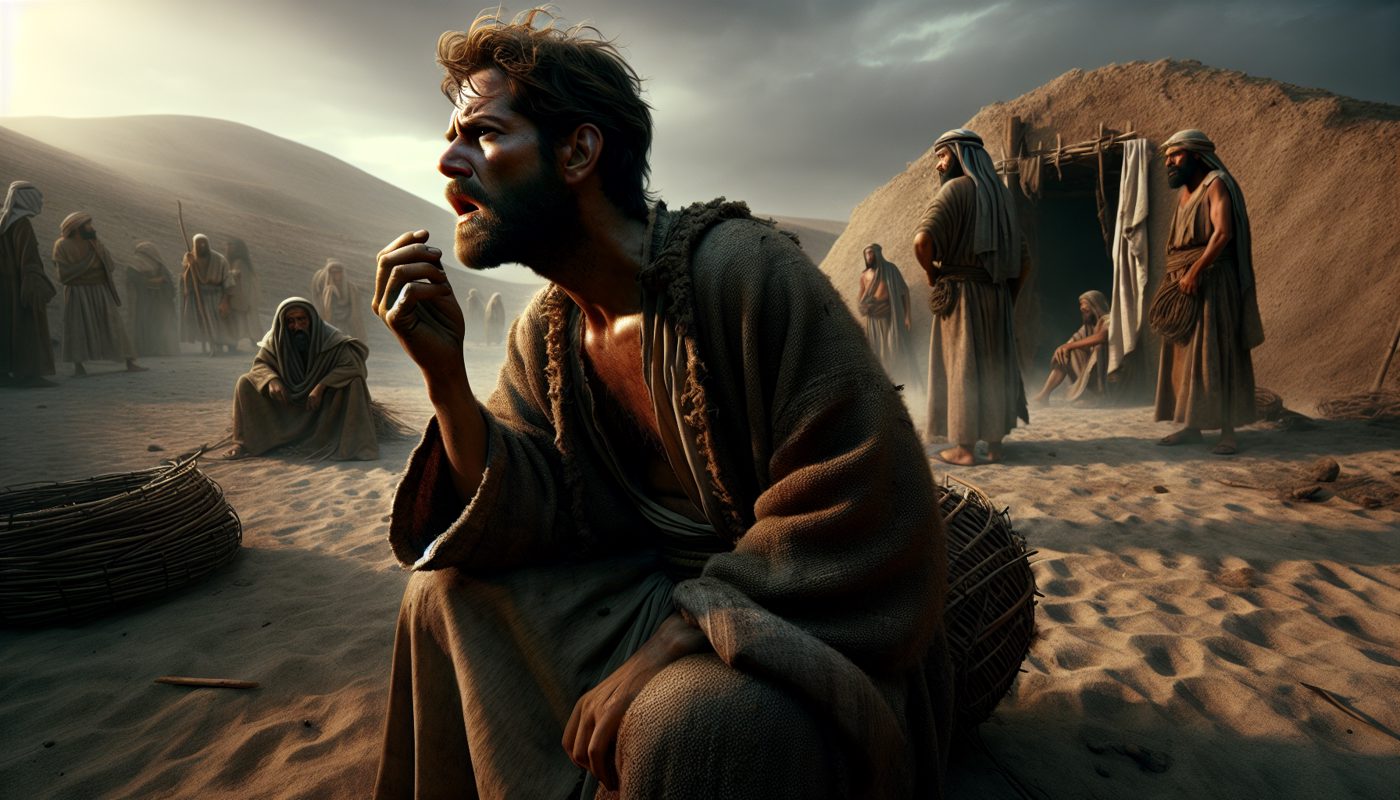
Zophar the Naamathite answered, and his answer was not a request for dialogue but a declaration. He had heard Job’s words as a reproof that shamed him, and the spirit of his own understanding compelled him to speak. There was no hesitation in his voice, no room for the possibility that the old framework might not hold. He began with a question that was not really a question: “Do you not know this of old time, since man was placed upon earth, that the triumphing of the wicked is short, and the joy of the godless but for a moment?” For Zophar, this was not a matter of observation but of axiom, a law written into the fabric of the world before Job’s suffering ever began.
He did not look at Job’s sores or his ash heap. He looked past him, at the logic that had always made sense. “Though his height mount up to the heavens, and his head reach unto the clouds, yet he shall perish forever like his own dung.” The image was deliberately crude, a reduction of human pride to waste. Zophar was not trying to comfort; he was trying to correct. He was drawing a line between the righteous and the wicked, and he was certain which side Job stood on.
The speech rolled forward with a grim momentum. “He shall fly away as a dream, and shall not be found; yea, he shall be chased away as a vision of the night.” The wicked man, in Zophar’s telling, leaves no trace. The eye that saw him sees him no more. His place does not know him. Even his children are reduced to seeking favor from the poor, and his hands are forced to give back what he took. There is no legacy, no continuity, only erasure.
Zophar turned to the interior life of the wicked man, and here his language became almost physiological. “Though wickedness be sweet in his mouth, though he hide it under his tongue, though he spare it and will not let it go, yet his food in his bowels is turned; it is the gall of asps within him.” The sweetness of sin becomes poison in the gut. What the wicked man swallows with pleasure he must vomit up again. God himself casts it out of his belly. The body of the wicked becomes a site of divine judgment, a stomach that cannot hold its own greed.
The violence of the imagery intensified. “He shall suck the poison of asps; the viper’s tongue shall slay him.” The rivers of honey and butter, the images of abundance, are denied him. He labors but does not swallow; he acquires but does not rejoice. Zophar was not describing a man who merely fails; he was describing a man under active assault from the Lord, a man whose every pleasure curdles into pain.
Why? Because he oppressed and forsook the poor. Because he violently took away a house and will not build it up. Because he knew no quietness within him and could not save anything he delighted in. Zophar’s logic was circular and airtight: the wicked man’s prosperity does not endure because he is wicked, and his wickedness is proven by the fact that his prosperity does not endure. There was no room in this system for a righteous sufferer.
Zophar painted a scene of siege. “In the fullness of his sufficiency he shall be in straits; the hand of every one that is in misery shall come upon him.” When the wicked man is about to fill his belly, God casts the fierceness of his wrath upon him and rains it down while he is eating. He flees from the iron weapon, but the bow of brass strikes him through. The arrow comes out of his body, the glittering point out of his gall, and terrors are upon him. This is not a natural death; it is an execution.
“All darkness is laid up for his treasures; a fire not blown by man shall devour him; it shall consume that which is left in his tent.” The heavens themselves reveal his iniquity; the earth rises up against him. His house departs, his goods flow away in the day of his wrath. Zophar concluded with a sentence that sounded like a verdict read from a bench: “This is the portion of a wicked man from God, and the heritage appointed unto him by God.”
Zophar spoke as if he had seen the books, as if he knew exactly what Job deserved. He did not ask whether Job had done these things; he assumed it. His certainty was unbroken, his theology untouched by the man sitting in front of him. He had answered not Job’s pain but his own need for a world that made sense, a world where suffering always meant guilt and prosperity always meant blessing. The speech was a wall built of old certainties, and Job was left on the other side of it.
Comments
Comments 0
Read the discussion and add your voice.
Members only
Sign in to join the conversation
We keep comments tied to real accounts so the discussion stays clean and trustworthy.
No comments yet. Be the first to add one.