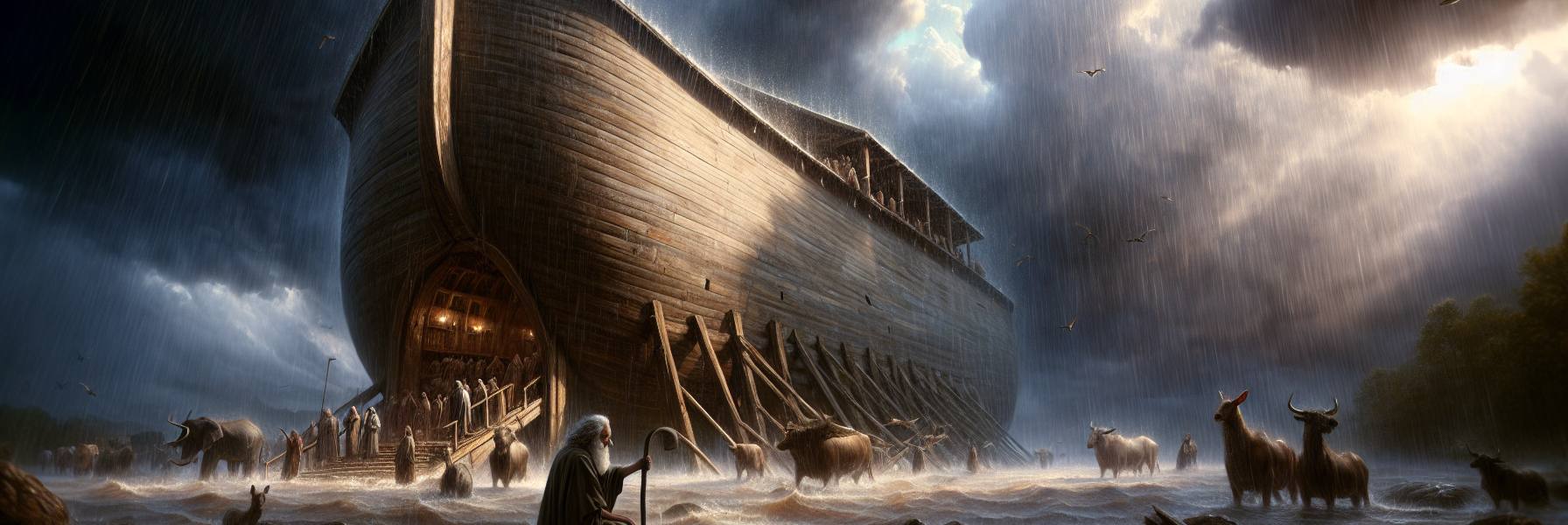

The rain stopped.
It didn’t taper off. It didn’t fade into a drizzle. It simply ceased, and the absence of its drumming on the great roof of the ark was a noise in itself. A deep, ringing silence filled the world, broken only by the shifting of animals and the creak of timber. Noah sat in that silence for a long time, his ears aching with the new quiet. The air, thick and damp for so long, began to feel different. A memory of freshness.
God remembered Noah.
That’s what the scribe would later write, and sitting there in the close dark, feeling the immense, floating loneliness of the vessel, Noah understood the word not as a reminder, but as a turning. A divine attention, focused once more. And God made a wind to pass over the earth. It wasn’t a storm wind. It was a sigh, a long, slow exhalation that began to work on the face of the waters. You couldn’t see it, not at first, but you could feel it in the way the ark no longer wallowed quite so heavily, in a new coolness that seeped through the planks.
The fountains of the deep were stopped. That violent, churning upwelling from below, that had made the very floor of the world shudder, closed its mouths. The windows of heaven were shut. The cataracts from above ceased. It was a great undoing, a meticulous reversal of the chaos.
And the waters returned from off the earth continually. That was the work of days, of months—a slow, patient draining. The ark, which had been tossed and lifted to terrifying heights, began to settle. Not with a crash, but with a gradual, groaning descent. After a hundred and fifty days of floating, of existing in a formless, liquid void, the ark finally found purchase. It grounded, with a soft, deep shudder that sent the animals into a brief stir of alarm, on the mountains of Ararat.
They were aground, but the world was still a sea. Peering through the vent he’d opened, Noah saw only water, a grey, endless plain stretching to a blurred horizon. But the peaks were there, beneath them. A promise of bone beneath the skin of the flood.
He waited. The patience that had built the ark, that had loaded it while neighbors mocked, that had endured the forty days of deluge and the long monotony of the deep, held firm. He waited another forty days. The waters were going down, but imperceptibly, like a tide on a scale of continents.
Then he opened the window he had made—a small, careful aperture, not the great vent. He needed to see, to know. The choice of bird was practical, instinctive. A raven. Tough, clever, a scavenger. He sent it out, and it flew back and forth, back and forth, never resting. It would leave the ark, a black speck against the grey, and return to perch on the timbers, cocking its head. It found no place for the sole of its foot. It was a creature of the in-between, living on the carcass of the old world, waiting for the new. It didn’t come back in. It just… circled.
So he tried a dove. A different spirit altogether. A cleaner bird, needing solid earth, tender shoots. It flew out, its wings beating a softer rhythm than the raven’s harsh croak. It came back at evening, tired, its feathers damp. Nothing. No rest. He put out his hand and drew it gently back into the ark.
He waited seven more days. The routine of the ark continued—feeding, mucking out, the endless cycle of care. But a new thread was woven in: anticipation. He watched the dove’s restless pacing on its perch. Again, he sent it forth. This time, the dove returned at evening, and Noah, taking it in his hands, felt a difference. There, clamped in its beak, was a freshly plucked olive leaf. A leaf. Green, living, pliable. It was a fragment of a world reborn, a silent, profound sermon. The waters had abated from off the earth.
He waited another seven days. A final test. He sent the dove again, and this time it did not return. It had found a home. It had found dry land.
The covering of the ark was removed. Not the whole structure, but the great shroud that had sealed it. Light, true, unfiltered light, flooded in for the first time in a year. It was startling, almost painful. And Noah looked, and beheld that the face of the ground was dry. Not just patches, but the whole of it. A vast, mud-colored landscape, sculpted anew, silent and waiting.
But it was God who gave the word. The door, sealed by God’s own hand, remained shut. Noah, his family, all the life within, waited for the command. It came, finally, a speaking into the stillness of Noah’s heart.
“Go forth.”
Simple words. The most complicated obedience was over. Now came the simple, terrifying act of stepping out.
They went forth. Noah, his wife, his sons, their wives. A slow, stiff procession, blinking in the vastness. The animals followed, not a stampede, but a wary, stumbling exodus, each to its kind. They stood on the mud-caked mountain slope, and the smell was not decay, but clean wet earth and stone. The silence was immense, broken only by the wind and the first, hesitant calls of birds released.
The first thing Noah built was not a house, but an altar. Rough stones, gathered from the new earth, piled with a careful, weary gratitude. He took of every clean beast, and of every clean fowl. It was a sacrifice of survival, of the best of what had been preserved. He offered burnt offerings on the altar.
The Lord smelled a sweet savour. Not the scent of roasting meat, but the fragrance of faithfulness, of a covenant kept. And the Lord said in his heart—an inward resolution, a promise etched into the very order of creation—“I will not again curse the ground any more for man’s sake. Neither will I again smite any more every thing living, as I have done. While the earth remaineth, seedtime and harvest, and cold and heat, and summer and winter, and day and night shall not cease.”
The rhythms were restored. The great stability of the world was re-established, not on the innocence of Eden, but on the grace that follows judgment. The rain had been a terror. Now, it would be a promise, part of the cycle, falling on the just and the unjust alike. The bow would be set in the cloud, a later sign, but the foundation of that promise was laid there, on a muddy mountain, with the smell of sacrifice and wet soil mingling in the quiet air. The world was awake, and it was fragile, and it was utterly, profoundly loved.