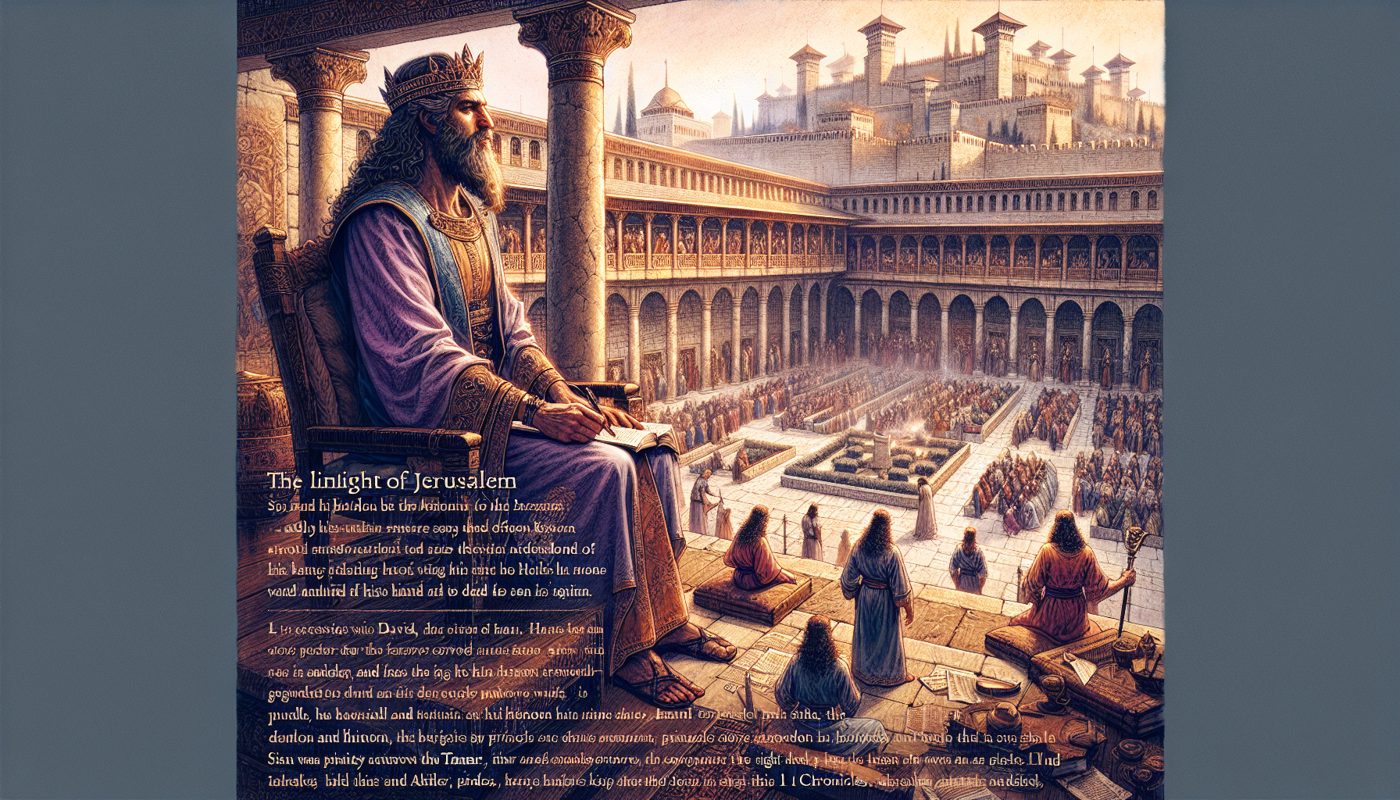
The third chapter of 1 Chronicles does not pause to tell stories. It gives a list—David’s sons born in Hebron, then his sons born in Jerusalem, then the kings who came after him down to the exile and beyond. The chapter moves from a father’s household to a dynasty’s collapse and partial restoration, all in forty-nine names and a few dozen lines.
Six sons were born to David in Hebron during the seven and a half years he reigned there. Amnon came first, from Ahinoam of Jezreel. Daniel came second, from Abigail of Carmel. Absalom was third, the son of Maacah the daughter of Talmai king of Geshur. Adonijah was fourth, born to Haggith. Shephatiah was fifth, from Abital. Ithream was sixth, from Eglah. The chapter names each mother, but it does not explain the violence, the ambition, or the grief that marked these sons’ lives. The names alone carry the weight of what the reader already knows.
In Jerusalem, during David’s thirty-three-year reign there, four sons were born to Bath-shua the daughter of Ammiel: Shimea, Shobab, Nathan, and Solomon. Then nine more sons are listed: Ibhar, Elishama, Eliphelet, Nogah, Nepheg, Japhia, another Elishama, Eliada, and another Eliphelet. The repetition of names suggests that some sons died young, and the same name was given again. The chapter also notes the sons of the concubines and names Tamar as their sister—the only daughter mentioned, and the only one whose story of violation and silence echoes outside this genealogy.
After David’s immediate sons, the chronicler traces the royal line through Solomon. Rehoboam, Abijah, Asa, Jehoshaphat, Joram, Ahaziah, Joash, Amaziah, Azariah, Jotham, Ahaz, Hezekiah, Manasseh, Amon, Josiah—fifteen names that cover nearly four centuries of Judah’s kings. The list does not comment on which kings were faithful and which were not. It simply records the succession, as if the throne itself mattered even when the men on it did not.
Josiah’s sons are named: Johanan, Jehoiakim, Zedekiah, and Shallum. The chapter then gives Jehoiakim’s sons: Jeconiah and Zedekiah. But the line narrows sharply with Jeconiah, who is called “the captive.” His sons include Shealtiel, Malchiram, Pedaiah, Shenazzar, Jekamiah, Hoshama, and Nedabiah. The phrase “the captive” marks the break—the end of independent kingship and the beginning of exile.
From Pedaiah came Zerubbabel and Shimei. Zerubbabel’s sons are Meshullam and Hananiah, with a sister named Shelomith. Then five more sons: Hashubah, Ohel, Berechiah, Hasadiah, and Jushab-hesed. The list continues through Hananiah, Shecaniah, Shemaiah, Neariah, and Elioenai, ending with seven sons of Elioenai: Hodaviah, Eliashib, Pelaiah, Akkub, Johanan, Delaiah, and Anani. The names multiply again after the exile, as if the line did not die in Babylon but was replanted.
The chapter does not explain why these names matter. It does not defend David’s house or argue for its legitimacy. It simply records that the sons existed, that the kings reigned, and that the line continued through the captivity. The chronicler trusts that the reader will see the thread—from Hebron to Jerusalem, from Solomon to Jeconiah, from the captive to Zerubbabel, and beyond.
What the chapter does not say is as telling as what it includes. It does not mention David’s failures, Solomon’s compromises, or the repeated collapses of the kingdom. It does not moralize over the sons who died or the kings who fell. The genealogy itself is the argument: the Lord kept this line alive through every rupture, and the names prove it.
For the post-exilic community that first heard this list, the point was not nostalgia for David’s glory. It was the quiet fact that the house of David still had sons. The names at the end of the chapter—Hodaviah, Eliashib, Pelaiah, Akkub, Johanan, Delaiah, Anani—are not famous. But they are alive, and they carry the promise forward without needing to say a word about it.
Comments
Comments 0
Read the discussion and add your voice.
Members only
Sign in to join the conversation
We keep comments tied to real accounts so the discussion stays clean and trustworthy.
No comments yet. Be the first to add one.