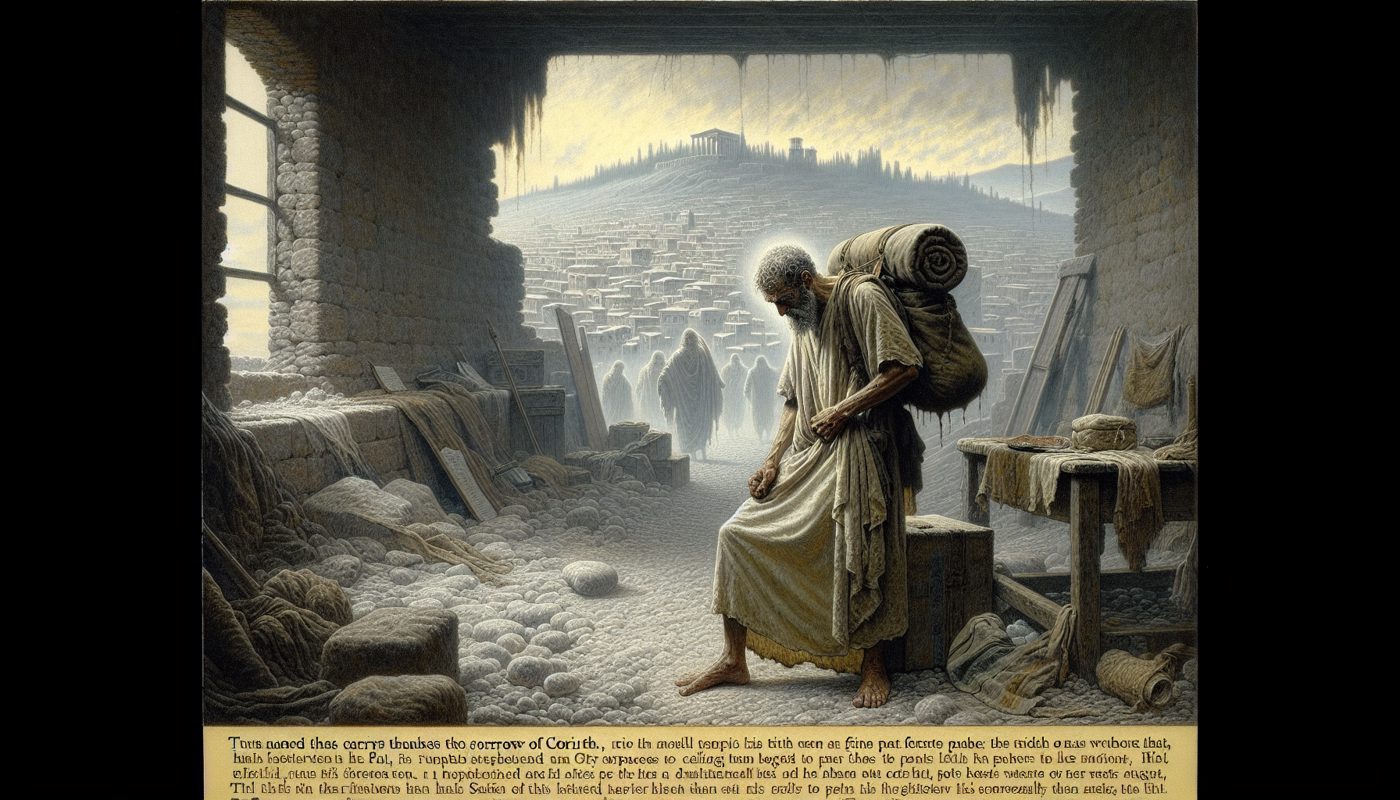
The apostle Paul wrote this chapter from a place of raw tension. He had sent a severe letter to Corinth, and the wait for their response had left him in a state of inner and outer turmoil. When he arrived in Macedonia, he found no relief. He describes the pressure as affliction on every side — external conflicts and internal fears. The word he uses for his own state is not dramatic exaggeration but a precise report of what it felt like to carry a congregation's possible rejection.
Into that strained silence came Titus. Paul does not romanticize the meeting. He says simply that God, who comforts the lowly, comforted him by Titus's arrival. But the comfort did not come from Titus's presence alone. It came from what Titus carried: the news of Corinth's response. Paul reports three specific reactions from the Corinthians — their longing, their mourning, and their zeal for him. These three words form the core of the chapter's emotional architecture.
Paul then revisits his own regret. He admits that he did regret sending that severe letter. The admission is honest and unguarded. But the regret dissolved when he saw the outcome. The Corinthians had been made sorry, but the sorrow was temporary and productive. Paul draws a sharp line between two kinds of sorrow. One kind, which he calls godly sorrow, produces repentance that leads to salvation and leaves no regret behind. The other kind, the sorrow of the world, produces death. He does not elaborate on what worldly sorrow looks like. He does not need to. The contrast is stark enough.
Paul then lists the specific fruits of that godly sorrow in Corinth. He names seven responses: earnest care, clearing of themselves, indignation, fear, longing, zeal, and avenging. The list is not abstract. It describes a community that did not merely feel bad but acted on their grief. They cleared themselves of the matter. They showed indignation toward the wrong. They demonstrated fear — likely the fear of the Lord, not of Paul. They showed longing for reconciliation. They showed zeal to do what was right. They even pursued a kind of avenging, which in context means they dealt with the offender seriously.
Paul clarifies why he wrote the earlier letter. It was not primarily for the sake of the one who did the wrong or the one who suffered the wrong. It was so that the Corinthians' own earnest care for Paul might be made visible to themselves and before God. The letter was a mirror, not a weapon. Paul wanted them to see their own loyalty, not merely to defend him but to recognize their own integrity in the sight of God.
The chapter then turns to Titus. Paul says that his own comfort was deepened by the joy of Titus, because Titus's spirit had been refreshed by the Corinthians. Paul had boasted to Titus about the Corinthians before sending him. That boast could have backfired. If the Corinthians had received Titus coldly, Paul would have been humiliated. But the boast was vindicated. The Corinthians received Titus with fear and trembling — not terror, but the serious respect due to an apostle's representative.
Paul ends the chapter with a statement of restored confidence. He says he rejoices that he is of good courage concerning them in everything. The word for courage here carries the sense of being bold or confident. The relationship is repaired. The severe letter did its work. The sorrow produced repentance, and the repentance produced restoration.
The chapter is not a general teaching on grief. It is a specific case study in how a Christian community handled correction. Paul does not tell the Corinthians to feel guilty. He tells them that their guilt produced something real. He does not soften the severity of his earlier letter. He defends it by pointing to its results. And he does not take credit for those results. He credits God, who comforts the lowly, and Titus, who carried the message both ways.
The final note is not a command but a declaration. Paul is not demanding that the Corinthians prove themselves again. He is stating that they have already done so. The chapter closes with a quiet but firm confidence: Paul is of good courage concerning them in everything. The tension that opened the chapter — the affliction, the fears, the regret — has been resolved not by ignoring the conflict but by walking through it.
Comments
Comments 0
Read the discussion and add your voice.
Members only
Sign in to join the conversation
We keep comments tied to real accounts so the discussion stays clean and trustworthy.
No comments yet. Be the first to add one.