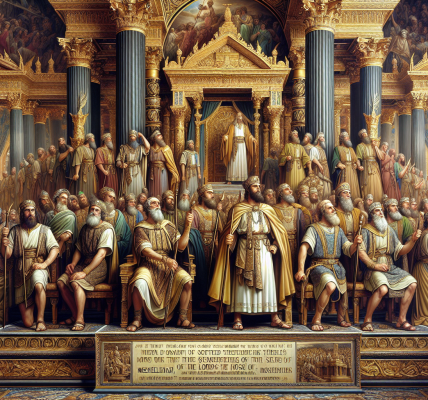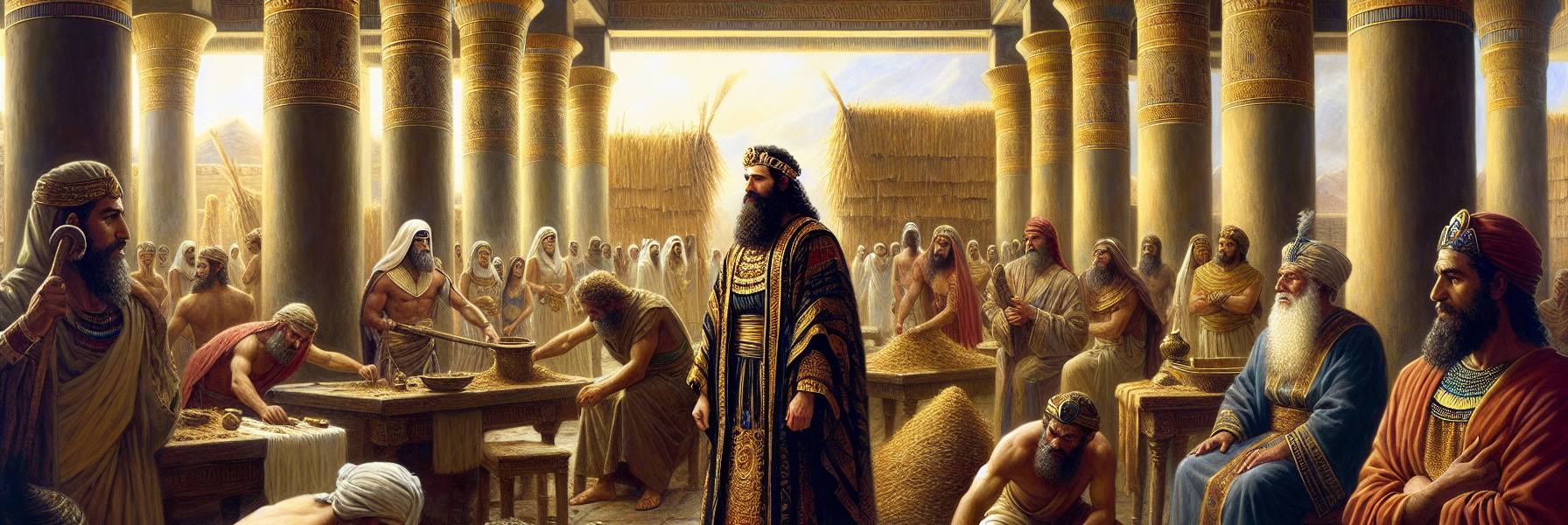

The air in the room was thick, still, and carried the sour scent of old papyrus and dust. It wasn’t the heat—Moses was long accustomed to the Egyptian heat—but a heavier, suffocating warmth that seemed to press down from the painted ceiling of the reception hall. He stood before Pharaoh, but he did not see the inlaid gold on the throne or the precise folds of the courtiers’ linens. He saw instead the straw-choked brick yards, the stooped backs of his people, the hopeless set of a mother’s shoulders as she mixed clay with bleeding hands.
He had come to the end of speaking. All the words—the demands, the warnings, the recounting of wonders that now seemed like grotesque parodies of power—felt like stones in his mouth. Pharaoh’s face, that familiar mask of contemptuous amusement, was set harder than granite. A fly, survivor of the last visitation, buzzed lazily against a sunlit window high on the wall.
Moses found his voice, but it wasn’t the thunderous voice of the prophet. It was low, weary, final. A voice that stated a fact, like a man commenting on the coming of night.
“Thus says the Lord,” he began, the formula now hollowed out by repetition. “About midnight I will go out in the midst of Egypt.”
A slight shift in the postures of the guards. Not fear, but a fresh alertness. The phrase ‘in the midst’ was unsettling. Not an attack from outside, but an eruption from within.
“Every firstborn in the land of Egypt shall die,” Moses continued, the words dropping into the silent room with the weight of millstones. “From the firstborn of Pharaoh who sits on his throne, even to the firstborn of the slave girl who is behind the handmill, and all the firstborn of the cattle.”
He let the list hang there. It was the terrible democracy of this final blow. No distinction between palace and hovel. The divine judgment would find its mark in the opulent bedchamber and the dusty corner where a servant girl ground grain in the predawn gloom. It would touch the prized bull in the temple precinct and the worn ox at the village well.
Pharaoh’s lip curled. It was the same disdain he had shown for the river of blood, the frogs, the gnats. Another threat. Another trick. His own firstborn son, a young man with keen eyes who stood at his right hand, glanced at his father, a flicker of something unreadable in his gaze before his face smoothed into impassivity.
Moses saw the look. A sharp, almost physical pain lanced through him. He was not a man of the court; he was a shepherd. He knew the cry of a ewe for her lamb. The image flashed, unbidden: not the prince, but a young boy in Goshen, teaching his little brother how to hold a lamb. He pushed it away.
“There shall be a great cry throughout all the land of Egypt,” he said, his voice gaining a fraction of strength, painting the sound he knew was coming. “Such a cry as there has never been, nor ever will be again.”
He paused, not for effect, but because the next part was a stark and inexplicable grace. A line drawn not in sand, but in the very fabric of the coming horror.
“But not a dog shall growl against any of the people of Israel, not a man, not a beast.” The words were quiet, a whisper of sanctuary in the proclamation of storm. “That you may know that the Lord makes a distinction between Egypt and Israel.”
The distinction had always been there, of course. In the lash, in the quota, in the decrees of drowning. Now it would be made visible, audible, in the profound and terrible silence of the Hebrew homes amidst the surrounding wail.
Moses finished. He looked not at Pharaoh, but at the officials clustered around him. He saw, for the first time, a crack. A courtier’s hand, usually so still, trembled slightly where it rested on his kilt. Another had gone pale, his eyes distant, perhaps thinking of his own son asleep in a room scented with lotus oil.
“And all these your servants shall come down to me,” Moses said, the ‘me’ sounding strange even to his own ears. A fugitive, a shepherd, the mouthpiece. “And bow down to me, saying, ‘Get out, you and all the people who follow you.’ And after that, I will go out.”
The prophecy of their own humiliation. They would chase him from their presence now, but in the shattered aftermath of the night, they would seek him, plead with him, bow to the very man they now despised. It was the complete inversion of the world order.
He turned then. He did not wait for a dismissal, for the furious shout, for the next empty threat. The audience was over. The last word had been spoken, and it belonged to a Voice older than the Nile.
He walked from the hall, his staff tapping softly on the alabaster floor. The heat outside was a relief after the room’s stagnant pressure. He did not feel triumphant. He felt emptied. The die was cast. The terrible machinery of deliverance, which demanded such a price, was now in motion. He thought of the instructions he must give his own people—the lamb, the blood, the hurried meal. A rite of salvation born in the shadow of an unimaginable grief.
Behind him, in the great palace, he knew Pharaoh would be scoffing, hardening his heart once more, surrounded by men who were trying to convince themselves that the Hebrew was a madman. They would go to their beds that night trusting in the thickness of their walls, the sharpness of their guards, the favor of their gods.
And Moses, an old man with a heavy heart, walked towards Goshen, towards the people he was charged to lead, with the scent of coming death on the wind, and the awful, silent knowledge of the hour ahead ticking like a heartbeat in his soul. Midnight was coming. And after midnight, nothing would ever be the same.