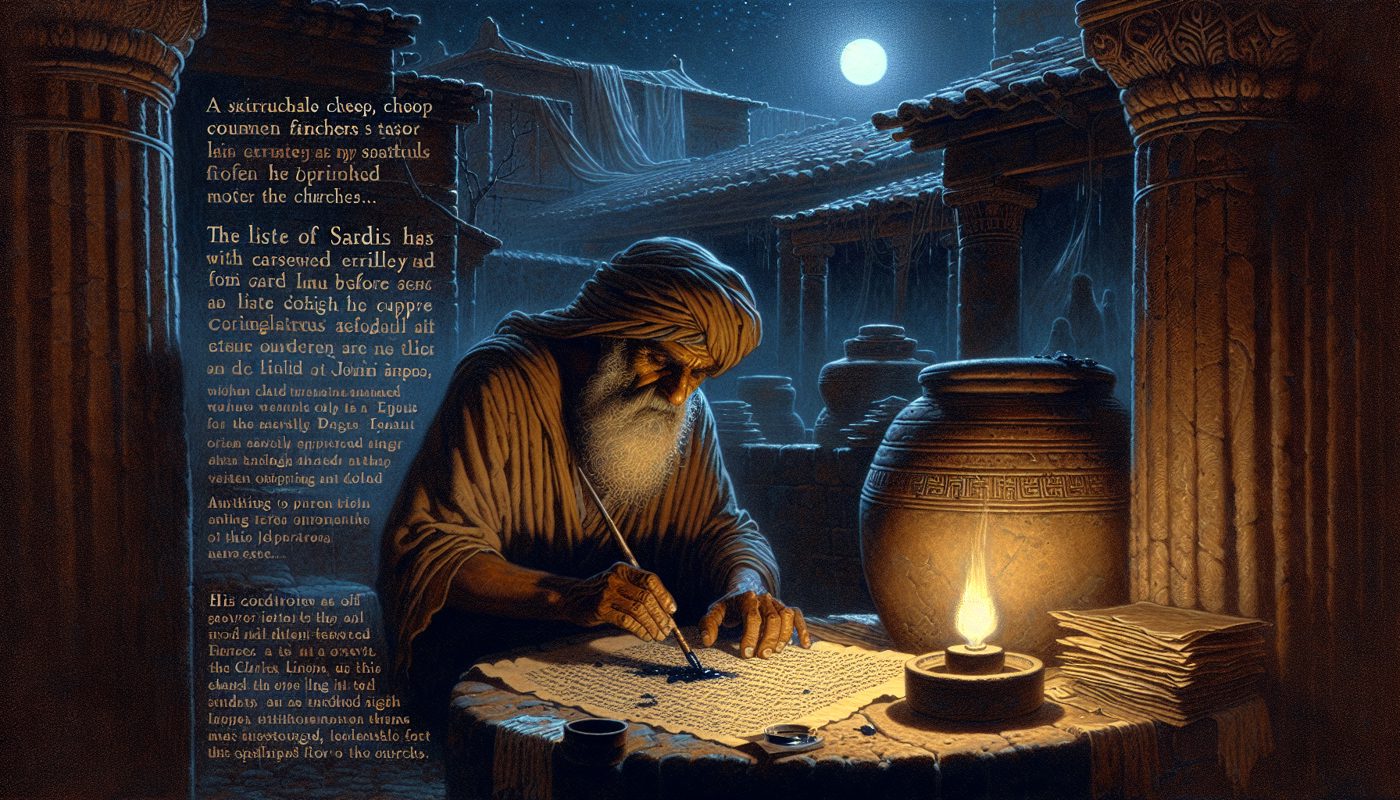
The letter to Sardis opens with a diagnosis that cuts through any pretense. The one who holds the seven Spirits of God and the seven stars speaks directly: the church has a name for being alive, but it is dead. No accusation of heresy or persecution is raised. The problem is a reputation that no longer matches reality. The works are incomplete, left unfinished before God. The command is blunt—wake up, strengthen what remains, remember what was received and heard, keep it, and repent. If the church does not watch, the Lord will come like a thief, at an hour they cannot know.
Yet a few names in Sardis have not defiled their garments. They will walk with the Lord in white, for they are worthy. The promise to the one who overcomes is white garments, a name that will not be blotted out of the book of life, and a confession of that name before the Father and his angels. The call to hear what the Spirit says to the churches closes the message.
The letter to Philadelphia follows a different tone. The one who is holy and true, who holds the key of David, who opens and no one shuts, who shuts and no one opens, addresses a church that has kept his word and not denied his name, though it has only a little power. A door has been set before them, opened and unshuttable. The Lord will make those from the synagogue of Satan—those who claim to be Jews but lie—come and worship at their feet, and know that the Lord has loved them.
Because they have kept the word of his patience, the Lord will keep them from the hour of trial that is coming upon the whole world to test those who dwell on the earth. He comes quickly. They are to hold fast what they have, so that no one takes their crown. The one who overcomes will be made a pillar in the temple of God, never to leave it. The Lord will write on them the name of God, the name of the city of God—the new Jerusalem coming down out of heaven—and his own new name. Again, the call to hear what the Spirit says to the churches.
The letter to Laodicea is the most severe. The Amen, the faithful and true witness, the beginning of God's creation, declares that he knows their works. They are neither cold nor hot. He wishes they were one or the other. Because they are lukewarm, he will spew them out of his mouth. They say they are rich, have gotten wealth, and need nothing, but they do not know that they are wretched, miserable, poor, blind, and naked.
The counsel is specific: buy from him gold refined by fire so they may become truly rich, white garments to cover their shameful nakedness, and eye salve to anoint their eyes so they may see. Those he loves, he reproves and disciplines. They are to be zealous and repent. Then comes the well-known image: he stands at the door and knocks. If anyone hears his voice and opens the door, he will come in and eat with that person, and that person with him.
The final promise to the one who overcomes is to sit with him on his throne, just as he overcame and sat down with his Father on his throne. The letter closes with the same refrain: he who has an ear, let him hear what the Spirit says to the churches.
These three letters form a sequence of escalating diagnosis. Sardis is dead while alive. Philadelphia is faithful with little power. Laodicea is self-deceived by wealth. Each receives a promise tailored to its condition: white garments for the undefiled, a pillar in God's temple for the faithful, and a seat on the throne for the overcomer. The warnings are not abstract. They are tied to specific failures—incomplete works, denied names, self-sufficiency. The call to hear is not optional. It is the same voice that speaks through all seven letters, demanding a response that matches the reality of the church's condition before the Lord.
Comments
Comments 0
Read the discussion and add your voice.
Members only
Sign in to join the conversation
We keep comments tied to real accounts so the discussion stays clean and trustworthy.
No comments yet. Be the first to add one.